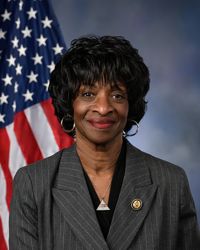
Valerie P. Foushee
DDemocratNC-4 · Representative
57
/ 100
Average
Attendance98
Avg: 96
Independence2
Avg: 4
Bipartisan Tone13
Avg: 15
Ethics Record100
Avg: 99
Transparency62
Avg: 53
Accountability Score — composite of attendance, independence, bipartisan tone, ethics record & transparency.
Methodology33
Bills Sponsored
0
Enacted into Law
0
Passed a Chamber
33
In Committee
All Sponsored Bills
HR10778In Committee
To amend the Internal Revenue Code of 1986 to establish a credit to incentivize the use of certain low-emission anesthetic gases by health care facilities, and for other purposes.
HR10494In Committee
American Tariff Rebate Act
HR10433In Committee
SAFE Platforms Act
HR10088In Committee
To direct the Secretary of Health and Human Services, acting through the Commissioner of Food and Drugs, to conduct a study to assess the potential for expanding the safe and effective use of reprocessed single-use devices, and for other purposes.
HR9956In Committee
Seizure Safe Schools Act of 2026
The federal government would require the Department of Education to create guidelines helping elementary and secondary schools better protect students with seizure disorders, including recommendations for staff training, emergency procedures, and safe environments. These guidelines would help schools recognize seizures, respond appropriately, and prevent injuries to affected students. The guidance would apply to all public and private schools across the country.
HR9903In Committee
Stop Prison Price Gouging Act of 2026
The federal government would be required to price items sold in prison commissaries (like snacks, toiletries, and other goods) at fair market rates rather than marking them up significantly, which would reduce costs for incarcerated people and their families who purchase these items. Currently, prisons often charge much higher prices than what these same products cost outside, effectively creating a captive market where prisoners have limited options. This change would primarily affect incarcerated individuals in federal prisons and their loved ones who send them money for commissary purchases.
HR9852In Committee
Slow Down Act
States would be allowed to include "super speeder" enforcement programs—which target drivers going significantly over the speed limit—as part of their official highway safety initiatives that receive federal funding and support. This change would let states use federal highway safety resources and grants to fund aggressive speeding enforcement efforts aimed at reducing traffic accidents and fatalities caused by extremely high-speed driving.
HRES1448In Committee
Expressing support for the designation of August 1 as "National Woman Astronomers Day".
The resolution would officially recognize August 1 as "National Woman Astronomers Day" to honor the contributions of women in astronomy and encourage more people to learn about their achievements. This designation would raise awareness about female astronomers throughout history and their important discoveries in space science. The recognition could inspire young women and girls to pursue careers in astronomy and related fields.
HR9677In Committee
Grad Student Affordable Housing Act of 2026
The federal government would create a new program to help graduate students afford housing through the Department of Housing and Urban Development. This assistance would make it easier for students pursuing advanced degrees to find affordable places to live while they study. The program would affect graduate students across the country who struggle with housing costs while completing their education.
HR9619In Committee
People-First Chatbot Act
Companies that make AI chatbots would have to follow strict rules to protect users' personal information and keep their data secure from hackers and misuse. The law would require these companies to be transparent about what data they collect, how they use it, and who they share it with, giving users more control over their information. This affects millions of people who use AI chatbots for work, school, or everyday tasks, as well as the tech companies that develop and operate these systems.
HR8893In Committee
Protecting Consumers from Deceptive AI Act
Protecting Consumers from Deceptive AI Act This bill requires the National Institute of Standards and Technology (NIST) to establish task forces to support the development of technical standards and guidelines for identifying content created using artificial intelligence (AI). Specifically, the task forces must address (1) identifying and labeling audio, visual, or text-based content created or substantially modified using generative AI; and (2) providing content provenance metadata, watermarking, digital fingerprinting, and other relevant technical measures. ( Content provenance is information about the origin and history of digital content.) The task forces must consider issuing guidance for online platforms on storing and displaying content provenance data and metadata in a manner that preserves privacy (e.g., by informing users when they are sharing content that contains content provenance data or metadata). To the extent possible, the output of these task forces should inform the development of technical standards by private, consensus organizations. The task forces must report to NIST within a specified period with recommendations related to relevant technical standards and guidance. They must also periodically report to Congress on their activities.
HR9427In Committee
AI Workforce Impact Study Act of 2026
The federal government would hire an independent auditor to research how artificial intelligence is changing American jobs—including which types of work might disappear, which new jobs might be created, and how workers can prepare for these changes. The study would help lawmakers understand whether new training programs or policies are needed to help workers adapt to AI technology. This information would be used to inform future decisions about education, job training, and worker support programs.
HR9274In Committee
Gun Violence Prevention and Public Safety Database Act of 2026
The CDC would create a database to collect and analyze information about gun violence incidents and their prevention, similar to how the agency tracks disease outbreaks. This would help public health officials, researchers, and policymakers better understand gun violence patterns and test what safety measures actually work. The database would affect law enforcement agencies, hospitals, researchers, and communities working to reduce gun injuries and deaths.
HR9273In Committee
To direct the Secretary of Health and Human Services to require public institutions of higher education that receive grants under the Medical Student Education program to include training for medical students relating to menopause in the curriculums of such institutions, and for other purposes.
Medical schools that receive federal grants would be required to teach their students about menopause as part of their standard curriculum. This would ensure that future doctors have proper training to recognize and treat menopause-related health issues that affect millions of women. The requirement applies to public universities that participate in the federal Medical Student Education grant program.
HR8926In Committee
State and Local Public Sector Innovation Act
The federal government would create a grant program to help state and local governments update their outdated computer systems and technology infrastructure. This funding would allow cities, counties, and states to modernize their IT equipment and software so they can better serve residents and operate more efficiently. The grants would be managed by the Commerce Department's communications office.
HCONRES100In Committee
Directing the President, pursuant to section 5(c) of the War Powers Resolution, to remove United States Armed Forces from hostilities with Iran.
This concurrent resolution directs the President to remove U.S. Armed Forces from hostilities against Iran or any part of its government or military unless a declaration of war or authorization to use military force for such purpose has been enacted. The resolution specifies that it shall not be construed to prevent the United States from defending itself, its Armed Forces, its diplomatic facilities, or allied states from imminent attack.
HR8683In Committee
To amend the Immigration and Nationality Act to codify the Optional Practical Training program.
The proposal would officially write into law the Optional Practical Training program, which allows foreign students who graduate from U.S. colleges and universities to work in the country for a limited time in their field of study. Currently, this program operates under temporary government rules rather than permanent legislation, so codifying it would give it more stable legal status and potentially make it harder to change without new laws. The change would mainly affect international students and the employers who hire them, as well as universities that host these students.
HR8478In Committee
RECON Act
The proposal would allow Social Security disability and supplemental income applicants to skip the reconsideration step when their initial claim is denied, letting them go directly to a hearing before a judge instead. Currently, people must request reconsideration (where the same agency reviews the denial) before they can appeal to a judge, which can delay their case by months. This change would give applicants more control over their appeals process and potentially speed up decisions for those who want to move straight to a hearing.
HR8479In Committee
Protecting Consumers from Deceptive AI Act
The federal government would require the National Institute of Standards and Technology to develop technical standards and guidelines for identifying content created by artificial intelligence, and would mandate that audio and video content made or significantly altered by AI include a clear label disclosing its AI origin. This would affect tech companies, content creators, and media platforms by establishing rules for how AI-generated material must be marked and identified. The goal is to help the public distinguish between human-created and AI-generated content.
HRES1136In Committee
Supporting the goals and ideals of "Long COVID Awareness Month".
This resolution recognizes Long COVID Awareness Month to highlight the ongoing health challenges faced by millions of people who continue experiencing symptoms weeks or months after their initial COVID-19 infection, such as fatigue, breathing problems, and brain fog. The measure aims to raise public awareness about Long COVID, support affected individuals and their families, and encourage research and medical attention to better understand and treat this condition. It does not create new laws or funding but serves as a statement of congressional support for efforts to address Long COVID.
HR7826In Committee
HBCU AI Research Leadership Act
This bill would direct federal funding and support to historically Black colleges and universities (HBCUs) to establish and expand artificial intelligence research programs and centers. The goal is to help these institutions build AI research capacity, train students in AI fields, and position HBCUs as leaders in developing this important technology. The funding would help increase diversity in AI research and development, an area where Black Americans and graduates from HBCUs are currently underrepresented.
HR7733In Committee
Ensuring OB–GYN Care in Prisons Act
This bill would require prisons to provide pregnant women and incarcerated people with access to obstetric and gynecological care, including prenatal and postpartum services. The legislation aims to ensure that pregnant inmates receive proper medical attention during pregnancy and childbirth rather than being denied or delayed necessary healthcare. The bill affects incarcerated women and their newborns by establishing standards for reproductive health services in correctional facilities.
HR7657In Committee
Military Family Diaper Partnership Act
This bill would establish a partnership program to help military families afford diapers and other essential baby care products, recognizing that service members and their families often face financial strain. The program would likely work with retailers or manufacturers to provide discounts or direct assistance to eligible military families, making childcare costs more manageable for those serving in the armed forces.
HR7535In Committee
Second Chance Mental Health Access Act of 2026
This bill would expand mental health services and treatment options for people with mental health conditions, particularly those who may have faced barriers to care in the past. It likely aims to improve access to mental health providers, increase funding for mental health programs, and remove obstacles that prevent individuals from getting the help they need. The changes would affect patients seeking mental health treatment, healthcare providers, and potentially insurance companies and government health programs.
HR7327In Committee
Empowering Young Readers Act of 2026
The bill aims to improve reading skills and literacy among young students, likely through funding, programs, or resources focused on early reading instruction and intervention. It probably affects schools, teachers, and elementary-age children by providing support for reading education initiatives. The measure is currently under review by the House Committee on Education and Workforce to determine its specific provisions and funding requirements.
HR7158In Committee
Expanding AI Voices Act
This bill would likely expand the use of artificial intelligence-generated voices in communications and media, possibly by clarifying rules about when companies can use AI to create synthetic speech or by removing barriers to AI voice technology development. The legislation would affect tech companies, broadcasters, and potentially consumers who encounter AI-generated audio in everything from customer service calls to entertainment. The bill's exact impact depends on whether it aims to promote AI voice adoption, establish safety standards, or address concerns about deepfakes and voice impersonation.
HR6638In Committee
To require a report on merits and options for establishing an institute relating to space resources, and for other purposes.
Congress would require the government to study whether the U.S. should create a new institute focused on space resources—such as mining materials from asteroids or the moon and developing technology to use them. The study would examine the benefits of establishing such an institute and what different approaches might work best, helping lawmakers decide if this is something worth pursuing. This affects space companies, scientists, and the government agencies that oversee space exploration.
HR6138In Committee
To direct the Secretary of Defense to establish a pilot program for partnerships between covered basic needs banks and military installations to provide diapers and diapering supplies to military families, and for other purposes.
The Department of Defense would create a test program allowing military bases to partner with organizations that distribute diapers and diaper supplies to help military families afford these essential items. This pilot program would provide free or low-cost diapers to service members and their families who need assistance, addressing a common financial hardship among military households. The program would run at select military installations to determine whether these partnerships effectively reduce the financial burden on military families.
HR5622In Committee
National Gun Violence Research Act of 2025
National Gun Violence Research Act of 2025 This bill promotes gun violence research, including by removing limitations on the use of firearms tracing data by the Bureau of Alcohol, Tobacco, Firearms and Explosives; permitting funds made available to the Department of Health and Human Services to be used for gun violence research; establishing the National Gun Violence Research Program to promote gun violence research; and authorizing competitive grants to support research into the nature, causes, consequences, and prevention of gun violence.
HRES532In Committee
Supporting the designation of "Brain and Spine Metastasis Awareness Month".
This resolution expresses support for Brain and Spine Metastasis Awareness Month.
HRES511In Committee
Honoring the unbreakable spirit, bravery, and legacy of women veterans and supporting recognition of "Women Veterans Recognition Day".
This resolution expresses support for the designation of Women Veterans Recognition Day and recognizes the contributions, sacrifices, and achievements of women veterans.
HR2122In Committee
IMPACT Act 2.0
IMPACT Act 2.0 This bill expands and modifies Federal Highway Administration (FHWA) programs, including the Surface Transportation Block Grant (STBG) program, to provide states reimbursement, incentives, and technical assistance to purchase low-emissions cement, concrete, asphalt binder, or asphalt mixtures. Under the bill, these are products that reduce, to the maximum extent practicable, greenhouse gas or directly related pollutant emissions to levels below the commercially available products. Specifically, the FHWA must provide to states reimbursement for the additional cost of using low-emissions cement, concrete, asphalt binder, and asphalt mixtures used in state highway projects; incentives for the acquisition of these products for use in state highway projects; technical assistance to update the state's specifications and standards to be performance-based specifications and standards; and technical assistance to benchmark and quantify embodied greenhouse gas emissions (i.e., emissions associated with the production and transportation of goods). The FHWA must leverage the Every Day Counts Initiative to promote the commercialization of low-emissions cement, concrete, asphalt binder, and asphalt mixtures. The FHWA must establish and maintain a publicly available directory of state-submitted low-emissions products that the FHWA determines to be eligible for reimbursement or incentives. Further, the bill modifies the STBG program to allow states to issue advance purchase commitments for cement, concrete, asphalt binder, or asphalt mixtures (1) with superior durability and performance to conventional materials, or (2) that achieve superior performance with respect to environmental performance or energy efficiency. The bill allows for multi-year contracts, under specific conditions.
HRES101In Committee
Expressing support for the designation of February 4, 2025, as "Transit Equity Day".
This resolution honors the life and legacy of Rosa Parks by nationally recognizing Transit Equity Day. The resolution also encourages the use of public transportation and the continued work to make public transit accessible for all.