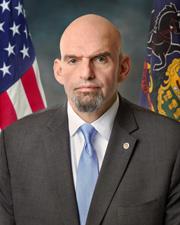
John Fetterman
DDemocratPA · Senator
57
/ 100
Average
Attendance94
Avg: 97
Independence32
Avg: 23
Bipartisan Tone20
Avg: 14
Ethics Record100
Avg: 100
Transparency23
Avg: 47
Accountability Score — composite of attendance, independence, bipartisan tone, ethics record & transparency.
Methodology19
Bills Sponsored
0
Enacted into Law
0
Passed a Chamber
16
In Committee
All Sponsored Bills
S4538Reported
Washington’s Trail—1753 National Historic Trail Feasibility Study Act of 2026
The federal government would study whether Washington's Trail-1753 should become an official national historic trail, which would bring it under federal protection and potentially increase funding for preservation and public access. The Secretary of the Interior would lead this feasibility study to determine if the trail meets the standards for national historic trail designation. This would affect hikers, history enthusiasts, local communities, and tourism in the Washington area.
S5200In Committee
Spotted Lanternfly Research and Development Act
Spotted Lanternfly Research and Development Act This bill includes combatting the spotted lanternfly (Lycorma delicatula) as a Department of Agriculture (USDA) high-priority research and extension area and reauthorizes other USDA research and extension initiatives. The bill specifically allows grants for developing and disseminating research-based tools and treatments to combat the spotted lanternfly, which is an invasive species native to Asia that feeds on a wide range of crops and plants (e.g., grapes, apples, hops, walnuts, and hardwood trees). Further, the bill reauthorizes USDA grants to support competitive specialized research and extension activities, including high-priority areas, through FY2028. The bill also specifically reauthorizes through FY2028 the Pulse Crop Health Initiative; the Comprehensive Food Safety Training Network; pollinator protection research and extension grants; increased USDA capacity and infrastructure to address and conduct research on colony collapse disorder and other pollinator issues; and a USDA-conducted nationwide honey bee pest, pathogen, health, and population status surveillance program.
S3733Reported
A bill to amend the Passport Act of June 4, 1920, to authorize certain public libraries to collect and retain a fee for the execution of a passport application.
Public libraries would be allowed to charge a fee when they help people fill out and submit passport applications, and they could keep that money instead of sending it all to the government. This would give libraries a new source of funding while making it more convenient for people to apply for passports at their local library rather than traveling to a government office. The change mainly affects libraries and people who need passports, particularly those in areas without nearby passport acceptance facilities.
S3468Reported
National Programmable Cloud Laboratories Network Act of 2025
National Programmable Cloud Laboratories Network Act of 2025 This bill provides statutory authority for a national programmable cloud laboratories program established by the National Science Foundation (NSF). Programmable cloud laboratories allow researchers to remotely design and run experiments in an automated, artificial-intelligence-enabled laboratory. Under the bill, NSF, in consultation with the National Institute of Standards and Technology (NIST), must designate up to six entities to operate cloud laboratories, called nodes, to comprise a national network. Eligible entities include institutions of higher education, private or nonprofit research entities, and groups thereof. In designating nodes, NSF must ensure, to the extent practicable, that at least one node can support biotechnology research. (On July 16, 2025, NSF issued a program solicitation seeking applicants to serve as nodes.) Designated nodes must provide access to advanced scientific and manufacturing instruments and a secure digital infrastructure. Where practicable, nodes must leverage commercially available hardware and software to minimize cost and accelerate deployment of automated capabilities. NIST, in cooperation with NSF and designated nodes, must establish and periodically update network-wide interoperability standards, data-sharing protocols, and minimum technical requirements and operating procedures. Further, after all nodes are designated, NSF must identify other laboratories that have or are developing programmable, automated, or remotely accessible research infrastructure and assess the potential for coordination between nodes and these laboratories. The bill provides for annual grants to each designated node for up to five years. The program and any associated funding terminate on September 30, 2031.
SRES676In Committee
A resolution recognizing and honoring National Mushroom Day and the contributions of Chester and Berks Counties to the national mushroom industry and to healthy diets.
This resolution supports the recognition of National Mushroom Day and honors Pennsylvania for its contributions to the national mushroom industry.
S4470In Committee
Supporting Urban and Innovative Farming Act of 2026
The bill would strengthen the federal government's Office of Urban Agriculture and Innovative Production, which helps cities and suburbs grow food locally through programs like community gardens and rooftop farms. This would benefit urban farmers, community organizations, and city residents looking to increase access to fresh produce in areas where grocery stores are scarce. The changes aim to expand funding and support for these local food-growing initiatives across the country.
S1127In Committee
Dennis and Lois Krisfalusy Act
Dennis and Lois Krisfalusy Act This bill expands eligibility for a memorial headstone or marker for the spouse, surviving spouse, child, or dependent of a veteran or member of the Armed Forces. Currently, for individuals whose remains are unavailable, such benefit is only available for individuals who died on or after November 11, 1998. The bill makes such individuals eligible regardless of the date they died.
S4045In Committee
Food and Nutrition Delivery Safety Act of 2026
This bill would establish new safety standards and requirements for companies that deliver food and groceries to customers' homes, likely covering areas like food handling, temperature control, and delivery worker training. It aims to protect consumers from foodborne illness and contamination during the delivery process, while also setting rules for how delivery services must operate to keep food safe from pickup to doorstep. The legislation would affect food delivery companies, grocery delivery services, and the millions of Americans who rely on these services for their meals.
S3796In Committee
Ohio River Restoration Program Act of 2026
This bill would establish a federal program to clean up and restore the Ohio River, which flows through or borders six states and serves millions of people. The program would likely fund projects to remove pollution, improve water quality, protect wildlife habitats, and address environmental damage from industrial activity and urban development. Communities that depend on the river for drinking water, fishing, and recreation would be the primary beneficiaries of these restoration efforts.
S3660In Committee
Credit Card Fairness Act
This bill would regulate credit card companies' practices, likely by capping interest rates, limiting fees, or requiring clearer disclosure of terms so consumers understand the true cost of borrowing. The changes would affect millions of Americans who carry credit card balances and help protect them from unexpected charges or predatory lending practices. Credit card companies would face new restrictions on how they can charge customers.
S2776In Committee
A bill to amend the Justice for United States Victims of State Sponsored Terrorism Act to provide rules for payments to Havlish Settling Judgment Creditors.
This bill would establish rules for how money gets distributed to people who won court judgments against countries that the U.S. government has designated as sponsors of terrorism, specifically addressing payments owed to victims in a case involving Cuba. The legislation would clarify the process and priority for these payments so that victims of terrorist attacks can actually receive the compensation they've been awarded by courts.
S2129In Committee
SAFE Tax Filing Act of 2025
The proposal would simplify the tax filing process by allowing the IRS to offer free, direct filing services to taxpayers, reducing reliance on private tax preparation companies. This would primarily benefit individual taxpayers and lower-income Americans who currently pay fees to file their taxes or struggle with complex forms. The change aims to make tax filing faster and more affordable while potentially saving people money on filing costs.
S1540In Committee
Fairness for Victims of SNAP Skimming Act of 2025
Fairness for Victims of SNAP Skimming Act of 2025 This bill requires the Supplemental Nutrition Assistance Program (SNAP) to provide for the replacement of the full amount of a household's stolen benefits. Specifically, using funds provided by the Department of Agriculture, a state agency must provide a household with replacement SNAP benefits equal to the amount of benefits stolen through card skimming, card cloning, or similar fraudulent methods. This requirement applies if the state agency determines that the benefits were stolen and meets certain requirements. Under current law, a state agency may only replace SNAP benefits that were stolen between the period beginning on October 1, 2022, and ending on December 20, 2024. Further, the replacement amount is limited to the lesser of the amount of (1) the benefits stolen, or (2) two months of the household's monthly allotment immediately prior to the date on which the benefits were stolen. Thus, this bill permanently extends the provision and provides for the replacement of the full amount of the benefits stolen.
S1385In Committee
Organic Science and Research Investment Act of 2025
Organic Science and Research Investment Act of 2025 This bill expands Department of Agriculture (USDA) support for organic agricultural research. USDA must establish the Coordinating and Expanding Organic Research Initiative for USDA resources dedicated to organic agricultural research. Every five years, the initiative must survey USDA's organic agricultural research and produce a report, including findings and recommendations on expanding research and increasing project coordination and effectiveness. USDA must take the findings and recommendations into consideration when preparing USDA's annual budget recommendations. In carrying out its work, the initiative must consult with the National Organic Standards Board and land-grant colleges and universities. In preparing each report, the initiative must consult organic and conventional farmers, ranchers, handlers and the organizations that serve them. The bill also reauthorizes the National Institute of Food and Agriculture’s Organic Agriculture Research and Extension Initiative through FY2030 and increases funding for the initiative. Further, eligible grant projects are expanded to include (1) facilitating the identification and adoption of traditional ecological knowledge and cultural practices, and (2) identifying how organic agriculture can adapt to and mitigate climate change. The bill also reauthorizes, and extends funding for, USDA's organic production and market data initiatives through FY2030. The Economic Research Service must conduct an economic impact analysis of organic agricultural management conducted in accordance with the National Organic Program. USDA may make competitive grants to support research, education, and extension activities relating to the transition from nonorganic production systems into organic agricultural production systems.
S1236In Committee
FISCAL Act
Without access to the specific provisions of this bill, the title "FISCAL Act" in the agriculture context likely aims to address financial or budgetary matters related to farming, food production, or forestry programs. The bill would probably affect farmers, agricultural businesses, food producers, and potentially consumers by changing how federal agriculture funding is allocated or managed. Once the committee reviews it, the details will clarify whether it focuses on crop subsidies, conservation programs, food assistance, or other farm-related spending.
S1156In Committee
Food Secure Strikers Act of 2025
Food Secure Strikers Act of 2025 This bill allows certain striking workers and their households to maintain their eligibility for the Supplemental Nutrition Assistance Program (SNAP). Specifically, the bill provides that a household that would otherwise be eligible to participate in SNAP is eligible for benefits if any member of the household is on strike because of a labor dispute. Current law generally prohibits a household from participating in SNAP if any member of the household is on strike unless the household was eligible for SNAP immediately prior to the strike. Also, under current law, households are not eligible for an increased SNAP allotment as a result of the decreased income of a striking member of the household. The bill expands SNAP eligibility for households with striking workers by repealing both of these restrictions. The bill also allows a government employee who is dismissed for striking and their household to maintain SNAP program eligibility. Specifically, current law prohibits certain individuals who voluntarily and without good cause quit a job from participating in SNAP. Further, a federal, state, or local government employee who participates in a strike against the government that results in their dismissal is considered to have voluntarily quit without good cause. The bill eliminates the provision that considers the dismissed government employee to have voluntarily quit without good cause, thereby allowing the employee and their household to maintain SNAP program eligibility if they are otherwise eligible for the program.
S993In Committee
School Lunch Debt Cancellation Act of 2025
School Lunch Debt Cancellation Act of 2025 This bill (1) requires the Department of Agriculture (USDA) to cancel school meal debts, and (2) expands USDA's authority to use Commodity Credit Corporation (CCC) funds for the Commodity Supplemental Food Program (CSFP) and the Emergency Food Assistance Program (TEFAP). Specifically, USDA must cancel and eliminate all household school meal debts (as of the date of the bill's enactment) under the school breakfast and lunch programs. USDA must also pay the amount of the cancelled debt to each local educational authority using CCC funds. The bill also reauthorizes the CSFP through FY2030 and allows USDA to use CCC funds for the program. As background, CSFP works to improve the health of low-income persons at least 60 years of age by supplementing their diets with nutritious USDA foods. In addition, the bill specifies that USDA may use CCC funds for all aspects of TEFAP. In recent years, USDA has used CCC funds for specific TEFAP activities. As background, through TEFAP, USDA purchases a variety of food commodities. TEFAP provides those food commodities (and cash support for storage and distribution costs) to state agencies that distribute the food to local emergency feeding organizations (e.g., food banks).
S393In Committee
Banning SPR Oil Exports to Foreign Adversaries Act
This bill would prevent the U.S. government from selling oil from the Strategic Petroleum Reserve to countries considered foreign adversaries, such as China or Russia. The goal is to ensure that America's emergency oil stockpile—meant to protect national security during supply disruptions—doesn't end up benefiting hostile nations or strengthening their economies. The measure affects oil companies that might buy reserve oil and the government agencies that manage the reserve.
S127In Committee
Whole-Home Repairs Act of 2025
Whole-Home Repairs Act of 2025 This bill establishes a pilot program through which the Department of Housing and Urban Development provides grants to state and local governments to support the ability of certain landlords and low- to moderate-income homeowners to make necessary modifications, repairs, or updates to their properties. State and local governments must use the funds they receive under the program to award grants to homeowners and loans to landlords to make changes that address issues such as accessibility, habitability, and energy efficiency. A homeowner is eligible for a grant if the homeowner's household income (1) does not exceed 80% of the area median income, (2) does not exceed 200% of the federal poverty guidelines, or (3) meets the income eligibility criteria of another federal program that serves families of limited means. A landlord is eligible for a loan (which may be forgivable) if the landlord owns fewer than 10 rental properties that have a total of up to 50 units and that mostly consist of units that are affordable (i.e., affordable to a tenant with an income that does not exceed 80% of the area median income). The program terminates on October 1, 2030.