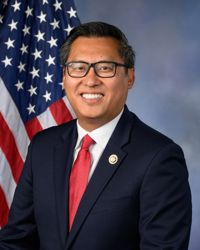
Vince Fong
RRepublicanCA-20 · Representative
55
/ 100
Average
Attendance97
Avg: 96
Independence2
Avg: 4
Bipartisan Tone9
Avg: 15
Ethics Record100
Avg: 99
Transparency60
Avg: 53
Accountability Score — composite of attendance, independence, bipartisan tone, ethics record & transparency.
Methodology15
Bills Sponsored
0
Enacted into Law
5
Passed a Chamber
10
In Committee
All Sponsored Bills
HR227Passed House
Clergy Act
Clergy Act This bill establishes a two-year window for certain members of the clergy and Christian Science practitioners to revoke their exemption from Social Security and Medicare taxes on ministerial earnings. Under current law, such individuals who object to participation in public insurance programs on religious or conscientious grounds may apply to the Internal Revenue Service (IRS) for an irrevocable exemption and will not receive Social Security or Medicare benefits in retirement unless they have qualifying credits from other employment. The IRS must develop a plan to inform members of the clergy and Christian Science practitioners of their eligibility to revoke prior exemptions, pursuant to the bill's changes.
HRES1561In Committee
Expressing support for the designation of the third week of September as "Fungal Disease Awareness Week" and encouraging efforts to improve awareness, diagnosis, treatment, surveillance, and prevention of fungal diseases in the United States.
HR2709Passed House
Save Our Sequoias Act
Save Our Sequoias Act This bill provides for the conservation of giant sequoia trees ( Sequoiadendron giganteum ) in California. Specifically, it provides statutory authority for the Giant Sequoia Lands Coalition and outlines the coalition's duties. The coalition must submit a Giant Sequoia Health and Resiliency Assessment and annually update it. The information from the assessment must be made available so the information can be integrated into certain other plans. The coalition must also create and maintain a website that contains the assessment, educational materials, searchable information about individual giant sequoia groves, and a searchable database to track the status and costs of reforestation and rehabilitation activities. In addition, the bill declares an emergency on certain public lands and allows officials to carry out protection plans during the emergency to respond to the threat of wildfires, insects, and drought. The emergency expires after seven years. The Department of the Interior must develop and implement a Giant Sequoia Reforestation and Rehabilitation Strategy. Finally, the bill establishes a variety of programs and funds to support the conservation of giant sequoias.
HJRES210Passed House
Providing for congressional disapproval under chapter 8 of title 5, United States Code, of the rule submitted by the Environmental Protection Agency relating to "California State Nonroad Engine Pollution Control Standards; Ocean-Going Vessels At-Berth; Notice of Decision".
This joint resolution revokes the authorization granted to the California Air Resources Board (CARB) to amend its Ocean-Going Vessels At-Berth Regulation. Among other elements, the amendment proposed by CARB and authorized by the Environmental Protection Agency (EPA) expanded auxiliary engine emissions reductions requirements to include additional categories of ocean-going vessels. (Under the Clean Air Act, the EPA may authorize California to adopt and enforce standards relating to the control of emissions from nonroad vehicles or engines if those standards meet certain requirements.) Specifically, the joint resolution nullifies the EPA authorization decision titled California State Nonroad Engine Pollution Control Standards; Ocean-Going Vessels At-Berth; Notice of Decision .
HR5351In Committee
NSF AI Education Act of 2025
NSF AI Education Act of 2025 This bill establishes, or authorizes the National Science Foundation (NSF) to establish, various scholarship, fellowship, and grant programs to promote education and professional development related to artificial intelligence (AI). The bill authorizes NSF to award scholarships and fellowships to college students focusing their studies on AI. NSF may also support AI-related professional development fellowships for (1) students and faculty, (2) K-12 teachers and school professionals, and (3) industry professionals seeking short-term appointments to teach AI. NSF must also establish up to eight centers of AI excellence at community colleges or area career and technical education schools. Designated centers must develop best practices for AI research and education, integrating AI into the classroom, and facilitating partnerships with the private sector, among other topics. This program must be administered in coordination with the Department of Commerce Regional Technology and Innovation Hubs program. NSF may make merit-based grants to eligible entities, including institutions of higher education and nonprofit organizations, for research on AI teaching models, integration of AI in the classroom, and AI’s impact on educational outcomes for students through grade 12. Awards must be used to (1) prepare K-12 teachers to integrate AI into their classrooms; and (2) research, test, and implement AI-related instructional materials, teaching models, and professional development for teachers. Finally, NSF may establish a pilot program through which regional cohorts will provide AI-related peer support, mentoring, and research experiences to K-12 teachers and school leaders.
HR8748In Committee
Surface Transportation Research and Development Act of 2026
The federal government would fund and oversee research projects aimed at improving roads, bridges, public transit, and other surface transportation systems, including testing new technologies and methods to make transportation safer and more efficient. This would affect transportation agencies, construction companies, researchers, and the traveling public by directing resources toward developing better infrastructure solutions. The bill has been sent to two House committees for review and consideration.
HR8892In Committee
CAL Repayment Act
States would be required to use federal unemployment insurance loan funds to pay back any outstanding debts they owe to the federal government before spending that money on other purposes. This change would affect state unemployment insurance programs and ensure that states repay their borrowing obligations more quickly. The requirement applies to advances made under the federal unemployment insurance system, which states sometimes borrow from when their unemployment trust funds run low.
HR8198In Committee
OUTPACE in Space Act
This bill aims to boost American competitiveness in space technology and communications by supporting research, development, and innovation in the space industry. It likely provides funding or establishes programs to help U.S. companies and researchers advance capabilities in areas like satellite communications, space exploration, and related technologies to keep pace with international competitors.
HR7825In Committee
Doug LaMalfa Protect Innocent Victims of Taxation After Fire Extension Act
This bill would allow people whose homes or property were destroyed in wildfires to deduct their losses from their taxes, reducing the amount they owe to the government. It aims to help fire victims recover financially by treating their losses similarly to other disaster-related tax deductions. The bill would primarily benefit homeowners and property owners in fire-affected areas who are already dealing with the costs of rebuilding.
HR390Passed House
ACERO Act
Advanced Capabilities for Emergency Response Operations Act or the ACERO Act This bill provides statutory authority for the Advanced Capabilities for Emergency Response Operations (ACERO) project. The ACERO project conducts research and development activities regarding aerial response to wildfires using uncrewed aircraft systems (UAS) and other advanced aviation technologies. It is administered by the National Aeronautics and Space Administration (NASA). The bill directs the ACERO project to address airspace management and deconfliction during wildfire response efforts, including through real-time information sharing among response teams and the development of a platform to provide situational awareness of aerial assets. The bill also directs the ACERO project to establish a multiagency concept of operations to facilitate the coordination of aerial wildfire response among federal, state, and local government agencies. NASA must consult with other federal agencies and departments to avoid duplication of these efforts. NASA generally may not procure UAS manufactured or assembled by specified foreign entities, including entities domiciled in or controlled by China, for use by the ACERO project.
HR7413In Committee
HIRE DEA Act
The bill would establish new hiring requirements or procedures for the Drug Enforcement Administration (DEA), likely aimed at improving how the agency recruits and staffs its workforce. The exact changes would affect DEA employees and potentially job applicants seeking positions at the agency, though the specific reforms are not detailed in the available information. Congress is currently reviewing the proposal to determine which committees should handle different aspects of the legislation.
HR5513In Committee
To amend the Federal Water Pollution Control Act to make certain technology investments eligible for additional subsidization, and for other purposes.
This bill would expand federal funding and tax breaks for companies and municipalities that invest in water pollution control technologies, making it easier and cheaper for them to adopt cleaner water treatment systems. The changes would likely help water utilities, industrial facilities, and communities reduce pollution in rivers, lakes, and drinking water supplies by making pollution-fighting equipment more affordable. The bill is still in early stages and has been sent to a congressional subcommittee for review.
HR4661In Committee
AMERICA DRIVES Act
The legislation would establish new federal funding and standards for America's roads, highways, and public transportation systems to improve infrastructure conditions and safety. It would affect drivers, commuters, construction workers, and transportation agencies by directing money toward repairs, upgrades, and expansion of transit options in communities across the country. The bill is currently being reviewed by the House subcommittee responsible for highway and transit policy.
HR3810In Committee
SKIM Act
The legislation would establish new federal penalties and enforcement measures targeting credit card skimming—a crime where thieves secretly capture card information from payment terminals or ATMs to commit fraud. Law enforcement agencies would gain additional tools and resources to investigate and prosecute skimming operations, while businesses that accept credit cards would face requirements to implement security measures to prevent this type of theft. The law aims to protect consumers and merchants from financial losses caused by this growing form of identity theft.
HR1223Passed House
ANCHOR Act
Accelerating Networking, Cyberinfrastructure, and Hardware for Oceanic Research Act or the ANCHOR Act This bill requires the National Science Foundation (NSF) to develop a plan to improve the cybersecurity and telecommunications capabilities of the U.S. Academic Research Fleet (ARF). ARF is comprised of U.S.-flagged vessels that provide at-sea laboratories where oceanographic scientists, educators, and students research and learn about marine science. The bill requires the plan to include assessments of telecommunications and networking needs of ARF, consistent with typical scientific missions; cybersecurity needs appropriate for the operation of ARF vessels and their specific research functions; the costs necessary to meet these needs; the time required to implement necessary upgrades; and opportunities for the adoption of common solutions or consortial licensing agreements, or for the centralization of cybersecurity, telecommunications, or data management at a single facility. The plan must also include a spending plan for the NSF, the Office of Naval Research, nonfederal owners of ARF vessels, and users of the vessels to cover identified costs. Among other factors specified in the bill, the NSF must consider, as appropriate, the network capabilities necessary to meet mission needs (e.g., to upload data to cloud-based or shoreside servers), international standards and guidance for information security, and requirements for controlled unclassified or classified information. The plan must be provided to Congress within 18 months of the bill's enactment, and the NSF must later report to Congress on the plan's implementation.