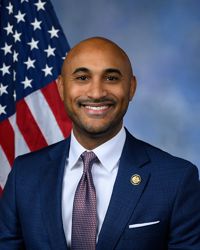
Shomari Figures
DDemocratAL-2 · Representative
59
/ 100
Average
Attendance98
Avg: 96
Independence4
Avg: 4
Bipartisan Tone25
Avg: 15
Ethics Record100
Avg: 99
Transparency58
Avg: 53
Accountability Score — composite of attendance, independence, bipartisan tone, ethics record & transparency.
Methodology22
Bills Sponsored
0
Enacted into Law
2
Passed a Chamber
20
In Committee
All Sponsored Bills
HR10551In Committee
Public Service Educational Assistance Act
HR6006Passed House
To designate the facility of the United States Postal Service located at 401 North Elm Street in Tuskegee, Alabama, as the "Tuskegee Airmen Memorial Post Office".
This bill designates the facility of the United States Postal Service located at 401 North Elm Street in Tuskegee, Alabama, as the "Tuskegee Airmen Memorial Post Office".
HR10229In Committee
Protecting American Beef Producers Act
HR10206In Committee
Restoring Opportunity for Advanced Education Act
HR9849In Committee
Tuskegee Airmen Memorial Act of 2026
The proposal would allow Tuskegee Airmen, Inc., a nonprofit organization, to build a memorial or monument honoring the Tuskegee Airmen—the pioneering African American pilots and support crew who served in World War II—somewhere in Washington, D.C. or the surrounding area. The bill is currently being reviewed by congressional committees to determine whether it meets the requirements for establishing such a commemorative work in the nation's capital.
HR9704In Committee
Tariff Impacted Farmer Support Act of 2026
The federal government would provide direct payments to farmers and agricultural producers who experienced revenue losses on major crops like corn, soybeans, wheat, and cotton due to specified circumstances. These payments would help offset income that producers lost when their crop revenues fell below expected levels, supporting farm families and rural communities during difficult economic periods. The Agriculture Department would handle determining which producers qualify and distributing the assistance funds.
HR9426In Committee
Affordable Youth Enrichment Opportunities Act
The legislation would create or expand programs that provide affordable activities and learning opportunities for young people, likely through funding mechanisms or tax incentives. This would help make enrichment activities like sports, arts, tutoring, and other youth programs more accessible to families who might otherwise struggle to afford them. The bill is currently being reviewed by the House Committee on Ways and Means to determine its financial impact and feasibility.
HR8502In Committee
HARVEST Act
The federal government would study how to help historically Black colleges and universities (known as 1890 Institutions) better educate farmers and ranchers about passing down agricultural land and property to the next generation, particularly addressing complications that arise when land ownership is unclear or shared among multiple heirs. The study would identify barriers these institutions face in offering this educational support and recommend ways to expand their role in helping rural communities preserve farming operations across generations. This affects minority farmers, ranchers, and rural communities seeking guidance on managing inherited agricultural property.
HR8503In Committee
Save SNAP Act of 2026
If a state runs out of money to pay its share of food stamp benefits, the federal government would automatically cover those costs instead of letting the program run short. This would guarantee that low-income individuals and families continue receiving their nutrition assistance without interruption, even during state budget crises. The change would shift some financial responsibility from states to the federal government when states cannot afford their portion of the program.
HR8504In Committee
Rural Health Resilience Act of 2026
Rural health centers struggling financially would gain access to low-cost loans and other financial support to help them stay open and continue serving their communities. This assistance aims to prevent rural clinics and hospitals from closing due to money problems, which would leave people in remote areas without nearby places to get medical care. The program would help ensure that rural residents can still access basic health services like doctor visits and emergency care.
HR8505In Committee
Veterinary Education Equity Act
The proposal would improve a federal grant program that helps fund veterinary education and training at universities across the country. By strengthening this program, it aims to increase the number of trained veterinarians available to work in rural areas, with livestock, and in food safety—areas where there are often shortages of qualified professionals. The changes would affect veterinary schools, students pursuing veterinary careers, and farmers and ranchers who depend on veterinary services.
HR8046In Committee
Food and Nutrition Delivery Safety Act of 2026
This bill would establish new safety standards and requirements for companies that deliver food and groceries to customers' homes, likely covering things like food handling, temperature control, and delivery worker training. The rules would apply to food delivery services and meal kit companies to reduce the risk of foodborne illness and contamination during the delivery process. It affects both the delivery companies operating these services and the consumers who receive food orders.
HR7533In Committee
RISE Reauthorization Act of 2026
This bill would reauthorize and update the RISE program, which supports agricultural research, innovation, and education initiatives. The legislation likely extends funding and potentially modifies requirements for farmers, agricultural researchers, universities, and food producers who participate in or benefit from these programs. The bill is currently under review by the House Agriculture Committee to determine what changes should be made before it moves forward.
HRES1086In Committee
Recognizing the historical significance of the Clotilda, condemning the United States role in the Atlantic slave trade, and acknowledging its lasting impact on African Americans.
This resolution acknowledges the historical importance of the Clotilda, the last known slave ship to bring enslaved Africans to the United States, and formally condemns America's participation in the Atlantic slave trade and its ongoing effects on Black Americans today. The measure is primarily symbolic, expressing Congress's official recognition of this dark chapter in U.S. history rather than creating new laws or programs. It affects how the country officially remembers and reckons with slavery's legacy.
HR6635In Committee
Bus Operator Safety and Security Act
This bill would establish new safety and security requirements for bus operators and transit workers, likely including protections against violence, improved working conditions, and standards for training or equipment. The legislation would affect public transit agencies, bus drivers, and passengers who rely on bus transportation across the country. By strengthening protections for operators, the bill aims to reduce assaults and improve the overall safety of public bus systems.
HR3962Passed House
ESTUARIES Act
Enhancing Science, Treatment, and Upkeep of America’s Resilient and Important Estuarine Systems Act or the ESTUARIES Act This bill reauthorizes through FY2031 grants provided under the National Estuary Program to protect and restore estuaries of national significance. Estuaries are coastal waterbodies where freshwater from rivers and streams mixes with the ocean’s saltwater. Under the existing program, the Environmental Protection Agency provides grants for (1) developing and implementing comprehensive conservation and management plans for estuaries of national significance, and (2) addressing issues that threaten the ecological and economic well-being of such estuaries. The existing program provides grants to states, regional water pollution control agencies and entities, state coastal zone management agencies, interstate agencies, other public or nonprofit private agencies, institutions, organizations, and individuals.
HR5850In Committee
GRAD Act
Guaranteeing Retention and Aid During Shutdowns Act or the GRAD Act This bill prohibits institutions of higher education that participate in federal student aid programs from terminating or otherwise altering the enrollment status of a student due to a disruption of the student’s federal student financial aid caused by a lapse in appropriations (i.e., government shutdown).
HR4653In Committee
First-Time Parents Tax Credit Act
The proposal would give new parents a tax credit—essentially a reduction in the taxes they owe—to help offset the costs of raising a child during their first few years of parenthood. Families with newborns or newly adopted children would receive this financial benefit when filing their taxes, making it easier to afford expenses like childcare, diapers, and medical care. The measure is currently being reviewed by the House committee responsible for tax policy.
HR4654In Committee
Baby Sleep Tax Relief Act
Baby Sleep Tax Relief Act This bill prohibits the imposition of duties (i.e., tariffs) on specified baby sleep items (e.g., cribs, toddler beds, and baby monitors) pursuant to certain presidential powers. Specifically, the bill prohibits the President from exercising authorities under the International Emergency Economic Powers Act (IEEPA) to impose duties on specified baby sleep items entering the United States. (IEEPA provides the President with broad authority to regulate various economic transactions following a declaration of a national emergency.) Further, the President must terminate the duties on these items that were imposed pursuant to IEEPA and are in effect as of the date of the bill's enactment. The bill also prohibits the President from using any other authorities to impose duties on these items that are substantially similar to the duties imposed pursuant to IEEPA.
HR4560In Committee
Building Resilient Infrastructure and Communities for All Act of 2025
Building Resilient Infrastructure and Communities for All Act of 2025 This bill changes grants historically provided under the Building Resilient Infrastructure and Communities (BRIC) program from competitive grants to noncompetitive formula grants allocated to each eligible state. These grants fund activities that reduce risk from natural hazards. The bill also provides eligibility for projects to receive grant funds from two different mitigation programs. Under current law, the Federal Emergency Management Agency (FEMA) may provide BRIC grants to states and Indian tribal governments through a competitive application process. The bill requires FEMA to instead allocate such grants based on a specified formula which distributes funding to each eligible state while giving certain preference proportionally to states with higher populations and states with the most vulnerability of critical infrastructure to natural hazards. States must distribute at least 50% of the grant funds to local governments carrying out mitigation projects. The bill also specifies a minimum for the amount to be provided to tribes. To be eligible to receive a formula grant under the bill, a state must annually recommend to FEMA specific predisaster mitigation projects. States generally may only use the grants for projects they recommended. Additionally, under current law, a project is not eligible to receive funds from two different FEMA grant programs for the same purpose. The bill prohibits FEMA from considering a project’s receipt of BRIC (or other predisaster mitigation) grant funding in determining such project’s eligibility to receive funding under the Hazard Mitigation Grant Program, and vice versa.
HR4401In Committee
Bridge Investment and Modernization Act of 2025
The legislation would provide federal funding and support for repairing, replacing, and modernizing bridges across the country, with the goal of improving safety and reducing traffic congestion. This would affect construction workers, commuters, and communities that rely on aging bridge infrastructure, while also potentially creating jobs in the construction and engineering sectors. States and local governments would receive resources to assess bridge conditions and complete necessary upgrades to transportation networks.
HR2046In Committee
To require congressional approval before the sale, disposal, declaration of excess or surplus, transfer, or conveyance of Federal property with historical significance, and for other purposes.
The federal government would need to get approval from Congress before selling, giving away, or transferring any government-owned buildings or land that have historical importance. This would prevent federal agencies from quietly disposing of historically significant properties without lawmakers having a say in what happens to them. The requirement would apply to all types of transfers, whether the property is being sold to private buyers, transferred to other agencies, or declared surplus.