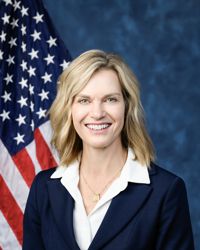
Julie Fedorchak
RRepublicanND · Representative
53
/ 100
Average
Attendance98
Avg: 96
Independence2
Avg: 4
Bipartisan Tone8
Avg: 15
Ethics Record100
Avg: 99
Transparency42
Avg: 53
Accountability Score — composite of attendance, independence, bipartisan tone, ethics record & transparency.
Methodology15
Bills Sponsored
1
Enacted into Law
4
Passed a Chamber
10
In Committee
All Sponsored Bills
HR10666In Committee
FCHIP Extension Act
HR6633Passed House
High-Capacity Grid Act
High-Capacity Grid Act This bill requires public electric utilities to use the best-available transmission conductor for certain interstate transmission lines (i.e., power lines) in order to recover the costs of the conductor through consumers' electric bills. Specifically, in any filing seeking to recover the costs of a transmission conductor for the transmission line and in any proceeding to determine if the costs may be recovered through rates, the bill directs the Federal Energy Regulatory Commission to presume that (1) the use of a best-available transmission conductor is a prudent practice and that the associated costs are just and reasonable, and (2) the use of a transmission conductor that is not a best-available transmission conductor is not prudent and that the associated costs are not just and reasonable. A best-available transmission conductor is a conductor that (1) provides the greatest feasible and commercially available energy-carrying capacity at a given voltage level, (2) provides the highest feasible and commercially available electrical efficiency at that voltage level, and (3) mitigates thermal sag (drooping of power lines) at the maximum rated transmission-carrying capacity of the facility. The bill applies to projects to (1) construct new transmission facilities; or (2) modify, upgrade, or replace an existing transmission line.
HR1830Passed House
To designate the facility of the United States Postal Service located at 840 Front Street in Casselton, North Dakota, as the "Commander Delbert Austin Olson Post Office".
This bill designates the facility of the United States Postal Service located at 840 Front Street in Casselton, North Dakota, as the "Commander Delbert Austin Olson Post Office".
HR9618In Committee
DEF Act
The proposal would modify air pollution rules for cars, trucks, and engines to maintain current environmental standards rather than allowing them to change. This affects automakers, engine manufacturers, and potentially consumers by establishing which pollution limits vehicles must meet. The bill aims to provide regulatory certainty so companies know what rules they'll need to follow for the foreseeable future.
HR9141In Committee
SAVE America Through REAL ID Act
The federal government would create a grant program to help states provide free identification cards that meet national security standards to people with low incomes. This would make it easier for low-income individuals to get the IDs they need for voting, traveling, or other purposes without paying fees. States would receive federal funding to cover the costs of issuing these compliant identification cards to eligible residents.
HR2252Passed House
North Dakota Trust Lands Completion Act of 2026
North Dakota Trust Lands Completion Act of 2026 This bill allows North Dakota to exchange certain state land grant parcels (e.g., lands granted to North Dakota by Congress when it became a state) located wholly or partially within an Indian reservation for certain federal land of substantially equivalent value. North Dakota manages oil, gas, and agriculture leases on state land grant parcels to generate revenue for education and other public benefits. However, tribal reservations were created on state land grant parcels and reduced the amount of land available for revenue generation. Specifically, the bill allows the North Dakota Board of University and School Lands to exchange with the Department of the Interior state land grant parcels located wholly or partially within tribal reservations for certain public land in North Dakota administered by the Bureau of Land Management. Upon the request of a tribe, Interior must hold exchanged land within the tribe's reservation in trust on behalf of the tribe. Further, the bill provides for the continuation of active grazing operations on land exchanged under this bill.
HR8006In Committee
Dakota Water Resources Act Amendments of 2026
This bill would modify existing water management policies and projects in the Dakota region, likely adjusting how water is allocated, developed, or protected across state lines or federal lands. The changes could affect farmers, cities, Native American tribes, and other groups that depend on water supplies in that area. The specific amendments would need to be reviewed in committee to determine whether they expand water access, protect environmental concerns, or shift how water projects are funded and managed.
HR7956In Committee
State Offices of Rural Health Program Reauthorization Act of 2026
This bill would continue funding and support for state offices that help rural communities access healthcare services and improve health outcomes in areas with limited medical resources. These offices work to address challenges like doctor shortages and long distances to hospitals that rural residents face. The bill essentially renews the federal program that helps states run these offices and coordinate rural health initiatives.
HJRES105Enacted
Providing for congressional disapproval under chapter 8 of title 5, United States Code, of the rule submitted by the Bureau of Land Management relating to "North Dakota Field Office Record of Decision and Approved Resource Management Plan".
This joint resolution nullifies the rule submitted by the Bureau of Land Management (BLM) relating to the Record of Decision and Approved Resource Management Plan (RMP) for the North Dakota Field Office and issued on January 8, 2025. By way of background, an RMP guides the management of lands administered by BLM. The 2025 North Dakota RMP modified the 1988 RMP, including by limiting development of oil and gas in low-potential areas and new coal leasing to areas within four miles of existing mines.
HR6336In Committee
Fair Allocation of Interstate Rates Act
This bill would change how electricity rates are set for power that crosses state lines, aiming to ensure that costs are distributed fairly among states and utility companies. The legislation likely addresses concerns that some states or regions pay disproportionately high rates for interstate power transmission, which ultimately affects what consumers pay for electricity. The bill has been sent to the House Committee on Energy and Commerce for review and debate.
HR3062Passed House
Promoting Cross-border Energy Infrastructure Act
Promoting Cross-b order Energy Infrastructure Act This bill establishes a new process for approving or revoking permits for the construction and operation of energy infrastructure across an international border of the United States. Thus, it replaces the existing process established under specified executive orders. The bill requires a person to obtain a certificate of crossing before constructing, connecting, operating, or maintaining a border-crossing facility for the import or export of oil or natural gas, or the transmission of electricity, across a U.S. border with Canada or Mexico. A certificate must be obtained from the Federal Energy Regulatory Commission (FERC) for a facility consisting of oil or natural gas pipelines or the Department of Energy (DOE) for an electric transmission facility. As a condition of issuing a certificate, DOE must require that an electric transmission facility be constructed, connected, operated, or maintained consistent with specified policies and standards. FERC and DOE must meet a deadline for issuing a certificate as set forth by this bill. The bill also requires FERC to meet a deadline for approving applications to import or export natural gas to or from Canada or Mexico. The bill also requires the President to obtain the approval of Congress before revoking a permit issued under executive orders for constructing, connecting, operating, or maintaining an oil or natural gas pipeline, an electric transmission facility, or a related border-crossing facility.
HR3843In Committee
Baseload Reliability Protection Act
This bill would likely protect and support power plants that provide steady, around-the-clock electricity to the grid, such as coal, nuclear, and natural gas facilities, possibly through subsidies or regulatory changes that favor these energy sources over intermittent renewable sources like wind and solar. The measure would affect energy companies, utility providers, and consumers who depend on reliable electricity supply, though the specific mechanisms aren't yet clear since the bill is still in early stages. The intent appears to be ensuring the U.S. maintains a stable electrical grid by preventing the retirement of traditional power plants.
HR2838In Committee
Ending Intermittent Energy Subsidies Act of 2025
Ending Intermittent Energy Subsidies Act of 2025 This bill phases out and eliminates the ability to transfer federal tax credits for solar and wind investments and energy production. Specifically, the bill phases out over five years the (1) clean electricity investment tax credit for investments in a facility that generates electricity using solar or wind energy, and (2) clean electricity production tax credit for electricity produced from solar or wind energy. Further, the bill eliminates the ability of a taxpayer to transfer to a third party in exchange for cash any portion of the clean electricity investment tax credit and clean electricity production tax credit attributable to solar or wind energy.
HJRES79In Committee
Providing for congressional disapproval under chapter 8 of title 5, United States Code, of the rule submitted by the Environmental Protection Agency relating to "Review of Final Rule Reclassification of Major Sources as Area Sources Under Section 112 of the Clean Air Act".
This joint resolution nullifies the Environmental Protection Agency final rule titled Review of Final Rule Reclassification of Major Sources as Area Sources Under Section 112 of the Clean Air Act (89 Fed. Reg. 73293) and published on September 10, 2024. Among other elements, the rule requires sources of persistent and bioaccumulative hazardous air pollutants to continue to comply with certain major source emission standards under the Clean Air Act even if the sources reclassify as area sources.
HRES32In Committee
Congratulating the North Dakota State University Bison football team for winning the 2024 National Collegiate Athletic Association Division I Football Championship Subdivision title.
This resolution congratulates the North Dakota State University Bison football team for winning the 2024 National Collegiate Athletic Association Division I Football Championship Subdivision title.