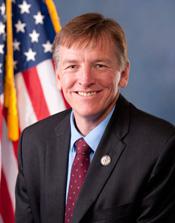
Paul A. Gosar
RRepublicanAZ-9 · Representative
55
/ 100
Average
Attendance93
Avg: 96
Independence10
Avg: 4
Bipartisan Tone26
Avg: 15
Ethics Record100
Avg: 99
Transparency29
Avg: 53
Accountability Score — composite of attendance, independence, bipartisan tone, ethics record & transparency.
Methodology17
Bills Sponsored
1
Enacted into Law
0
Passed a Chamber
16
In Committee
Bills That Became Law
All Sponsored Bills
HR10669In Committee
LANDs Act
HR10556In Committee
VA Hiring Integrity Act of 2026
HR8686In Committee
To amend the Military Land Withdrawals Act of 2013 to withdraw and reserve certain public land in the vicinity of Yuma Proving Ground, Arizona.
The federal government would set aside additional public land near Yuma Proving Ground in Arizona for military use, preventing other uses like mining or recreation on that property. This expansion would give the military more space for testing weapons and conducting training exercises in the area. The change would affect anyone who might have wanted to use that public land for other purposes, including outdoor enthusiasts and companies interested in resource extraction.
HJRES192In Committee
Disapproving the action of the District of Columbia Council in approving the Full Accountability in Arrest Reporting Temporary Amendment Act of 2026.
Congress is considering blocking a Washington D.C. law that would require police to report detailed information about arrests, including data on who gets arrested and under what circumstances. If approved, this would overturn the D.C. Council's decision to implement the arrest reporting requirements, preventing the city from collecting and publishing this accountability data. The measure affects D.C. residents, police departments, and anyone interested in tracking law enforcement practices in the nation's capital.
HJRES193In Committee
Disapproving the action of the District of Columbia Council in approving the Body-Worn Camera Transparency for Use of Force Temporary Amendment Act of 2026.
Congress would reject a new Washington D.C. law that requires police to release body camera footage when officers use force, preventing the transparency rule from taking effect. The measure affects D.C. residents and police accountability advocates who support public access to videos of police incidents, as well as the D.C. Police Department. If approved, this would block the D.C. Council's decision to make body camera videos more accessible to the public in use-of-force cases.
HR8300In Committee
Swalwell Act
Currently, taxpayers pay for settlements when members of Congress or their senior staff are accused of workplace misconduct like harassment or discrimination, but this bill would require those individuals to pay for their own settlements instead. The bill would also make information about past settlements public (while keeping victims' identities private) and ensure that any criminal allegations are reported to the Department of Justice for investigation. This change would hold elected officials and their top aides personally accountable for their conduct rather than shifting the cost to ordinary Americans.
HR7678In Committee
Gun Owner Registration Information Protection Act
Gun Owner Registration Information Protection Act This bill prohibits federal funding of, or support for, state databases that list (1) firearms lawfully owned or possessed by individuals, or (2) individuals who lawfully own or possess firearms.
HR1043Enacted
La Paz County Solar Energy and Job Creation Act
La Paz County Solar Energy and Job Creation Act This act directs the Department of the Interior, after receiving a request from La Paz County, Arizona, to convey approximately 3,400 acres of identified land managed by the Bureau of Land Management to the county for fair market value. Interior must exclude from the conveyance any federal land that contains significant cultural, environmental, wildlife, or recreational resources. As a condition of the conveyance, La Paz County and any subsequent owner must make good faith efforts to avoid disturbing tribal artifacts; minimize impacts on tribal artifacts if they are disturbed; coordinate with the Colorado River Indian Tribes Tribal Historic Preservation Office to identify artifacts of cultural and historic significance; and allow tribal representatives to rebury unearthed artifacts at, or near, where they were discovered. The federal land is withdrawn from the operation of U.S. mining and mineral leasing laws, and thus the land is not available for new mining claims, new mineral or geothermal leases, nor sales of mineral materials. The county must pay all costs related to the conveyance.
HR7430In Committee
FAIR AIR Act
The FAIR AIR Act would establish new rules or protections related to air quality and public lands, likely addressing how air pollution affects federally managed natural resources or communities near them. The bill has been sent to the House Transportation and Infrastructure Committee, suggesting it may involve regulating emissions from transportation or industrial activities on or near public lands. The exact provisions aren't yet clear since the bill is still in the early referral stage.
HR34In Committee
LASSO Act
Land And Social Security Optimization Act or the LASSO Act This bill requires 10% of revenue generated by public lands, including submerged lands on the Outer Continental Shelf, under the jurisdiction of the Department of the Interior and the Forest Service to be deposited into the Federal Old-Age and Survivors Insurance Trust Fund, which is used to pay Social Security benefits to retirees and their families and to survivors of deceased workers.
HR7159In Committee
Protecting Local Zoos Act of 2026
This bill would provide federal support and protections for local zoos across the country, likely through funding, tax benefits, or regulatory relief to help them operate more affordably. The measure aims to help zoos continue their work in animal care, conservation, and public education while making them more financially sustainable for their communities. Zoo operators, animal welfare organizations, and families who visit zoos would be the primary beneficiaries of this legislation.
HR5183In Committee
District of Columbia Home Rule Improvement Act of 2025
District of Columbia Home Rule Improvement Act This bill establishes a uniform 60-day period of congressional review for all nonemergency legislation enacted by the District of Columbia (DC). It also authorizes congressional disapproval of DC regulations and other executive actions, specific provisions in legislation, and extensions of emergency legislation. Currently, DC legislation is generally subject to a 30-day period of congressional review during which time Congress may enact a joint resolution of disapproval to nullify the legislation. Legislation involving criminal law is subject to a 60-day period of congressional review. Emergency legislation is not subject to congressional review. The bill applies a 60-day period of congressional review to all DC legislation other than emergency legislation. It also authorizes Congress to nullify (1) extensions of emergency DC legislation, and (2) one or more discrete provisions in DC legislation. The bill prohibits the DC Council from withdrawing legislation that it has transmitted to Congress for review or enacting legislation that is substantially the same as legislation that Congress disapproved. The bill also establishes a 60-day period of congressional review for DC executive orders and regulations according to procedures comparable to those for legislation. The bill additionally specifies the procedures for expedited consideration of joint resolutions of disapproval for DC legislation in each chamber, particularly the Senate. Finally, the bill requires the DC Mayor and the chair of the DC Council to present a report on DC to specified congressional committees at least once every calendar year.
HR4668In Committee
End the Vaccine Carveout Act
End the Vaccine Carveout Act This bill removes liability protections for manufacturers and administrators for vaccine-related injuries, and removes limitations on bringing civil actions for vaccine-related injuries or seeking compensation, under the National Vaccine Injury Compensation Program (VICP). It also excludes COVID-19 vaccines from liability protections under the Countermeasures Injury Compensation Program (CICP). Under current law, the VICP provides compensation for alleged injuries caused by certain routinely administered vaccines. Individuals generally may not file a civil action in court unless a VICP claim is filed and the resulting judgement is rejected. The VICP also limits the types of claims and amount of damages that may be sought (e.g., no liability for unavoidable side effects or failure to directly warn), and it imposes deadlines for filing claims. The bill removes the requirement to first file a claim under the VICP before pursuing a civil action, so individuals alleging vaccine-related injuries may choose to either bring a civil action or utilize the VICP. It also removes the restrictions on the types of civil actions and damages. The bill also removes the deadlines for filing claims under the VICP and applies this change retroactively. Additionally, under current law, the CICP provides compensation for alleged injuries caused by certain medical countermeasures during public health emergencies, including COVID-19 vaccines. The bill excludes COVID-19 vaccines from being considered as medical countermeasures. Therefore, under the bill, individuals may file civil actions against manufacturers of COVID-19 vaccines rather than filing claims under the CICP.
HR4092In Committee
Protect RAIL Act
The legislation would establish stricter immigration enforcement measures focused on rail transportation and border security. It would affect railroad companies, immigration authorities, and individuals traveling by train, potentially requiring enhanced documentation checks and reporting procedures at rail facilities. The bill aims to prevent unauthorized border crossings and immigration violations through increased oversight of rail-based transportation.
HR2315In Committee
Fairness for High-Skilled Americans Act of 2025
Fairness for High-Skilled Americans Act of 2025 This bill eliminates the Optional Practical Training Program or any successor program, unless Congress expressly authorizes such a program. (The program provides an F-1 student visa holder temporary employment authorization before or after completion of the student's studies, or both.)
HR1769In Committee
Local Zoning Decisions Protection Act of 2025
This bill would protect local governments' ability to make their own zoning decisions without federal interference, allowing cities and counties to control how land in their communities can be used and developed. The legislation aims to prevent the federal government from overriding local zoning rules that communities have established for housing, commercial, and other types of development. This would affect developers, homebuilders, local officials, and residents who care about how their neighborhoods are shaped.
HR908In Committee
Stop the Censorship Act
Stop the Censorship Act This bill limits the federal liability protection afforded to providers and users of interactive computer services (e.g., social media companies) for their efforts to screen and block objectionable content. This liability protection is often referred to as Section 230 protection. Specifically, the bill eliminates the existing liability protection for providers and users that take voluntary, good faith action to screen and block material they deem obscene, lewd, lascivious, excessively violent, harassing, or otherwise objectionable (or that make available the technical means to screen and block such content). The bill instead provides liability protection to providers and users (1) that take voluntary, good faith action to screen and block unlawful material (or that make available the technical means to do so), or (2) that provide users with the option to screen or block any other material.