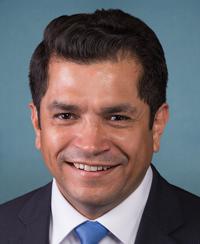
Jimmy Gomez
DDemocratCA-34 · Representative
53
/ 100
Average
Attendance94
Avg: 96
Independence3
Avg: 4
Bipartisan Tone8
Avg: 15
Ethics Record80
Avg: 99
Transparency73
Avg: 53
Accountability Score — composite of attendance, independence, bipartisan tone, ethics record & transparency.
Methodology11
Bills Sponsored
0
Enacted into Law
0
Passed a Chamber
11
In Committee
All Sponsored Bills
HR10023In Committee
ASSET Act
The proposal would remove or raise the asset limits that currently prevent people from receiving federal assistance programs like food stamps, Medicaid, and housing aid if they have too much money or property saved up. This change would allow more low-income workers and families to qualify for these benefits even if they own a home, car, or have some savings, making it easier for people to receive help while building financial security. The bill affects millions of Americans who rely on federal assistance programs and has been sent to multiple congressional committees for review.
HR8174In Committee
To amend title 31, United States Code, to prohibit the issuance of United States currency and securities containing the signature of the sitting President.
The proposal would prevent the sitting President's signature from appearing on U.S. currency and government securities like Treasury bonds, changing a tradition that has been in place for decades. This would affect all money and bonds issued while a President is in office, requiring the government to use signatures from other officials instead. The change would be primarily symbolic but would alter the appearance of bills and bonds that millions of Americans use and hold.
HRES1097In Committee
Of inquiry requesting the President of the United States, and directing the Secretaries of the Treasury and Homeland Security, to furnish certain information to the House of Representatives relating to the implementation and enforcement of the "Memorandum of Understanding for the Exchange of Information for Nontax Criminal Enforcement" between the Department of the Treasury and the Department of Homeland Security.
The House is requesting that the President, Treasury Secretary, and Homeland Security Secretary provide information about how the Treasury and Homeland Security departments share data with each other for criminal investigations that aren't related to taxes. This inquiry focuses on understanding how these two agencies coordinate their information-sharing practices, particularly as they relate to immigration enforcement. The request has been sent to the House Ways and Means Committee for review.
HRES995In Committee
Supporting the goals and ideals of Korean American Day.
This measure expresses support for Korean American Day, a day dedicated to recognizing the contributions and culture of Korean Americans in the United States. The resolution celebrates Korean American heritage, history, and achievements while promoting awareness and appreciation of Korean American communities. It does not create new laws or programs, but rather serves as a symbolic statement of congressional recognition.
HR6390In Committee
Make Housing Affordable and Defend Democracy Act
This bill addresses housing affordability and democracy-related issues through tax policy changes, though the specific provisions are not yet detailed in available summaries. The bill has been referred to multiple committees including Ways and Means (which handles taxes), Armed Services, Homeland Security, and Judiciary, suggesting it may combine tax measures affecting housing with provisions related to national security or voting rights. Once the committees review it, they will determine which parts fall under their jurisdiction and make recommendations on whether it should become law.
HR5378In Committee
Tribal Healthcare Careers Act
Tribal Healthcare Careers Act This bill requires the Department of Health and Human Services (HHS) to reserve a portion of Health Profession Opportunity Grants for Indian tribes, tribal organizations, and tribal colleges and universities. HHS must award at least 10 grants to tribal applicants.
HR4797In Committee
EATS Act of 2025
Enhance Access To SNAP Act of 2025 or the EATS Act of 2025 This bill expands eligibility for the Supplemental Nutrition Assistance Program (SNAP) for certain students. Specifically, the bill removes the restriction on SNAP eligibility for students to allow otherwise eligible students who are attending institutions of higher education (IHEs) at least half time to participate in SNAP. Under current law, students 18-49 years old are restricted from participating in SNAP, with exceptions (e.g., caring for a child under the age of 6 or employed for at least 20 hours a week). The Consolidated Appropriations Act, 2021 temporarily exempted some students from certain SNAP eligibility requirements; these temporary student exemptions expired after the end of the COVID-19 public health emergency on May 11, 2023. Further, the bill provides that students enrolled at least half time in a recognized school, training program, or IHE constitute individual households (not residents of institutions ) and may be eligible for SNAP benefits. (Participation in SNAP is limited to households.)
HR4666In Committee
Baby Clothing Tax Relief Act
Baby Clothing Tax Relief Act This bill prohibits the imposition of duties (i.e., tariffs) on specified baby clothing items (e.g., baby garments and clothing accessories, socks and booties, and shoes) pursuant to certain presidential powers. Specifically, the bill prohibits the President from exercising authorities under the International Emergency Economic Powers Act (IEEPA) to impose duties on specified baby clothing items entering the United States. (IEEPA provides the President with broad authority to regulate various economic transactions following a declaration of a national emergency.) Further, the President must terminate the duties on these items that were imposed pursuant to IEEPA and are in effect as of the date of the bill's enactment. The bill also prohibits the President from using any other authorities to impose duties on these items that are substantially similar to the duties imposed pursuant to IEEPA.
HR3964In Committee
Affordable Housing Equity Act of 2025
HR3763In Committee
Protect Vulnerable Immigrant Youth Act
HRES33In Committee
Supporting the goals and ideals of Korean American Day.
This resolution expresses support for the goals and ideals of Korean American Day and honors the 122nd anniversary of the arrival of the first Korean immigrants to the United States.