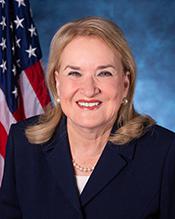
Sylvia R. Garcia
DDemocratTX-29 · Representative
50
/ 100
Average
Attendance95
Avg: 96
Independence2
Avg: 4
Bipartisan Tone6
Avg: 15
Ethics Record100
Avg: 99
Transparency28
Avg: 53
Accountability Score — composite of attendance, independence, bipartisan tone, ethics record & transparency.
Methodology19
Bills Sponsored
0
Enacted into Law
1
Passed a Chamber
18
In Committee
All Sponsored Bills
HRES1414In Committee
Providing for consideration of the bill (H.R. 1589) to authorize the cancellation of removal and adjustment of status of certain aliens, and for other purposes.
This resolution provides for the consideration of the bill (H.R. 1589) to authorize the cancellation of removal and adjustment of status of certain aliens, and for other purposes.
HR8878In Committee
Incentivizing Local Solutions to Homelessness Act
The legislation would modify federal homeless assistance programs to encourage communities to develop their own local solutions to homelessness rather than relying solely on federal programs. It would likely provide incentives such as grants or flexibility in how federal funds are used for communities that create effective local strategies to address homelessness. This would affect homeless individuals, local governments, nonprofits that provide housing services, and federal agencies that administer homeless assistance programs.
HR8877In Committee
Improving Self-Sufficiency of Families in HUD-Subsidized Housing Act
The federal government would study how local public housing agencies enforce work requirements for people receiving housing assistance, examining what rules they use and how well those rules work. The study would help lawmakers understand whether these requirements are being applied fairly and effectively across different communities. This would affect low-income families and individuals who live in public housing and may be subject to work-related conditions for their assistance.
HJRES180In Committee
Providing for congressional disapproval under chapter 8 of title 5, United States Code, of the rule submitted by the Bureau of Consumer Financial Protection relating to the withdrawal of the rule relating to "Statement of Policy Regarding Prohibition on Abusive Acts or Practices".
Congress would reject a decision by the Consumer Financial Protection Bureau to withdraw its policy against abusive financial practices, which would keep the original protections in place for consumers dealing with banks and financial companies. This measure would block the agency from removing rules that prevent financial institutions from engaging in unfair or deceptive behavior toward customers. The proposal is currently under review by the House Committee on Financial Services.
HJRES181In Committee
Providing for congressional disapproval under chapter 8 of title 5, United States Code, of the rule submitted by the Bureau of Consumer Financial Protection relating to the withdrawal of the rule relating to "Consumer Financial Protection Circular 2022-07: Reasonable Investigation of Consumer Reporting Disputes".
Congress would reject a decision by the Consumer Financial Protection Bureau to withdraw its guidance on how credit reporting companies should investigate disputes from consumers about errors on their credit reports. This would restore the agency's previous rules requiring credit bureaus to conduct reasonable investigations when consumers challenge inaccurate information. The change would affect credit reporting companies and consumers who dispute errors on their credit files.
HR8373In Committee
Improving Access to Financial Coaching Act of 2026
The federal government would create a grant program that gives money to organizations to offer free or low-cost financial coaching services to help people manage their money, build savings, and make better financial decisions. These grants would go to nonprofits, community groups, and other eligible organizations that work directly with individuals who need help with budgeting, debt management, and financial planning. The program aims to improve financial stability for everyday Americans by connecting them with expert guidance on personal finances.
HRES1170In Committee
Supporting the designation of April 10 as "Dolores Huerta Day", in honor of the accomplishments and legacy of the trailblazing labor and civil rights leader Dolores Huerta.
This bill would officially designate April 10 as "Dolores Huerta Day" to honor the labor and civil rights activist who fought for workers' rights and social justice throughout her career. The designation is largely symbolic and would recognize Huerta's contributions to American history without creating new laws or programs. It affects no one directly but serves as a national acknowledgment of her legacy and importance to the labor and civil rights movements.
HRES1149In Committee
Supporting the goals and ideals of Social Work Month and World Social Work Day on March 17, 2026.
This resolution recognizes Social Work Month and World Social Work Day on March 17, 2026, to highlight the contributions of social workers who help vulnerable populations access services and support. The measure celebrates social workers' efforts in addressing issues like poverty, mental health, and family welfare across communities. It's a symbolic gesture that doesn't create new laws or programs, but rather acknowledges the profession's importance to American society.
HR7344In Committee
Affordable Housing Supply Chain Clarity Act
This bill would require companies involved in building affordable housing to disclose information about their supply chains, such as where they get materials and labor. The goal is to make the affordable housing construction process more transparent and potentially reduce costs by identifying inefficiencies or problems in how materials and workers move through the system. This would affect homebuilders, construction suppliers, and housing developers working on affordable housing projects.
HR6790In Committee
D-BLOC Act
The D-BLOC Act addresses railroad safety and infrastructure issues, likely focusing on how trains transport hazardous materials or how rail systems are maintained and regulated. The bill would affect railroad companies, workers in the transportation industry, and communities near rail lines that handle dangerous cargo. By being referred to the subcommittee on railroads and hazardous materials, the legislation appears designed to improve safety standards or oversight in these areas.
HR7252In Committee
Restoring Community Trust Act of 2026
Based on the title and immigration focus, this bill likely aims to address public confidence in immigration enforcement and policy by making changes to how immigration laws are implemented or enforced. The specific provisions aren't yet clear since the bill is still in early stages, but it probably affects immigrants, immigration enforcement agencies, and communities where immigration policies are applied. Once referred to the Judiciary Committee, lawmakers will debate what specific reforms would best restore public trust in the immigration system.
HR6772In Committee
Affordable Housing Through Common-Sense Standards Act
This bill would likely change the rules and standards that apply to affordable housing programs, aiming to make it easier or cheaper to build and maintain affordable homes for lower-income families. The changes would probably affect housing developers, local governments, and families struggling to find affordable places to live by adjusting requirements that currently govern how affordable housing projects are built and operated.
HR5514In Committee
POJA Act of 2025
Protect Older Job Applicants Act of 2025 or the POJA Act of 2025 This bill prohibits employers from limiting, segregating, or classifying job applicants based on an applicant's age. It also requires the Equal Employment Opportunity Commission to study and report on claims received from job applicants involving age discrimination.
HR1860Passed House
Women Veterans Cancer Care Coordination Act
Women Veterans Cancer Care Coordination Act This bill requires the Department of Veterans Affairs (VA) to hire or designate a Regional Breast Cancer and Gynecologic Cancer Care Coordinator for each Veteran Integrated Services Network (i.e., regional VA health care administrative areas). Among other duties, such coordinators must ensure the coordination of care between VA clinicians and breast and gynecologic cancer community care providers. Under the bill, veterans are eligible for such care coordination if they are diagnosed with a breast or gynecologic condition and are eligible for health care through the Veterans Community Care Program.
HR4664In Committee
Stop Shackling and Detaining Pregnant Women Act
The legislation would prohibit law enforcement from using physical restraints like shackles, handcuffs, and leg irons on pregnant women during arrest, transport, and incarceration, except in cases where an officer determines there is an immediate safety threat. The bill would also require correctional facilities to provide pregnant inmates with appropriate medical care and housing accommodations. These protections would apply to pregnant women in federal, state, and local custody.
HR4497In Committee
Extreme Heat Emergency Act of 2025
The legislation would establish federal procedures and resources to help communities respond to dangerous heat waves, similar to how the government currently handles other natural disasters like hurricanes and floods. It would likely provide emergency funding, coordination between federal agencies, and support for affected workers, elderly people, and vulnerable populations during extreme heat events. The bill aims to treat severe heat as a serious public health emergency requiring the same level of government preparation and response as other major disasters.
HRES326In Committee
Supporting the designation of April 10 as "Dolores Huerta Day", in honor of the accomplishments and legacy of the trailblazing labor and civil rights leader Dolores Huerta.
This bill would officially recognize April 10 as "Dolores Huerta Day" to honor the labor and civil rights activist who fought for farmworkers' rights and social justice throughout her career. The designation is largely symbolic and would raise awareness about Huerta's contributions to the civil rights movement and her legacy as a pioneering organizer. The bill doesn't create new laws or programs, but rather designates a national day of recognition for her accomplishments.
HRES275In Committee
Supporting the goals and ideals of Social Work Month and World Social Work Day on March 18, 2025.
This resolution recognizes Social Work Month and World Social Work Day on March 18, 2025, to highlight the contributions of social workers who help vulnerable populations including children, elderly people, and those struggling with poverty or mental health issues. The measure aims to raise public awareness about the important role social workers play in communities and encourage support for the profession. It does not create new programs or funding, but rather serves as a formal statement of appreciation for social workers' efforts.
HR1589In Committee
American Dream and Promise Act of 2025
American Dream and Promise Act of 2025 This bill provides certain non-U.S. nationals ( aliens under federal law) with a path to receive permanent resident status and contains other immigration-related provisions. The Department of Homeland Security (DHS) or the Department of Justice (DOJ) shall provide conditional permanent resident status for 10 years to a qualifying individual who entered the United States as a minor and (1) is deportable or inadmissible, (2) has deferred enforced departure (DED) status or temporary protected status (TPS), or (3) is the child of certain classes of nonimmigrants. The bill imposes various qualifying requirements, such as the individual being continuously physically present in the United States since January 1, 2021, passing a background check, and being enrolled in or having completed certain educational programs. DHS shall remove the conditions placed on permanent resident status granted under this bill if the individual applies and meets certain requirements, such as completing certain programs at an educational institution, serving in the military, or being employed. Furthermore, DHS or DOJ shall provide lawful permanent resident status to certain individuals who had TPS, were eligible for TPS, or were eligible for DED status on certain dates. Such individuals must meet certain requirements and apply for such status within three years of this bill's enactment. This bill also repeals a restriction that bars a state from providing higher education benefits to undocumented individuals unless those benefits are available to all U.S. nationals without regard to residency in the state.