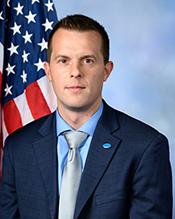
Jared F. Golden
DDemocratME-2 · Representative
52
/ 100
Average
Attendance97
Avg: 96
Independence21
Avg: 4
Bipartisan Tone13
Avg: 15
Ethics Record100
Avg: 99
Transparency7
Avg: 53
Accountability Score — composite of attendance, independence, bipartisan tone, ethics record & transparency.
Methodology13
Bills Sponsored
0
Enacted into Law
2
Passed a Chamber
11
In Committee
All Sponsored Bills
HR10780In Committee
Congressional Budget Reform Act
HR10555In Committee
VETS Access Act
HR8509In Committee
To amend the Consolidated Appropriations Act, 2023 to extend the time period for which certain regulations concerning the North Atlantic right whale are effective.
The government put temporary rules in place to protect North Atlantic right whales, and this proposal would extend how long those rules stay in effect. The rules likely include things like shipping restrictions or fishing limits designed to prevent harm to these endangered whales. The change would give regulators more time to study whether the protections are working before deciding what to do next.
HR7735In Committee
Improving Mental Health Support for Servicemembers and Veterans Act
This bill would expand mental health services and support programs available to active-duty military members and veterans, likely including increased access to counseling, therapy, and crisis intervention services. The legislation aims to address mental health challenges like depression, anxiety, and post-traumatic stress that many service members and veterans experience. The bill has been sent to a congressional subcommittee for review and discussion.
HR2550Passed House
Protect America's Workforce Act
Protect America's Workforce Act This bill nullifies the Executive Order titled Exclusions from Federal Labor-Management Relations Programs (issued on March 27, 2025), which excludes specified executive agencies and subdivisions from the Federal Service Labor-Management Relations Statute. The statute authorizes federal employees' participation in collective bargaining and enforces collective bargaining rights. The bill also specifies that a covered collective bargaining agreement in place as of March 26, 2025, shall have full force and effect through the stated term of the agreement.
HRES432Passed House
Providing for consideration of the bill (H.R. 2550) to nullify the Executive order relating to Exclusions from Federal Labor-Management Relations Programs, and for other purposes.
This resolution provides for immediate consideration by the House of Representatives of H.R. 2550, the Protect America's Workforce Act , a bill nullifying Executive Order 14251 , entitled Exclusions from Federal Labor-Management Relations Programs (issued on March 27, 2025). The Executive Order excludes specified federal agencies from substantive and procedural requirements that generally apply to federal employees' labor organizing and collective bargaining, as well as respective management obligations.
HR4978In Committee
Secure Trade Act
The proposal would establish new rules and requirements for international trade and financial transactions to protect American economic interests and security. It addresses how the U.S. conducts business with foreign countries and manages financial dealings across borders, affecting businesses that import or export goods, financial institutions, and potentially consumers who buy imported products. The bill is currently being reviewed by multiple congressional committees to determine which parts fall under each committee's area of responsibility.
HR4665In Committee
Loggers Economic Assistance and Relief Act
The proposal would provide financial assistance and relief to logging workers and timber industry businesses affected by economic hardship or emergencies. It aims to help loggers recover from disruptions to their work and income, potentially through direct payments, loans, or other support programs. The measure is currently being reviewed by the House Agriculture Committee.
HR3762In Committee
Supporting Healthy Moms and Babies Act
This bill aims to improve health outcomes for pregnant women and newborns through various healthcare programs and support services, likely including measures to expand access to prenatal care, maternal health services, and resources for new mothers. The legislation would affect pregnant women, new mothers, babies, and healthcare providers, potentially involving changes to insurance coverage, Medicaid benefits, or federal funding for maternal health initiatives. The bill is currently being reviewed by three House committees to determine which parts fall under each committee's area of responsibility.
HR3509In Committee
Supporting Our Surviving Spouses Act
The legislation would provide additional financial support and benefits to surviving spouses of military members and veterans who die in service or from service-related causes. Surviving spouses would receive enhanced survivor benefits, potentially including increased monthly payments and access to additional healthcare or educational programs. The bill aims to better support families who have lost a loved one through military service.
HR2258In Committee
To designate the Maine Forest and Logging Museum, located in Bradley, Maine, as the National Museum of Forestry and Logging History.
HR1308In Committee
FISC Act
Family Income Supplemental Credit Act or the FISC Act This bill replaces the federal child tax credit with monthly payments provided by the Social Security Administration (SSA) to qualified pregnant women and caregivers of eligible children. Specifically, the bill provides a monthly payment of $800 to a qualified pregnant woman, $400 to a qualified caregiver for each eligible child who is under six years old, and $250 to a qualified caregiver for each eligible child who is at least six years old. The monthly payment increases by 20% if the individual is a married pregnant woman or married to a qualified caregiver of an eligible child. Under the bill, the monthly payment begins to phase out for individuals with an adjusted gross income exceeding $125,000 ($250,000 for joint filers) for the most recently ended tax year. (Other limitations apply.) The bill defines an eligible child as an individual who is under 18 years old; is a U.S. citizen, U.S. national, or permanent resident alien; and does not provide more than half of their own financial support during the tax year. Further, a qualified caregiver must be at least 18 years old, reside with the child, and economically support the child. The bill also provides funding for the monthly payments and establishes the Bureau of Family Statistics within the SSA to provide certain information. Finally, the bill requires the SSA to issue regulations, establish a system to report marital or caregiver status changes, and report to Congress annually on the payments.
HR1193In Committee
Future in Logging Careers Act
The proposal would support training and education programs to help people prepare for careers in the logging industry, addressing workforce shortages in forestry-related jobs. It aims to connect workers with apprenticeships, certifications, and skills development opportunities in timber harvesting and related forest management positions. The measure would benefit both job seekers looking to enter the logging field and employers struggling to find qualified workers.