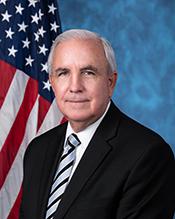
Carlos A. Gimenez
RRepublicanFL-28 · Representative
55
/ 100
Average
Attendance93
Avg: 96
Independence3
Avg: 4
Bipartisan Tone14
Avg: 15
Ethics Record100
Avg: 99
Transparency54
Avg: 53
Accountability Score — composite of attendance, independence, bipartisan tone, ethics record & transparency.
Methodology8
Bills Sponsored
1
Enacted into Law
3
Passed a Chamber
4
In Committee
Bills That Became Law
All Sponsored Bills
HR10554In Committee
SCREEN Act of 2026
HR9388Passed House
One-Stop Pilot Program Extension Act
One-Stop Pilot Program Extension Act This bill revises and extends the One Stop Security program of the Transportation Security Administration (TSA). Under this pilot program, eligible passengers and their checked baggage arriving in the United States from certain foreign airports with connecting flights may be eligible to continue without additional TSA security re-screening. The bill extends the pilot program through December 23, 2032, from the current December 23, 2028. The bill also revises the security requirements for excluding checked baggage from additional TSA security re-screening. Among other things, the bill specifies that a passenger must be unable to access their checked baggage until arrival at their final destination and that U.S. Customs and Border Protection must have received timely images of the baggage from the participating foreign airport prior to a passenger’s arrival in the United States.
HR9057In Committee
COOL Online Act
Country of Origin Labeling Requirement Act or the COOL Online Act This bill requires sellers of imported products online to conspicuously disclose the country of origin of the products and the country where the seller's principal place of business is located. This requirement does not apply to specified products, such as agricultural commodities, food or drugs, or previously owned items. The Federal Trade Commission must enforce violations of this requirement as unfair or deceptive trade practices.
HRES1272In Committee
Celebrating 200 years of United States diplomatic relations with Peru.
This resolution celebrates 200 years of diplomatic relations between the United States and Peru and encourages continued partnership to address shared regional and global challenges.
HRES998In Committee
Commending President Trump, his administration, and the brave men and women of the Armed Forces, Intelligence Community, and Justice Department for the remarkable success of "Operation Absolute Resolve".
This is a resolution expressing congressional praise for President Trump's administration and military and intelligence personnel for an operation called "Operation Absolute Resolve," though the resolution itself does not create new laws or policies. The measure has been sent to multiple congressional committees for review, including those overseeing foreign affairs, armed services, intelligence, and the judiciary. Since the operation's specific details are not publicly defined in the resolution's title, Congress appears to be formally commending actions taken by these agencies, though the actual nature and scope of the operation would need to be examined in the full text.
HR504Enacted
Miccosukee Reserved Area Amendments Act
Miccosukee Reserved Area Amendments Act This bill expands the Miccosukee Reserved Area to include a portion of Everglades National Park in Florida that is known as Osceola Camp. The Department of the Interior, in consultation with the Miccosukee Tribe of Indians, must take appropriate actions to protect structures within the Osceola Camp from flooding.
HR1608Passed House
Department of Homeland Security Vehicular Terrorism Prevention and Mitigation Act of 2025
Department of Homeland Security Vehicular Terrorism Prevention and Mitigation Act of 2025 This bill directs the Department of Homeland Security (DHS) to submit a report to Congress on the department's efforts to prevent, deter, and respond to vehicular terrorism (i.e., an action that utilizes automotive transportation to commit terrorism). DHS must submit the report in coordination with the Transportation Security Administration and the Cybersecurity and Infrastructure Security Agency. Among other things, the report on vehicular terrorism must include an assessment of the current and emerging threats; a review of higher-risk locations and events that may be vulnerable, including critical infrastructure sites (e.g., airports and government facilities); a description of DHS’s coordination efforts with federal, state, local, tribal, and territorial law enforcement agencies related to prevention; and recommendations for the research, development, and deployment of technologies to detect, deter, and mitigate vehicular terrorism. DHS must submit a classified report to Congress, but may include an unclassified executive summary. DHS must publish the executive summary on the department's website. In addition, DHS must brief Congress on the report's findings, conclusions, and recommendations.
HR1166Passed House
Decoupling from Foreign Adversarial Battery Dependence Act
Decoupling from Foreign Adversarial Battery Dependence Act This bill prohibits the Department of Homeland Security (DHS) from using appropriated funds to procure a battery produced by certain entities, particularly six specific companies owned and operated in China. This prohibition begins on October 1, 2027. The bill allows DHS to waive the prohibition if DHS assesses in the affirmative that (1) the batteries to be procured do not pose a risk to U.S. national security, data, or infrastructure; and (2) there is no available alternative to procure batteries that are of similar or better cost and quality and that are produced by an entity not specified in this bill. DHS may also waive the prohibition upon a determination that the batteries to be procured are for the sole purpose of research, evaluation, training, testing, or analysis. The bill requires DHS to notify Congress within 15 days after granting a waiver under this bill. The bill also requires DHS to report to Congress on the anticipated impacts associated with carrying out this bill, including with respect to specified agencies of DHS.