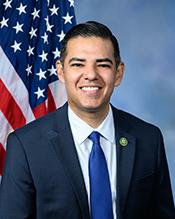
Robert Garcia
DDemocratCA-42 · Representative
45
/ 100
Below Average
Attendance94
Avg: 96
Independence2
Avg: 4
Bipartisan Tone0
Avg: 15
Ethics Record100
Avg: 99
Transparency7
Avg: 53
Accountability Score — composite of attendance, independence, bipartisan tone, ethics record & transparency.
Methodology14
Bills Sponsored
0
Enacted into Law
1
Passed a Chamber
13
In Committee
All Sponsored Bills
HR10820In Committee
Epstein Wall Street Records Act of 2026
HR5578Passed House
Expanding Whistleblower Protections for Contractors Act of 2026
Expanding Whistleblower Protections for Contractors Act of 2025 This bill expands whistleblower protections for employees of federal contractors and grant recipients to include the act of refusing to obey an unlawful order and to apply these protections to members of the intelligence community and other governmental employees. Current law protects employees of federal contractors or grant recipients from a reprisal (i.e., discharge, demotion, or discrimination) for disclosing evidence to Congress or another appropriate official of certain misconduct involving federal contracts, grants, or funds. The bill expands these protections to include an employee's refusal to obey an order that would require the employee to violate a law, rule, or regulation related to any contract, subcontract, grant, or subgrant. The bill also specifies that these protections apply to employees of federal contractors or grant recipients who are current or former members of the intelligence community or employees of state, local, or tribal governments. Further, the bill specifies that these protections may not be waived in a predispute arbitration agreement and renders any such agreement unenforceable. The bill specifies that an executive branch official may not request a federal contractor or grant recipient to engage in a reprisal against a protected employee, and it authorizes federal agencies to propose disciplinary action against officials that do so.
HR9741In Committee
To name the District of Columbia tuition assistance grant program the "Eleanor Holmes Norton District of Columbia Tuition Assistance Grant Program".
The District of Columbia offers tuition assistance grants to help local students pay for college, and this bill would rename that program after Eleanor Holmes Norton, the longtime congressional representative from Washington, D.C. The change honors Norton's decades of service advocating for D.C. residents and education. Students receiving these grants would see the program's name reflect this tribute to her legacy.
HRES1228In Committee
Directing the Committee on Oversight and Government Reform of the House of Representatives to initiate or intervene in judicial proceedings.
The House Committee on Oversight and Government Reform would be authorized to start or join lawsuits on behalf of Congress, allowing the committee to defend the legislative branch's interests in court. This would give Congress a direct legal tool to challenge executive branch actions or defend its own powers without waiting for the Department of Justice to act. The measure affects how Congress can protect its constitutional authority and oversight responsibilities through the judicial system.
HR8508In Committee
Piers Reinvestment Act
The federal government would provide grants to help cities and towns repair, upgrade, or strengthen their public piers to better withstand damage from storms, flooding, and other environmental threats. These grants would be part of an existing transportation program focused on making infrastructure more resilient and cost-effective. Local governments and port communities would be the main beneficiaries of this funding.
HR7827In Committee
Stop Militarizing Our Streets Act of 2026
This bill would limit the military's ability to deploy troops and equipment to domestic streets and neighborhoods during civilian situations, likely requiring stricter approval processes before the armed forces can be used for law enforcement or crowd control within the United States. The legislation would affect military commanders, local police departments, and civilians by establishing clearer rules about when and how military resources can support domestic operations. The bill has been sent to two committees to review different aspects of the proposal—one focusing on military policy and another on legal and constitutional questions.
HR6085In Committee
Stop Ballroom Bribery Act
HR6056In Committee
International Human Rights Defense Act of 2025
This bill would likely establish or strengthen U.S. government programs and policies aimed at protecting human rights around the world, potentially including support for activists, monitoring of abuses, and diplomatic pressure on countries with poor human rights records. It could affect foreign aid decisions, international relations, and how the U.S. responds to countries that violate basic freedoms like freedom of speech and assembly. The bill would primarily impact U.S. foreign policy and international organizations that work on human rights issues.
HR4325In Committee
Clean Shipping Act of 2025
The legislation would require ships operating in U.S. waters to use cleaner fuels and reduce air pollution from maritime vessels, which currently contribute significantly to coastal air quality problems. The rules would apply to shipping companies and cargo operators, potentially increasing their fuel costs but improving air quality for people living near ports and coastal communities. The measure aims to cut emissions of harmful pollutants like sulfur dioxide and nitrogen oxides that come from ship engines.
HR4227In Committee
AMMO Act
I don't have enough information about what this specific bill actually does to write an accurate summary. The title "AMMO Act" and subject area of crime and law enforcement could refer to several different proposals with very different effects. To provide you with a factual, nonpartisan summary, I would need details about the bill's actual provisions—such as whether it addresses ammunition regulation, law enforcement funding, crime prevention measures, or something else entirely. Could you provide the bill number or more details about its specific content?
HR3101In Committee
SHIELD Act
The SHIELD Act would restrict federal funding to cities and states that have adopted sanctuary policies limiting cooperation with immigration enforcement. The bill aims to pressure local governments to work more closely with federal immigration authorities by threatening to withhold federal grants and resources from jurisdictions that refuse to comply.
HR2710In Committee
People Over Parking Act of 2025
HR766In Committee
SEWER Act
Surveilling Effluent Water for Epidemic Response Act or the SEWER Act This bill provides statutory authority for the Centers for Disease Control and Prevention (CDC) National Wastewater Surveillance System (NWSS) program, which detects and monitors pathogens in wastewater. It requires the CDC to expand and intensify the activities of the NWSS, including with respect to SARS-CoV-2 (the virus that causes COVID-19), influenza, mpox, dengue, West Nile virus, and respiratory syncytial virus (RSV). The NWSS provides funding and guidance to public health departments for wastewater surveillance activities. Under the NWSS, health departments and other partners coordinate on wastewater surveillance at sampling sites and share data with the CDC. The NWSS was initially implemented to monitor SARS-CoV-2 and has since expanded to include influenza A, avian influenza A, mpox, and RSV.
HR673In Committee
ICE Security Reform Act of 2025
ICE Security Reform Act of 2025 This bill requires the Department of Homeland Security (DHS) to operate Homeland Security Investigations (HSI) as a separate entity within DHS. The functions of HSI remain the same. HSI is a law enforcement agency that currently operates under U.S. Immigration and Customs Enforcement. In addition, U.S. Immigration and Customs Enforcement is redesignated as U.S. Immigration Compliance Enforcement.