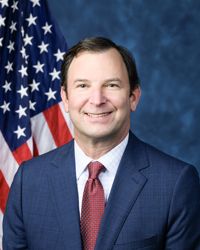
Craig A. Goldman
RRepublicanTX-12 · Representative
53
/ 100
Average
Attendance99
Avg: 96
Independence2
Avg: 4
Bipartisan Tone2
Avg: 15
Ethics Record100
Avg: 99
Transparency51
Avg: 53
Accountability Score — composite of attendance, independence, bipartisan tone, ethics record & transparency.
Methodology13
Bills Sponsored
1
Enacted into Law
1
Passed a Chamber
10
In Committee
All Sponsored Bills
HR10271In Committee
Mobile Workforce State Income Tax Simplification Act of 2026
HR10141In Committee
To designate the facility of the United States Postal Service located at 4450 Oak Park Lane in Fort Worth, Texas, as the "United States Representative Kay Granger Post Office Building".
This bill designates the facility of the United States Postal Service located at 4450 Oak Park Lane in Fort Worth, Texas, as the "United States Representative Kay Granger Post Office Building".
HRES1481In Committee
Honoring the life and legacy of the Honorable Kay Granger, a Representative from the State of Texas.
HR9892In Committee
Stop EU Overreach Act
The bill would require the U.S. Trade Representative to investigate whether the European Union is unfairly restricting American trade or stealing intellectual property, which could lead to the U.S. imposing tariffs or other trade penalties on EU goods. This investigation would affect American businesses that export to Europe, European companies selling products in the U.S., and potentially consumers who might face higher prices if tariffs are imposed. The measure is currently under review by the House committee that handles trade and tax issues.
HR9335Reported
Advanced Transmission Technology to Reduce Rates Act
The legislation would support the development and deployment of advanced electrical transmission technologies designed to modernize the power grid and potentially lower electricity costs for consumers. By encouraging investment in newer transmission systems that can move electricity more efficiently across long distances, the bill aims to reduce energy losses and operational expenses that utility companies currently pass on to households and businesses. This would primarily affect electric utilities, power companies, and the millions of Americans who pay electricity bills.
HR9396In Committee
Prior Authorization Accountability Act
Insurance companies and health plans would be required to publicly display how often they deny patient claims for medical coverage, making it easier for consumers and employers to compare which insurers approve or reject treatment requests most frequently. This transparency measure would apply to health insurance companies, employer-sponsored health plans, and other health coverage providers. The goal is to help people make more informed choices about their health insurance by showing them which plans are more likely to cover the medical care they request.
HR9336In Committee
Better Care, Better Cost Act
States would be required to consider how well managed care companies perform when deciding which ones get to serve Medicaid patients, rather than assigning patients based solely on other factors. This could reward insurance companies that provide better care and customer service while potentially penalizing those with poor track records. The change would affect millions of low-income Americans who rely on Medicaid for health coverage.
HR9147In Committee
Abraham Accords Expansion Act of 2026
This bill would change the job responsibilities of a State Department official who works on Middle East peace agreements between Israel and Arab nations. The official would take on new duties related to these normalization agreements and a regional forum called the Negev Forum. The changes would affect how the U.S. government coordinates diplomatic efforts in the Middle East.
HR4758Passed House
Homeowner Energy Freedom Act
Homeowner Energy Freedom Act This bill repeals the Department of Energy's (1) high-efficiency electric home rebate program for certain electrification projects in low- or moderate-income households, (2) state-based home energy efficiency contractor training grants, and (3) assistance for states and local governments to adopt specified building energy codes. It also rescinds any unobligated balances available for the rebates or adopting the building energy codes. (The unobligated balances for the contractor training grants were previously rescinded by the 2025 reconciliation act.)
HR7592In Committee
Zero-Based Regulatory Budgeting to Unleash American Energy Act of 2026
This bill would require federal agencies to justify all energy regulations from scratch each year, rather than automatically continuing existing rules, with the goal of reducing regulatory requirements on energy companies. The approach, called "zero-based budgeting," would force agencies to prove that each regulation is necessary and beneficial before keeping it in place, potentially eliminating rules related to environmental protection, safety, or emissions. Energy companies and producers would likely benefit from fewer restrictions, while environmental advocates worry it could weaken protections for air and water quality.
HR7034In Committee
To amend the Internal Revenue Code of 1986 to eliminate the dollar limitations on the exclusion of gain from sales of principal residences, and for other purposes.
This proposal would remove the current $250,000 limit (or $500,000 for married couples) on how much profit homeowners can exclude from taxes when they sell their primary residence, allowing people to avoid paying capital gains taxes on larger home sale profits. The change would primarily benefit homeowners in high-cost real estate markets who have seen their property values increase significantly over time, though it could reduce tax revenue collected by the federal government.
HR3341In Committee
LIT Act of 2025
HJRES75Enacted
Providing for congressional disapproval under chapter 8 of title 5, United States Code, of the rule submitted by the Office of Energy Efficiency and Renewable Energy, Department of Energy relating to "Energy Conservation Program: Energy Conservation Standards for Commercial Refrigerators, Freezers, and Refrigerator-Freezers".
This joint resolution eliminates new, more stringent energy conservation standards for commercial refrigerators, freezers, and refrigerator-freezers. Under the joint resolution, such equipment is no longer required to comply with the new standards. Specifically, the joint resolution nullifies the rule titled Energy Conservation Program: Energy Conservation Standards for Commercial Refrigerators, Freezers, and Refrigerator-Freezers and published by the Department of Energy's Office of Energy Efficiency and Renewable Energy on January 21, 2025. Under the rule, the office adopted new energy conservation standards for commercial refrigeration equipment to achieve the maximum improvement in energy efficiency that is technologically feasible and economically justified. The rule required the equipment to comply with the those standards by January 22, 2029.