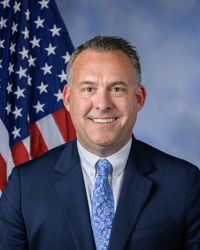
Adam Gray
DDemocratCA-13 · Representative
56
/ 100
Average
Attendance94
Avg: 96
Independence18
Avg: 4
Bipartisan Tone33
Avg: 15
Ethics Record100
Avg: 99
Transparency16
Avg: 53
Accountability Score — composite of attendance, independence, bipartisan tone, ethics record & transparency.
Methodology5
Bills Sponsored
0
Enacted into Law
0
Passed a Chamber
5
In Committee
All Sponsored Bills
HR9855In Committee
CURRENT Act
The legislation would change how the federal government issues permits and licenses for activities that affect water quality and pollution control. These reforms would affect businesses, manufacturers, and other organizations that discharge water or operate near waterways, potentially making the permitting process faster or changing the requirements they must meet. The specific details of these reforms are under review by the House Committee on Transportation and Infrastructure.
HR6640In Committee
Build Now Act
The Build Now Act would likely streamline environmental review processes to speed up construction projects, reducing the time and paperwork required before building can begin on infrastructure, development, and other major projects. The bill aims to balance environmental protection with faster project approval, affecting construction companies, developers, and communities where new projects are planned. It has been sent to the House Committee on Natural Resources for review.
HR3812In Committee
STRIVE Act of 2025
Stop Troubling Retroactive Invoices for Veteran Expenses Act of 2025 or the STRIVE Act of 2025 This bill prohibits the Department of Veterans Affairs (VA), under certain conditions, from collecting copayments from a veteran for hospital care or medical services more than two years after the veteran receives the care or service. Specifically, the VA is prohibited from collecting any copayment from a veteran for hospital care or medical services after the end of the two-year period beginning on the date the veteran received the care or service if the VA did not provide the veteran with timely notice of the copay or provide notice that the aggregate copay amount exceeds $2,000, annually adjusted for inflation. The VA may waive the requirement for a veteran to make any copayment for hospital care or medical services whenever it determines the waiver is appropriate, regardless of whether a veteran submits a request for a waiver. Finally, the bill extends the limitation on pension amounts for certain hospitalized or institutionalized veterans through February 29, 2032. Currently, the limitation expires on November 30, 2031.
HR4849In Committee
Protecting Health Care and Lowering Costs Act of 2025
Protecting Health Care and Lowering Costs Act 2025 This bill makes permanent temporary provisions that generally expand eligibility for and increase the amount of the premium tax credit. This bill also repeals multiple Medicaid, Medicare, and health-related tax provisions enacted by the One Big Beautiful Bill Act (OBBBA). Currently, eligible taxpayers may claim the premium tax credit, which applies toward the cost of obtaining health insurance through health insurance exchanges. To qualify, a taxpayer’s household income must meet or exceed 100% of the federal poverty level (FPL) and, after 2025, may not exceed 400% of the FPL (maximum income limit). For 2021-2025, the maximum income limit is eliminated, which generally expands eligibility for the premium tax credit. Further, under current law, the amount of the premium tax credit is partially based on the taxpayer’s household income multiplied by the applicable percentage. The applicable percentage varies depending on which of six income ranges (adjusted for inflation after 2025) the taxpayer’s household income falls within. For 2021-2025, the applicable percentages are lowered and the adjustment of the applicable percentages for inflation is eliminated, which generally increases the amount of the premium tax credit. The bill permanently eliminates the 400% maximum income limit, lowers the applicable percentages, and eliminates the inflation adjustment for the applicable percentages. Finally, the bill repeals multiple Medicaid, Medicare, and health-related tax provisions enacted by the OBBBA, including certain Medicare and Medicare eligibility and verification requirements, the reduced window for retroactive Medicaid coverage, and premium tax credit verification requirements.
HR2842In Committee
Stop Raising Prices on Food Act
This bill would likely address how U.S. trade policies affect food prices for consumers by examining tariffs, trade agreements, or import regulations that might be driving up costs at the grocery store. The legislation would probably give Congress tools to review or modify trade-related policies that contribute to higher food prices, affecting both shoppers buying groceries and farmers producing food. The bill has been sent to committees that handle trade and tax policy to determine what specific changes it would make.