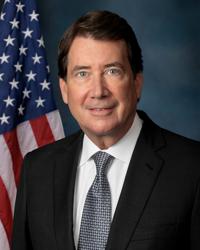
Bill Hagerty
RRepublicanTN · Senator
54
/ 100
Average
Attendance97
Avg: 97
Independence23
Avg: 23
Bipartisan Tone6
Avg: 14
Ethics Record100
Avg: 100
Transparency25
Avg: 47
Accountability Score — composite of attendance, independence, bipartisan tone, ethics record & transparency.
Methodology21
Bills Sponsored
1
Enacted into Law
0
Passed a Chamber
19
In Committee
Bills That Became Law
All Sponsored Bills
S5492In Committee
Safe Transit Act
S5252In Committee
BLADE Act
S5259In Committee
End Housing Welfare for Illegal Aliens Act
SJRES195In Committee
A joint resolution disapproving the action of the District of Columbia Council in approving the Full Accountability in Arrest Reporting Temporary Amendment Act of 2026.
Congress is considering blocking a new Washington D.C. law about how police departments report arrest information, which the D.C. City Council recently approved. If passed, this resolution would overturn that local law and prevent it from taking effect. The measure affects how D.C. police handle and disclose arrest data to the public.
SJRES194In Committee
A joint resolution disapproving the action of the District of Columbia Council in approving the Body-Worn Camera Transparency for Use of Force Temporary Amendment Act of 2026.
Congress would reject a new Washington D.C. law that requires police to release body camera footage when officers use force against people. The D.C. Council had approved this transparency measure, but this resolution would block it from taking effect, preventing the public from easily accessing videos of police force incidents in the nation's capital. The decision would affect D.C. residents, police departments, and anyone seeking accountability for law enforcement actions in the district.
S4265In Committee
Freedom to Build Act
Without specific subjects listed, this bill likely aims to reduce regulations or barriers that slow down construction and housing development projects. Based on its referral to the Banking, Housing, and Urban Affairs Committee, it probably affects builders, developers, and people trying to buy or build homes by streamlining permitting processes or loosening zoning restrictions. The bill's intent appears to be making it easier and faster to construct new buildings and housing.
S4198In Committee
Main Street Depositor Protection Act
This bill would protect deposits at smaller community banks by ensuring that depositors have insurance coverage for their money even if the bank fails, likely expanding or clarifying existing federal deposit insurance protections. The measure aims to give customers of local and regional banks greater peace of mind that their savings are safe, which could help these smaller financial institutions compete with larger national banks. Community banks and their customers would be the primary beneficiaries of this protection.
SRES652Introduced
A resolution recognizing the importance of the United States-Japan Alliance and welcoming the visit of Prime Minister Takaichi Sanae to the United States.
Congress is formally expressing support for the strong partnership between the United States and Japan and officially welcoming Japan's Prime Minister Takaichi Sanae to visit the country. This symbolic resolution affirms the importance of the U.S.-Japan alliance to American lawmakers and recognizes the diplomatic relationship between the two nations. The resolution passed unanimously in the Senate without any changes.
S2999In Committee
Main Street Depositor Protection Act
This bill would protect deposits at smaller community banks and credit unions by ensuring that depositors' money is fully insured even if the bank fails, likely by expanding or clarifying federal deposit insurance coverage beyond current limits. The measure aims to help Main Street businesses and individuals who rely on local financial institutions feel more secure keeping their money in these banks rather than moving it to larger national banks. Community banks and their customers would be the primary beneficiaries of this protection.
S3290In Committee
Financial Services and General Government Appropriations Act, 2026
Financial Services and General Government Appropriations Act, 2026 This bill provides FY2026 appropriations for several federal departments and agencies, including the Department of the Treasury, the Executive Office of the President, the judiciary, the District of Columbia, and several independent agencies. The independent agencies funded in the bill include the Administrative Conference of the United States, the Commodity Futures Trading Commission, the Consumer Product Safety Commission, the Council of the Inspectors General on Integrity and Efficiency, the Election Assistance Commission, the Federal Communications Commission, the Federal Deposit Insurance Corporation, the Federal Election Commission, the Federal Labor Relations Authority, the Federal Permitting Improvement Steering Council, the Federal Trade Commission, the General Services Administration, the Harry S. Truman Scholarship Foundation, the Merit Systems Protection Board, the Morris K. Udall and Stewart L. Udall Foundation, the National Archives and Records Administration, the National Credit Union Administration, the Office of Government Ethics, the Office of Personnel Management, the Office of Special Counsel, the Privacy and Civil Liberties Oversight Board, the Public Buildings Reform Board, the Securities and Exchange Commission, the Selective Service System, the Small Business Administration, the U.S. Postal Service, and the U.S. Tax Court. The bill also sets forth requirements and restrictions for using funds provided by this and other appropriations acts.
S3129In Committee
Preventing Foreign Interference in American Elections Act
The legislation would establish new rules and requirements to prevent foreign governments and foreign-controlled organizations from interfering in U.S. elections, likely through measures such as increased transparency requirements, stronger penalties for violations, and enhanced coordination between election officials and federal agencies. The bill would affect election administrators, political campaigns, social media platforms, and federal agencies responsible for election security and national defense. By closing potential loopholes that foreign actors might exploit, the measure aims to protect the integrity of voting processes and ensure that American elections reflect the will of American voters rather than foreign influence.
S2840In Committee
Financial Exploitation Prevention Act of 2025
This bill aims to protect people from financial fraud and scams, likely by requiring banks and financial institutions to implement stronger safeguards against elder abuse, identity theft, and other forms of financial exploitation. It would probably establish new rules for how financial companies must monitor suspicious activity and report potential victims to authorities. The legislation would affect banks, credit unions, and other financial service providers that handle customer accounts and transactions.
S2553In Committee
Protect Our Communities from DUIs Act
S2368In Committee
Defending American Property Abroad Act of 2025
This bill would protect American property and investments held in foreign countries by establishing legal mechanisms and potentially imposing penalties on countries that seize or unfairly take U.S. assets without compensation. The law would likely affect American businesses, investors, and corporations operating internationally by giving them stronger tools to recover losses if their property is taken abroad. It aims to deter foreign governments from confiscating American-owned assets and ensure U.S. citizens and companies are treated fairly in international disputes.
S1582Enacted
GENIUS Act
Guiding and Establishing National Innovation for U.S. Stablecoins Act or the GENIUS Act This act establishes a regulatory framework for payment stablecoins (digital assets which an issuer must redeem for a fixed value). Under the act, only permitted issuers may issue a payment stablecoin for use by U.S. persons, subject to certain exceptions and safe harbors. Permitted issuers must be a subsidiary of an insured depository institution, a federal-qualified nonbank payment stablecoin issuer, or a state-qualified payment stablecoin issuer. Permitted issuers must be regulated by the appropriate federal or state regulator. Permitted issuers may choose federal or state regulation; however, state regulation is limited to those with a stablecoin issuance of $10 billion or less. Permitted issuers must maintain reserves backing the stablecoin on a one-to-one basis using U.S. currency or other similarly liquid assets, as specified. Permitted issuers must also publicly disclose their redemption policy and publish monthly the details of their reserves. The act specifies requirements for (1) reusing reserves; (2) providing safekeeping services for stablecoins; and (3) supervisory, examination, and enforcement authority over federal-qualified issuers. The act allows foreign issuers of stablecoins to offer, sell, or make available in the United States stablecoins using digital asset service providers, subject to requirements, including a determination by the Department of Treasury that they are subject to comparable foreign regulations. Under the act, permitted payment stablecoins are not considered securities or commodities under law. However, permitted issuers are subject to the Bank Secrecy Act for anti-money laundering and related purposes. (Sec. 3) This section establishes that only payment stablecoin issuers permitted under this act are allowed to issue a payment stablecoin in the United States. Knowing violations of this requirement shall be subject to a fine of up to $1 million for each violation, up to 5 years imprisonment, or both. Treasury may issue regulations establishing limited safe harbors from this requirement that are consistent with the act's purposes, limited in scope, and apply to a de minimus volume of transactions. Three years after the date of enactment, digital asset service providers are prohibited from offering or selling stablecoins that are not issued by permitted issuers. Providers are also prohibited from offering, selling, or otherwise making available in the United States a foreign-issued payment stablecoin, unless it complies with requirements provided in section 18 of the act. (Sec. 4) This section establishes requirements for permitted issuers. Issuers must maintain reserves on a one-to-one basis. Reserves must be comprised of U.S. coins and currency; demand deposits or shares at an insured depository institution; certain Treasury acts, notes, or bonds; money received under certain repurchase agreements or reverse repurchase agreements; certain investment company securities and money market funds invested in certain approved assets on this list; similarly liquid federal assets approved by regulators; or certain listed reserves in tokenized forms. Issuers must comply with redemption requirements, such as establishing timely redemption procedures and disclosing such procedures and associated fees. Issuers must also report on the monthly composition of the issuer's reserves. These reports must be examined by a registered public accounting firm and certified by the chief executive officer and chief financial officer of the issuer. The section prohibits the rehypothecation, or reuse, of reserves with limited exceptions. Primary federal payment stablecoin regulators (federal regulators) and state payment stablecoin regulators (state regulators), where applicable, must issue regulations to implement capital requirements, liquidity reserve standards, reserve asset diversification standards, and risk management standards. Issuers are subject to the anti-money laundering and counterterrorism requirements that are applicable to financial institutions. The section sets forth requirements regarding activities of a permitted issuer, including by prohibiting issuers from providing services on the condition that a customer obtains an additional paid product or service from the issuer or a subsidiary. Large issuers (those with more than $50 billion in consolidated total outstanding issuance) must publish an audited annual financial statement in accordance with generally accepted accounting principles. The section prohibits a public nonfinancial services company from issuing payment stablecoins unless the company obtains unanimous approval from the Stablecoin Certification Review Committee. A state qualified payment stablecoin issuer with a consolidated total outstanding issuance of not more than $10 billion may opt for state regulation if such regulation is substantially similar to the federal regulatory framework under this act. If the issuance exceeds that amount, the issuer must transition to federal regulation, receive a waiver from the federal regulator to remain under state regulation, or stop issuing stablecoins until the issuance is under the threshold. (Sec. 5) This section establishes requirements for stablecoins issued by subsidiaries of insured depository institutions and certain entities chartered by the Office of the Comptroller of the Currency (OCC) to issue payment stablecoins. Federal regulators must establish an application process and a supervision framework for such entities. The section sets forth requirements for the review of applications, explanations for denials, and an appeals process. (Sec. 6) This section sets forth supervision, examination, and enforcement requirements for payment stablecoin issuers under federal supervision. The provisions include reporting on financial conditions, risk management, compliance with the act, and compliance with sanctions and anti-money laundering requirements. The section specifies that payment stablecoin issuers with less than $10 billion in consolidated total outstanding issuance are subject to federal supervision if they are not state qualified payment stablecoin issuers. The section establishes civil penalties for violations of this act that are committed by those subject to federal supervision. (Sec. 7) This section establishes state regulatory authority over issuers that qualify for and elect state regulation. The Federal Reserve Board may exercise enforcement authority over state issuers in unusual and exigent circumstances. The OCC must exercise enforcement authority over nonbank state issuers in these circumstances. (Sec. 8) This section requires foreign issuers to comply with the terms of lawful orders to be allowed to offer, sell, or make available for trading a payment stablecoin in the United States. The section sets forth enforcement and appeal provisions. Treasury may waive the prohibition against the secondary trading of foreign payment stablecoins in the United States from noncompliant foreign issuers on a case-by-case basis if certain criteria are met. (Sec. 9) Treasury must seek public comment regarding methods, techniques, or strategies for financial institutions to detect illicit activities involving digital assets and perform research and risk assessments on such methods, techniques, or strategies. Treasury must report their legislative recommendations to Congress and the Financial Crimes Enforcement Network must issue rules based on the results. (Sec. 10) This section establishes requirements for custodial or safekeeping services for payment stablecoin reserves, collateral, and the private keys used to issue stablecoins. Among other requirements, such property must be separately accounted for and not comingled with other assets of the custodian. (Sec. 11) This section addresses the treatment of payment stablecoins and stablecoin issuers in bankruptcy and insolvency proceedings, including their claim priority, conditions for an automatic stay, and the treatment of reserves as property of the estate. Federal regulators must also report on topics regarding potential insolvency proceedings of issuers. (Sec. 12) Federal regulators may, if determined necessary after an assessment, prescribe technical standards for issuers to promote compatibility and interoperability with other issuers and the broader digital finance system. (Sec. 13) This section requires regulators to issue regulations to carry out the act, with federal and state regulators and Treasury coordinating as appropriate. (Sec. 14) This section requires Treasury to study and report on nonpayment stablecoins, including endogenously collateralized payment stablecoins (a digital asset the originator of which has represented will be converted, redeemed, or repurchased for a fixed amount of monetary value and that relies solely on the value of another digital asset created or maintained by the same originator to maintain the fixed price). (Sec. 15) This section requires federal regulators to annually report on payment stablecoin activity trends, the number of payment stablecoin issuer applicants, and the potential financial stability risks to the safety and soundness of the broader financial system posed by payment stablecoin activities. (Sec. 16) This section defines authorities related to the act, such as by providing that the act does not limit the authority of a depository institution, credit union, national bank, or trust company to issue digital assets to represent deposits or shares. Federal financial regulators may not require a financial institution to include certain digital assets held in its custody as a liability on financial statements or balance sheets. (Sec. 17) This section establishes that payment stablecoins issued by permitted issuers are not securities or commodities under federal law. (Sec. 18) This section provides an exception to the act's prohibition on foreign-issued payment stablecoins. For the exception to apply, foreign issuers must be subject to regulation and supervision by a foreign country that is comparable to the requirements under this act, as determined by Treasury. The foreign issuer must also be registered with the OCC, hold sufficient reserves in a U.S. financial institution (subject to exceptions), and the country where the issuer is domiciled must not be subject to U.S. sanctions. The section sets forth requirements for Treasury's determination as to whether a foreign country has comparable regulatory and supervisory requirements, including the process of requesting a determination, the deadline for Treasury to render a decision, and the process by which Treasury may rescind a previous determination. The section also sets forth OCC registration requirements. Treasury may implement reciprocal or bilateral agreements between the United States and jurisdictions with comparable regulatory requirements. (Sec. 19) This section requires certain federal employees to disclose holdings over $5,000 of permitted payment stablecoins as part of required financial disclosures. (Sec. 20) The act takes effect on the earlier of (1) 18 months after the date of enactment, or (2) 120 days after federal regulators issue final regulations implementing the act.
S2205In Committee
Equal Representation Act
This bill likely aims to change how representation works in government, though the specific reforms aren't clear from the title alone. Based on its referral to the Homeland Security and Governmental Affairs Committee, it probably addresses issues like voting districts, congressional seats, or how different groups are represented in elected bodies. The changes would affect voters, elected officials, and potentially how political power is distributed across states or communities.
S1715In Committee
Protecting Privacy in Purchases Act
This bill would limit how financial companies and payment processors can collect, use, and share information about what people buy. It aims to give consumers more control over their purchase data and prevent companies from selling or using that information for purposes beyond processing the actual transaction. The rules would apply to banks, credit card companies, digital payment services, and other financial institutions that handle consumer purchases.
S1283In Committee
Innovate to De-Escalate Modernization Act
Innovate to De-Escalate Modernization Act This bill removes less-than-lethal projectile devices (e.g., certain TASERs) from regulation under the Gun Control Act. The term less-than-lethal projectile device means a device that (1) is not designed or intended to expel (and may not be readily converted to discharge) commonly used ammunition or projectiles exceeding a velocity of 500 feet per second; (2) is designed and intended to be used in a manner not likely to cause death or serious bodily injury; and (3) does not accept (and cannot be readily modified to accept) an ammunition feeding device. The bill also requires the Bureau of Alcohol, Tobacco, Firearms and Explosives to determine whether a device satisfies the definition of a less-than-lethal projectile device within 90 days of a request.
S985In Committee
PROTECT USA Act of 2025
Prevent Regulatory Overreach from Turning Essential Companies into Targets Act of 2025 or the PROTECT USA Act of 2025 This bill prohibits businesses integral to U.S. national interests from complying with certain foreign sustainability regulations, including the European Union's Corporate Sustainability Due Diligence Directive. Specifically, any business entity integral to U.S. national interests is barred from complying with any foreign sustainability due diligence regulation (i.e., any foreign law, regulation, or legal instrument that requires a person to assess the environmental or social impacts of its operations or value chain, take actions to address those impacts, and report on those impacts and actions). Entities covered by this bill include those that do business with any part of the federal government, including by way of federal contracts or leases. Other covered entities include those businesses organized under the laws of the United States that (1) derive at least 25% of their revenue from activities related to the extraction or production of raw materials from the earth, (2) are primarily involved in manufacturing, or (3) produce arms or other products integral to U.S. national defense. The bill prohibits adverse action against entities that comply with this prohibition and requires the President to take action in the public interest to protect such entities from an adverse action. Affected entities may bring a civil action against persons who have taken an adverse action. Penalties for violators include up to a $1 million fine and three years of ineligibility for federal awards or contracts.
S522In Committee
Credit Union Board Modernization Act
Credit Union Board Modernization Act This bill revises the required frequency of meetings held by a credit union's board of directors. Specifically, new credit unions and credit unions with a low soundness rating must meet monthly. All other credit unions must hold at least six meetings annually, with at least one meeting held during each fiscal quarter. Currently, all credit union boards must meet at least once a month.
S497In Committee
FENCE Act
Fixing Exemptions for Networks Choosing to Enable Illegal Migration Act or the FENCE Act This bill denies federal tax-exempt status under Internal Revenue Code (IRC) Section 501(c)(3) to an organization that engages in a pattern or practice of providing financial assistance, benefits, services, or other material support to individuals that such organization knows or reasonably should know are unlawfully present in the United States. However, the bill does not require an organization to verify an individual’s citizenship or immigration status, or act in violation of religious beliefs. As background, an organization may be exempt from federal income tax under IRC Section 501(c)(3) if it is organized and operated exclusively (1) for religious, charitable, scientific, literary, or educational purposes; (2) for testing for public safety; (3) for the prevention of cruelty to children or animals; or (4) to foster national or international amateur sports competition (subject to limitations). However, under current law, a tax-exempt organization may not be organized for an illegal purpose or engage in substantial illegal activity.