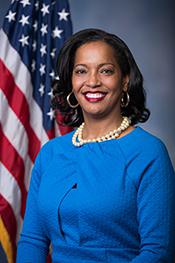
Jahana Hayes
DDemocratCT-5 · Representative
59
/ 100
Average
Attendance98
Avg: 96
Independence2
Avg: 4
Bipartisan Tone16
Avg: 15
Ethics Record100
Avg: 99
Transparency72
Avg: 53
Accountability Score — composite of attendance, independence, bipartisan tone, ethics record & transparency.
Methodology34
Bills Sponsored
0
Enacted into Law
0
Passed a Chamber
34
In Committee
All Sponsored Bills
HR10782In Committee
Clean School Bus Reauthorization Act
HR10393In Committee
WIC for Kids Act
HR9957In Committee
Time for Completion Act
The legislation would require colleges and universities to publicly report detailed information about student outcomes, such as graduation rates, employment after graduation, and earnings data, so prospective students and families can better compare schools before deciding where to attend. By making this achievement data more transparent and comprehensive, the bill aims to help students make more informed choices about their education and hold institutions accountable for their results.
HR9958In Committee
Head Start Expansion and Improvement Act of 2026
Head Start Expansion and Improvement Act of 2026 This bill reauthorizes through FY2032 and otherwise revises Head Start programs. Specifically, the bill expands eligibility for Head Start programs to include families with incomes below 138% of the federal poverty level. The bill also adds a definition for public assistance under the Head Start Act to include Temporary Assistance for Needy Families (TANF); Supplemental Security Income (SSI); the Supplemental Nutrition Assistance Program (SNAP); the Special Supplemental Nutrition Program for Women, Infants, and Children (WIC); or the Children’s Health Insurance Program (CHIP). The bill directs the Department of Health and Human Services (HHS) to establish a program to make grants to Head Start agencies (including Early Head Start agencies) to construct or improve facilities. HHS must also establish and carry out a program to make grants to Head Start agencies for increasing the compensation paid to employees. The bill also provides student loan forgiveness for certain Head Start and Early Head Start child care workers. In particular, the Department of Education must cancel the outstanding balance of principal, interest, and fees due on Federal Direct Loans for a borrower who (1) has been employed full-time by a Head Start or Early Head Start program for three years, and (2) has provided care or instruction to children enrolled in such a program.
HCONRES112In Committee
Recognizing the need to improve physical access to many federally funded facilities for all persons of the United States, particularly persons with disabilities.
This concurrent resolution recognizes that people with disabilities experience barriers to access every day and pledges to make universal and inclusive design a guiding principle for all infrastructure bills and projects.
HR9467In Committee
Green Ribbon Act of 2026
The Green Ribbon Schools Program would be expanded to help more schools across the country focus on environmental education and environmental health practices. The bill would give states more resources and support to increase the number of schools participating in the program and encourage more schools to apply for recognition. This would affect schools, students, and educators who want to integrate environmental learning and sustainable practices into their classrooms and school operations.
HR9431In Committee
Fair Telehealth Billing Act of 2026
Healthcare providers and facilities would be banned from charging separate facility fees when delivering telehealth services to patients, meaning people using virtual doctor visits would only pay for the actual medical consultation rather than additional facility charges. The change would apply to health plans covered under federal retirement and employee benefits law, potentially saving patients money on remote healthcare visits. Workers and retirees with employer-sponsored health insurance would be the primary beneficiaries of this restriction on extra fees.
HR9245In Committee
Beginning Educator Mentorship and Retention Act
The federal government would create a new grant program to help public schools develop and run programs that support new teachers and school leaders during their first few years on the job. Schools could use these grants to provide mentoring, training, and other resources to help new educators succeed and stay in the profession. The program aims to improve teacher retention and school leadership quality across the country.
HR8928In Committee
Scratch Cooked Meals for Students Act
Schools would be able to participate in a new pilot program that encourages them to prepare meals from basic ingredients rather than relying on pre-made foods, with the goal of improving nutrition and teaching students about cooking. The program would affect school cafeterias, food service workers, and students by potentially changing what meals look like and how they're prepared during the school day. Schools participating in the pilot would likely receive support or resources to help them transition to scratch cooking methods.
HR8815In Committee
Teacher Debt Relief Act
The legislation would modify rules for teachers seeking loan forgiveness programs, making it easier for educators to qualify for having their student loans cancelled or reduced after years of service. Teachers in public schools and certain nonprofit organizations would be the primary beneficiaries of these changes to federal student loan forgiveness policies.
HRES1255In Committee
Supporting the designation of the week of May 4 through May 8, 2026, as "Teacher Appreciation Week".
The proposal would officially recognize the week of May 4-8, 2026, as "Teacher Appreciation Week" to honor and celebrate teachers across the country. This designation would encourage schools, communities, and organizations to hold special events and activities during that week to acknowledge teachers' contributions to education and student development. The measure is currently under review by the House Committee on Education and Workforce.
HRES1221In Committee
Supporting the designation of the week of April 27 through May 1, 2026, as "National Specialized Instructional Support Personnel Appreciation Week".
The proposal would officially recognize the week of April 27 through May 1, 2026, as "National Specialized Instructional Support Personnel Appreciation Week" to honor school staff members who provide specialized support services to students, such as speech therapists, counselors, and special education aides. This designation would raise awareness about the important contributions these professionals make to student success and well-being in schools across the country. The recognition does not create new programs or funding, but rather designates a specific week for celebrating and acknowledging these education support workers.
HR8333In Committee
YouthBuild for the Future Act
This bill would extend and renew the YouthBuild program, which helps low-income young people ages 16-24 earn high school diplomas or GED certificates while learning job skills through paid work on community development projects. The program serves disadvantaged youth by combining education, job training, and real-world work experience to help them transition into employment or further education. The bill likely includes updates to how the program operates and may adjust funding levels or eligibility requirements.
HR8263In Committee
Educational Equity Challenge Grant Act of 2026
This bill would likely create a federal grant program that provides funding to schools and districts working to reduce educational disparities and improve outcomes for disadvantaged students. The grants would probably support initiatives like improving teacher quality, expanding access to advanced courses, or addressing resource gaps in low-income communities. Schools and districts serving students from lower-income backgrounds would be the primary beneficiaries of this funding.
HR8008In Committee
Social Determinants for Moms Act
Social Determinants for Moms Act This bill requires the Department of Health and Human Services (HHS) to establish a task force and a grant program to address social determinants of maternal health. These are nonmedical factors that impact maternal health outcomes, such as transportation, food security, and economic security. The task force, composed of federal and nonfederal stakeholders, must develop strategies and coordinate efforts to eliminate preventable maternal mortality, severe maternal morbidity, and maternal health disparities. Additionally, HHS must award grants to community-based organizations, nonprofits, tribal organizations, public health departments, or consortia of these entities to address social determinants of maternal health and eliminate disparities in maternal health outcomes.
HR7497In Committee
Supporting Trauma-Informed Education Practices Act of 2026
This bill would encourage schools to adopt trauma-informed teaching practices that recognize how students' past experiences with trauma can affect their learning and behavior. Schools using these approaches would train teachers to create safer classroom environments, respond compassionately to struggling students, and connect them with mental health support rather than relying solely on punishment. The changes would affect teachers, school administrators, and students, particularly those who have experienced abuse, violence, or other traumatic events.
HR6088In Committee
Restoring Food Security for American Families and Farmers Act of 2025
The legislation would modify federal food assistance programs and agricultural policies to increase food availability and affordability for low-income families while supporting farmers' incomes and market stability. It affects millions of Americans who rely on food stamps and nutrition assistance, as well as farmers and agricultural businesses across the country. The specific changes would be determined as the bill moves through the House Agriculture Committee.
HR6795In Committee
School MEALS Act of 2025
School Modernization and Efficient Access to Lunches for Students Act of 2025 or the School MEALS Act of 2025 This bill establishes programs and revises requirements relating to direct certification processes for the National School Lunch Program. Direct certification allows schools to use data matching procedures to approve school meals without the need for applications for children who receive assistance under other programs, such as the Supplemental Nutrition Assistance Program (SNAP). Specifically, the bill directs the Department of Agriculture to provide grants and technical assistance for states and tribal organizations to improve their direct certification processes, including with respect to children who receive assistance under a food distribution program on Indian reservations. The bill also expands the time frame for schools to elect and gather eligibility data for the Community Eligibility Provision. This provision permits schools in high-poverty areas to serve free meals to all enrolled students without the need for applications. Further, the bill specifies that a state subject to a continuous improvement plan (for not directly certifying at least 95% of children eligible for direct certification because they receive SNAP benefits) must implement the improvement measures within three years.
HR5950In Committee
Keep SNAP and WIC Funded Act of 2025
This bill would ensure that federal funding continues for SNAP (food stamps) and WIC (a nutrition program for low-income pregnant women, new mothers, and young children), protecting these benefits from being cut or eliminated. The legislation aims to guarantee that millions of Americans who rely on these programs to buy groceries and feed their families maintain access to this assistance. The bill has been sent to the House Committee on Appropriations, which handles decisions about federal spending.
HR5112In Committee
Tipped Worker Protection Act
This bill would change how tipped workers are paid by requiring employers to pay them a higher base wage rather than relying on tips to make up the difference, and would likely increase the federal minimum wage for tipped employees who currently can earn as little as $2.13 per hour. The legislation would affect millions of restaurant servers, bartenders, and other service workers across the country, as well as the businesses that employ them. The bill is currently being reviewed by two congressional committees to determine how it would impact labor standards and tax policy.
HCONRES45In Committee
Recognizing the need to improve physical access to many federally funded facilities for all people of the United States, particularly people with disabilities.
The federal government would be required to improve physical access at buildings and facilities it funds or operates so that people with disabilities can enter and use them more easily. This could involve adding ramps, elevators, accessible bathrooms, and other modifications to make sure everyone, regardless of disability, can access these public spaces. The bill affects federal agencies, contractors who manage government buildings, and millions of Americans with disabilities who currently face barriers when trying to use federally funded facilities.
HR4133In Committee
EQIP Improvement Act of 2025
EQIP Improvement Act of 2025 This bill modifies payment limitations and reduces the federal cost share and required payments for certain projects authorized under the Environmental Quality Incentives Program (EQIP). As background, this Department of Agriculture program provides technical and financial assistance to agricultural producers and forest landowners to address natural resource concerns. Specifically, the bill limits the total payments available to a person or legal entity under EQIP to $150,000 over a specified five-year period. (A $450,000 statutory limit was in effect for FY2019-FY2024, and a regulatory contract limit of $450,000 currently applies.) The bill also reduces the maximum federal cost share to 40% (from 75%) for the costs associated with planning, installation, or maintenance for specified conservation practices (e.g., access roads, dams, and waste storage facilities) and removes a requirement that 50% of EQIP funding for payments go to practices related to livestock production.
HR2055In Committee
Caring for Survivors Act of 2025
Caring for Survivors Act of 2025 This bill increases the monthly rate of dependency and indemnity compensation payable to surviving spouses through the Department of Veterans Affairs (VA). Dependency and indemnity compensation is a monthly payment made to eligible survivors (i.e., spouses, parents, or children) of (1) certain veterans who died as a result of a service-connected condition; (2) service members killed while on active military duty or active or inactive duty for training; or (3) veterans who did not die from a service-connected condition, but were totally disabled by a service-connected disability for a certain period of time. The bill also (1) reduces, from 10 years to 5 years, the period of time that certain veterans must have been rated totally disabled due to a service-connected disability in order for a survivor to qualify for benefits; and (2) specifies the amount that is payable to survivors of veterans who were rated totally disabled for a period of less than 10 years before their death.
HR3968In Committee
School Violence Prevention Act
HR3442In Committee
SNAP Administrator Retention Act of 2025
SNAP Administrator Retention Act of 2025 This bill directs the Food and Nutrition Service (FNS) to pay Supplemental Nutrition Assistance Program (SNAP) state agencies for 100% of SNAP administrative personnel costs. The bill also requires that state SNAP agency administrators be paid at least the same amount as federal employees. (Under current law, FNS generally pays 50% of a state's administrative costs for SNAP.) Specifically, FNS must pay a state agency for 100% of all SNAP administrative personnel costs that are part of an FNS-approved state agency personnel wage plan. This must include all costs associated with hiring and training new employees, maintaining those personnel costs, and complying with wage standards. The state agency must use these funds (1) to supplement, not supplant, nonfederal funds used for existing administrative personnel costs; and (2) for existing or additional full-time positions that are above the number of positions that were held in FY2024. The bill also requires that the wage standards for SNAP state agency administrators be (1) at least the same amount as the General Schedule (GS) pay rate for federal employees; and (2) updated annually based on any increase in the GS pay rate, including locality adjustments.
HRES380In Committee
Supporting the designation of the week of May 5 through May 9, 2025, as "Teacher Appreciation Week".
The proposal would officially recognize the week of May 5-9, 2025, as "Teacher Appreciation Week" to honor and celebrate teachers across the country. This designation is largely symbolic and encourages schools, communities, and individuals to acknowledge the important work teachers do in educating students. The measure has been sent to the House Committee on Education and Workforce for consideration.
HRES355In Committee
Supporting the designation of the week of April 28 through May 2, 2025, as "National Specialized Instructional Support Personnel Appreciation Week".
The proposal would officially recognize the week of April 28 through May 2, 2025, as "National Specialized Instructional Support Personnel Appreciation Week" to honor school staff members like speech therapists, counselors, psychologists, and special education aides who provide targeted support to students with disabilities and special needs. This designation would raise awareness about the important work these professionals do in helping students succeed academically and socially. The recognition would apply nationally but does not create any new programs or funding.
HR2435In Committee
Save Our Small Farms Act of 2025
This bill aims to help small farms stay in business by likely providing financial assistance, reducing regulatory burdens, or improving access to credit and markets for family-owned agricultural operations. The legislation would affect small farmers and rural communities that struggle to compete with large industrial agriculture operations. The bill is currently being reviewed by a House subcommittee focused on farm support programs and agricultural financing.
HRES297In Committee
Expressing the sense of the House of Representatives that paraprofessionals and education support staff should have fair compensation, benefits, and working conditions.
This resolution expresses the House's view that school paraprofessionals and support staff—such as teacher's aides, cafeteria workers, and custodians—deserve fair pay, health benefits, and safe working conditions. While the resolution itself doesn't create new laws or funding, it signals congressional support for improving how schools treat and compensate these workers who help keep schools running day-to-day.
HR2195In Committee
Feed Hungry Veterans Act of 2025
Feed Hungry Veterans Act of 2025 This bill expands eligibility for the Supplemental Nutrition Assistance Program (SNAP) for certain disabled veterans, including those determined to be catastrophically disabled. In addition, those disabled veterans who are eligible for SNAP under this bill are exempt from the general SNAP work registration and employment and training requirements. The bill takes effect on October 1, 2030.
HR680In Committee
Caring for Survivors Act of 2025
Caring for Survivors Act of 2025 This bill increases the monthly rate of dependency and indemnity compensation payable to surviving spouses through the Department of Veterans Affairs (VA). Dependency and indemnity compensation is a monthly payment made to eligible survivors (i.e., spouses, parents, or children) of (1) certain veterans who died as a result of a service-connected condition; (2) service members killed while on active military duty or active or inactive duty for training; or (3) veterans who did not die from a service-connected condition, but were totally disabled by a service-connected disability for a certain period of time. The bill also (1) reduces, from 10 years to 5 years, the period of time that certain veterans must have been rated totally disabled due to a service-connected disability in order for a survivor to qualify for benefits; and (2) specifies the amount that is payable to survivors of veterans who were rated totally disabled for a period of less than 10 years before their death.
HRES119In Committee
Declaring racism a public health crisis.
This resolution declares racism a public health crisis and supports efforts to address health disparities and inequities across all sectors.
HR777In Committee
Closing the College Hunger Gap Act
Closing the College Hunger Gap Act This bill requires the Department of Education (ED) to send information regarding potential eligibility for assistance under the Supplemental Nutrition Assistance Program (SNAP) to certain college students. Specifically, ED must send this information, in both written and electronic form, to a student who submits the Free Application for Federal Student Aid (FAFSA) and has a negative or zero student aid index for the year. ED must also provide the student with contact information for the state agency that administers SNAP in the state in which the student resides. ED must consult with the Department of Agriculture and other applicable federal or state agencies to design the written and electronic communications regarding potential SNAP eligibility and the SNAP application process.
HR433In Committee
Department of Education Protection Act
Department of Education Protection Act This bill prohibits the use of appropriated funds made available to the Department of Education (ED) to decentralize, reduce the staffing level of, or alter the responsibilities or functionality of ED compared to its organization or operation on January 1, 2025.