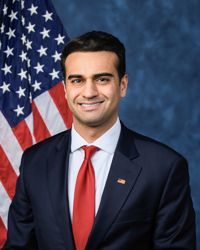
Abraham J. Hamadeh
RRepublicanAZ-8 · Representative
56
/ 100
Average
Attendance99
Avg: 96
Independence5
Avg: 4
Bipartisan Tone15
Avg: 15
Ethics Record100
Avg: 99
Transparency45
Avg: 53
Accountability Score — composite of attendance, independence, bipartisan tone, ethics record & transparency.
Methodology25
Bills Sponsored
0
Enacted into Law
3
Passed a Chamber
22
In Committee
All Sponsored Bills
HR10495In Committee
CATFISH Act of 2026
HR3393Passed House
To designate the facility of the United States Postal Service located at 12208 North 19th Avenue in Phoenix, Arizona, as the "Officer Zane T. Coolidge Post Office".
This bill designates the facility of the United States Postal Service located at 12208 North 19th Avenue in Phoenix, Arizona, as the "Officer Zane T. Coolidge Post Office".
HR8481Passed House
Kayleigh’s Law Act of 2026
Kayleigh’s Law Act of 2026 This bill establishes a federal statutory framework to require federal courts to issue an order prohibiting contact with a victim (i.e., a no-contact order) in the case of a defendant who is convicted of certain violent crimes or sex crimes. Specifically, in the case of a defendant convicted of a felony offense that is a crime of violence or that involves a sexual act or sexual conduct, on a motion by the victim or federal government, the court must issue a no-contact order. Under the framework, the no-contact order must be imposed at sentencing and be in effect for the lifetime of the defendant unless it is terminated or suspended in accordance with specified procedures. Additionally, no fee may be assessed or collected from a victim in connection with the issuance of a no-contact order.
HR10155In Committee
To amend title 10, United States Code, to include certain prior active duty as a regular member of an Armed Force for reduced eligibility age for retirement as a member of the reserve components.
HR10091In Committee
Mueller-Keating Memorial Highway Act
HRES1478In Committee
Expressing the sense of the House of Representatives regarding United States policy recognizing the Simele Massacre of 1933.
HR9780In Committee
BRRRRT Act of 2026
The military would be required to follow specific rules about what to do with its A-10 aircraft, including how to get rid of them, keep important ones in working condition, and keep track of what planes exist and where they are. The bill also gives Congress oversight to make sure the Defense Department handles these aircraft according to the requirements set out in the legislation. This affects military operations and budget decisions related to one of the Air Force's main combat aircraft.
HRES1421In Committee
Impeaching Sparkle L. Sooknanan, a Judge of the United States District Court for the District of Columbia, for high crimes and misdemeanors.
This resolution would remove Judge Sparkle L. Sooknanan from her position on the federal court in Washington, D.C., based on allegations of serious misconduct or crimes. The House Judiciary Committee would investigate the charges and determine whether to recommend impeachment to the full House of Representatives, which would need to vote on whether to proceed with removal. If approved by the House and convicted by the Senate, the judge would be permanently removed from office.
HR9547In Committee
Veterans and Servicemembers PTSD Emerging Treatment Review Act of 2026
The Department of Defense would be required to study and report to Congress on new experimental treatments for post-traumatic stress disorder (PTSD) that don't respond to standard therapies, focusing on what's available for veterans, active-duty military members, and those leaving the military. This report would help lawmakers understand what cutting-edge treatment options exist and how accessible they are to service members struggling with severe PTSD. The goal is to identify promising new approaches that could help veterans who haven't found relief through conventional treatment methods.
HR9465In Committee
Combat Pay Protection Act
Military members would receive a one-time pay increase to correct past underpayments in special and incentive pay categories, along with automatic annual adjustments going forward to keep these bonuses competitive. This affects service members in the Army, Navy, Air Force, Marines, and Coast Guard who receive extra pay for hazardous duties, special skills, or other incentivized roles. The goal is to ensure military compensation stays fair and helps the armed forces recruit and retain qualified personnel.
HR9241In Committee
No Equipment Left Behind Act of 2026
The military would be required to better track and account for equipment and supplies in overseas combat zones to prevent loss, theft, or misuse of government property. This would involve stricter reporting requirements and oversight procedures for how the Department of Defense manages valuable assets like weapons, vehicles, and supplies in active war theaters. The changes aim to ensure taxpayer money is spent responsibly and that critical military equipment is properly accounted for.
HR9242In Committee
No American Left Behind Act
The Department of Defense would be required to report to Congress on efforts to recover American citizens who are missing or held in foreign countries. The report would provide details on the status of these cases and any actions being taken to bring these individuals home. This affects families of missing Americans and gives Congress oversight of military recovery operations.
HR9027In Committee
Military and Veterans Fuel Discount Act of 2026
The proposal would provide discounts on fuel purchases for active-duty military members, veterans, and their families at participating gas stations and fuel retailers across the country. The discount program aims to reduce transportation costs for these groups as a benefit for their military service. Eligible individuals would likely need to show military ID or veteran status to receive the reduced fuel prices.
HR7103In Committee
Improving Emerging Tech Opportunities for Veterans Act
The bill would help veterans transition into careers in emerging technologies like artificial intelligence, cybersecurity, and advanced manufacturing by creating training programs, education benefits, and job placement services tailored to their military experience. Veterans would gain access to specialized certifications and apprenticeships in high-demand tech fields, while companies hiring veterans in these roles could receive support or incentives. The goal is to connect the technical skills many veterans already have with growing job opportunities in the tech sector.
HRES1220In Committee
Condemning the attempted assassination of President Donald J. Trump on April 25, 2026, condemning the multiple attempts against the President's life, and recognizing the critical mission of the Department of Homeland Security.
Congress would formally condemn an assassination attempt against President Trump and recognize the importance of the Department of Homeland Security's work protecting the president and the nation. The resolution expresses disapproval of violence against the president and affirms support for the agency responsible for presidential security. This is a symbolic statement rather than a law that changes policy or creates new requirements.
HR8331In Committee
Maverick Act
Without specific subjects listed for this bill, it likely addresses military or defense policy given its referral to the House Armed Services Committee. The bill's name suggests it may authorize unconventional or independent military approaches, though the exact provisions affecting service members, defense contractors, or military operations cannot be determined from the title alone. More details would be needed to explain what specific changes it would make.
HR6861In Committee
Consolidating Veteran Employment Services for Improved Performance Act
Consolidating Veteran Employment Services for Improved Performance Act This bill transfers specified programs from the jurisdiction of the Department of Labor to the Department of Veterans Affairs (VA) and establishes the Office of the Deputy Under Secretary for Veterans Economic Opportunity and Transition to implement such programs. Specifically, the bill transfers to the VA (1) job counseling, training, and placement services for veterans, (2) federal government employment services for veterans, (3) administration of employment and reemployment rights of members of the uniformed services, and (4) homeless veterans reintegration programs. The VA must include funding requests for such programs in its budget request for FY2028 and each subsequent year. The transfer of such programs does not affect any suits, proceedings or applications for benefits, services, licenses, permits, certificates, or financial assistance that are pending on the date of the enactment of this bill. The Office of Management and Budget is authorized to determine the functions (e.g., duties) that are transferred under this bill, and may make additional incidental dispositions of personnel, assets, liabilities, grants, contracts, property, records, and unexpended balances as may be necessary to implement this bill. The bill also (1) modifies state responsibilities regarding the employment of full or part-time veterans’ employment specialists (currently known as veteran employment representatives), and (2) expands the purpose and responsibilities of such specialists. The VA and Labor must jointly conduct a study and report on the implementation of the transfer of programs and functions and amendments made by this bill.
HR6794In Committee
VA Medical Center Facility Transparency Act
This bill would require the Department of Veterans Affairs to publicly disclose information about the condition, maintenance needs, and operations of VA medical facilities so veterans and the public can see which hospitals and clinics need repairs or improvements. The transparency would help Congress and veterans' advocates identify which VA facilities are struggling and may need additional funding or resources. Veterans and their families would benefit by having clearer information about the quality and readiness of the medical centers where they receive care.
HR7102In Committee
Federal Workforce Civics Competency and Accountability Act
This bill would require federal employees to demonstrate knowledge of civics and American government principles, likely through testing or training requirements. The legislation aims to ensure that people working in government understand how the political system functions and their role within it, affecting hundreds of thousands of federal workers across all agencies.
HR6643In Committee
American Border Story Memorial Act
This bill would establish a memorial on public lands to commemorate the history and experiences of people affected by border-related events and policies. The memorial would likely be located in a southwestern state and would serve as a place for visitors to learn about and reflect on border-related stories and experiences. The bill affects public land management agencies and communities near the U.S. border.
HR6190In Committee
Tax Cuts for Veterans Act of 2025
This bill would provide tax breaks to military veterans, likely through reduced tax rates, deductions, or credits on their income or other taxes. The changes would put more money back in veterans' pockets by lowering what they owe to the federal government. The proposal is currently being reviewed by the House committee that handles tax policy.
HR3767Passed House
Health Professionals Scholarship Program Improvement Act of 2025
Health Professionals Scholarship Program Improvement Act of 2025 or the HPSP Improvement Act of 2025 This bill requires, through FY2027, the Department of Veterans Affairs (VA) to ensure a participant in the Health Professionals Scholarship program receives a contract for employment within 90 days of the completion of their courses. The program provides financial assistance to students in a direct or indirect health care services discipline in exchange for service in the Veterans Health Administration. The contract must offer employment in the full-time clinical practice of the participant’s profession at a VA facility with the highest need.
HR2499In Committee
To codify Executive Order 14248, entitled "Preserving and Protecting the Integrity of American Elections".
This bill provides statutory authority for an executive order that restricts voting in federal elections. Executive Order 14248, titled Preserving and Protecting the Integrity of American Elections, was signed by President Donald Trump on March 25, 2025. Specifically, the order directs the Election Assistance Commission (EAC) to update the national mail voter registration form to require individuals to provide documentary proof of U.S. citizenship when registering to vote in federal elections. The order specifies what documents are considered acceptable proof of U.S. citizenship, such as a U.S. passport or identification that complies with the REAL ID Act of 2005 and indicates U.S. citizenship. Additionally, the order directs the EAC to (1) revise the most recent version of the Voluntary Voting System Guidelines (which was adopted by the EAC in 2021) to prohibit voting systems that use a barcode or quick-response code in the vote counting process; and (2) review and, if appropriate, recertify voting systems under the new standards established in the order and rescind all previous certifications of voting equipment based on prior standards. The order directs the Department of Justice (DOJ) to enforce federal election law against states that do not adopt an interpretation requiring mail-in ballots to be received, rather than sent, by Election Day to be counted. The order addresses additional issues, including state election database access by the federal government, conditions for federal election funding, and additional requirements for DOJ to enforce federal election law.
HRES167In Committee
To establish uniform standards for flag displays in the House of Representatives facilities.
This bill would create consistent rules for how flags are displayed throughout House of Representatives office buildings and meeting spaces. The standards would likely cover things like which flags can be flown, where they should be placed, and how they should be maintained, ensuring a uniform appearance across all congressional facilities. This affects House members, staff, and visitors who use these buildings.
HRES110In Committee
Prohibiting the distribution of Chinese Communist Party-controlled publications within House facilities, and for other purposes.
This resolution prohibits the Office of the Chief Administrative Officer of the House of Representatives from accepting, distributing, or delivering Chinese Communist Party-controlled publications (e.g., China Daily).