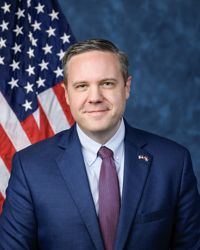
Jeff Hurd
RRepublicanCO-3 · Representative
52
/ 100
Average
Attendance99
Avg: 96
Independence3
Avg: 4
Bipartisan Tone4
Avg: 15
Ethics Record100
Avg: 99
Transparency41
Avg: 53
Accountability Score — composite of attendance, independence, bipartisan tone, ethics record & transparency.
Methodology24
Bills Sponsored
1
Enacted into Law
5
Passed a Chamber
17
In Committee
Bills That Became Law
All Sponsored Bills
HR10758In Committee
Veterans Outdoor Rehabilitation Act
HR5631Passed House
Geothermal Energy Advancement Act
Geothermal Ombudsman for National Deployment and Optimal Reviews Act This bill establishes a geothermal ombudsman and task force to oversee geothermal project permitting and authorizations on federal land. The Department of the Interior must appoint a geothermal ombudsman from within the Bureau of Land Management (BLM). The ombudsman must act as a liaison among different parts of BLM, provide dispute resolution services between BLM and geothermal project applicants, and facilitate permit processing in different BLM field offices regarding geothermal projects on federal land. The ombudsman must also lead the Geothermal Permitting Task Force established by this bill. The task force must support the ombudsman’s duties. Through the task force, the ombudsman may reassign employees from other Interior bureaus or offices to assist in the completion of geothermal authorizations. The ombudsman may pay a retention allowance to reassigned employees.
HR3857Passed House
Snow Water Supply Forecasting Program Reauthorization Act of 2026
Snow Water Supply Forecasting Reauthorization Act of 2025 This bill reauthorizes through FY2031 and modifies the Snow Water Supply Forecasting Program of the Bureau of Reclamation. Under the existing program, Reclamation implements activities to improve snowpack measurements used for water supply forecasts in certain western states. The bill directs Reclamation to incorporate, to the greatest extent practicable, information from technologies that provide complete integration of accurate, timely, and spatially complete snowpack measurements and models when determining water supply forecasts or allocations to federal water contractors. Additionally, the bill requires the program's framework to emphasize the deployment of technologies that provide integration of snowpack measuring and modeling. The bill also requires the program's focus—activities that maintain, establish, expand, or advance snowpack measurement and integrated modeling—to place an emphasis on (1) enhancing activities to achieve improved snow and water supply forecasting results that are more responsive to changing weather and watershed conditions, (2) real-time integration of measurement and modeling activities with water supply forecasts, (3) activities in river basins where measurements or modeling can produce snow and water supply data to inform water management decisions, and (4) building the capacity of the program partners to implement and adapt to the new measurement and forecast capabilities.
HR10411In Committee
To direct the Secretary of Agriculture to consider certain acreage not planted due to a lack of irrigation water to be eligible for prevented planting payments, and for other purposes.
HR7954Reported
Don Young Doug LaMalfa Indian Buffalo Management Act
This bill would establish a program allowing Native American tribes to manage buffalo herds on federal lands, giving tribes more control over wildlife conservation and hunting practices on their territories. The legislation aims to support tribal sovereignty and cultural traditions by letting Native communities participate directly in decisions about buffalo populations rather than having the federal government make those decisions alone. The bill has been sent to the House Committee on Natural Resources for review.
HRES1446In Committee
Honoring the lives and service of Emily Barker, Nick Hutcherson, Sydney Watson, Nicholas Dale, and all those who serve on the front lines of America's wildland firefighting efforts.
This resolution honors wildland firefighters, including Emily Barker, Nick Hutcherson, Sydney Watson, and Nicholas Dale, who risk their lives fighting wildfires across America. The measure recognizes the dangerous work these firefighters perform on the front lines and acknowledges their service to protect communities and public lands. It has been referred to the House Committee on Oversight and Government Reform for consideration.
HR9826In Committee
Glenwood Hot Springs Protection Act
The federal government would be prevented from allowing a limestone quarry near Glenwood Springs, Colorado to expand its operations or increase its size. This would affect the quarry's owners and operators who want to grow the business, as well as communities in the area concerned about environmental impacts like dust, noise, and land use changes. The measure is currently under review by the House Committee on Natural Resources.
HR9646In Committee
Quantum-Enhanced Critical Minerals Mapping Act of 2026
The federal government would use advanced quantum technology to map and identify critical minerals like lithium, cobalt, and rare earths that are essential for batteries, electronics, and defense equipment. This survey would help the U.S. reduce its dependence on foreign sources for these materials by better understanding where domestic supplies are located. Mining companies, manufacturers, and policymakers would benefit from more accurate information about America's mineral resources.
HR9248In Committee
Recreation Permitting Improvement Act
The proposal would expand federal permitting rules to cover certain recreational activities and projects, making it easier and faster for companies and organizations to get the approvals they need from the government. This could affect outdoor recreation businesses, national parks, and other entities that need federal permits for activities like hiking trails, campgrounds, or water sports facilities. The bill is still in early stages and has been sent to the House Committee on Natural Resources for review.
HR9407In Committee
SPIRIT Act
Small distillery owners would receive a tax credit for purchasing ingredients and materials produced in the United States, making it cheaper for them to source domestically rather than importing supplies. The credit would help small distilleries reduce their tax bills when they buy American-made grains, barrels, bottles, and other production materials. This incentive is designed to support both small distillery businesses and American suppliers of distillery materials.
HR8954In Committee
Tribal Regulatory Reform Implementation Act of 2026
The proposal would shift some administrative duties related to tribal business and regulatory matters from their current handlers to the Secretary of the Interior, the federal official who oversees Native American affairs and tribal lands. This change would affect how Native American tribes manage their business development and regulatory processes, potentially streamlining decision-making by centralizing these responsibilities within the Interior Department. The bill is currently under review by the House Committee on Natural Resources.
HR5911Passed House
Crystal Reservoir Conveyance Act
Crystal Reservoir Conveyance Act This bill directs the Forest Service to convey specified property and water rights in Ouray County, Colorado, to the City of Ouray, Colorado, for use as open space for recreational activities (such as fishing) at no cost to the public. The property and water rights include the site known as Crystal Reservoir and the associated lake and infrastructure, Full Moon Dam and the associated facilities, and the approximately 45-acre parcel of land underlying and surrounding Crystal Reservoir. The conveyance must (1) convey fee simple title to the land; (2) be subject to existing valid rights and easements; and (3) be completed at no cost to the city, except for costs related to necessary surveys. The conveyance must also be subject to a reversionary interest whereby if the land is used in a manner that violates the conveyance, the land shall revert to the United States, subject to the discretion of the Forest Service. In addition to holding the land open to the public for recreational purposes, the city must assume responsibly for Full Moon Dam and must not conduct unneeded development or commercial operations, nor alter Crystal Reservoir in a manner that would harm wetlands located upstream, subject to certain conditions. After the completion of this conveyance, the Forest Service must recognize a perpetual easement for the site known as Red Mountain Ditch for use by the city for specified activities related to Crystal Reservoir.
HR8688In Committee
Forest Health and Wildfire Risk Reduction Act
The federal government would officially allow the Bureau of Land Management to modify tree density on public lands without conducting lengthy environmental reviews, based on procedures announced in April 2026. This change would speed up forest management projects on federal property by treating certain tree-thinning activities as routine actions that don't require the same environmental analysis as major projects. The change affects public lands managed by the Bureau of Land Management and could impact timber companies, environmental groups, and communities near federal forests.
HR8461In Committee
Western Tribal Water Act of 2026
The proposal would extend and renew federal funding for a program that helps American Indian tribes improve drinking water systems on their reservations. Native American communities would receive continued support to build, repair, and maintain safe water infrastructure on tribal lands. The bill is currently being reviewed by two congressional committees to determine how to move forward.
HR8257In Committee
Small County PILT Parity Act
This bill would adjust how the federal government distributes payments to small counties that contain federal lands, aiming to make the funding formula fairer for less populated areas. Counties that host national forests, parks, and other federal property receive annual payments to offset lost tax revenue, and this legislation would modify those payments to better account for the needs of smaller counties. The changes would affect rural county budgets and services in areas with significant federal land ownership.
HR7342Passed House
Made in America Jobs Act of 2026
Made in America Jobs Act of 2026 This bill expands the criteria for various grants under the Economic Development Administration's public works program to include projects that facilitate the relocation of employment opportunities into the United States or the growth of the manufacturing sector. Specifically, the bill modifies grants for (1) public works and economic development; (2) planning and administrative expenses; (3) training, research, and technical assistance; and (4) regions experiencing adverse economic changes.
HR7811In Committee
Responsible Containment Reauthorization Act
This bill would reauthorize federal programs related to containing and managing energy-related risks or hazards, likely focusing on nuclear waste storage, oil spill prevention, or similar containment infrastructure. The legislation would extend funding and authority for existing containment initiatives that have expired or are set to expire, affecting energy companies, government agencies, and potentially communities near energy facilities. By reauthorizing these programs, Congress would maintain oversight and resources for protecting public safety and the environment from energy-related accidents or leaks.
HR2600Passed House
ASCEND Act
Accessing Satellite Capabilities to Enable New Discoveries Act or the ASCEND Act This bill provides statutory authority for the Commercial SmallSat Data Acquisition (CSDA) program run by the National Aeronautics and Space Administration (NASA). Through the CSDA program, NASA acquires remote sensing data and imagery from commercial satellites to support its Earth science research. ( Remote sensing generally refers to the collection of data by instruments in Earth’s orbit, such as satellites, that can be processed into imagery of Earth’s surface.) Under the bill, NASA may establish or modify end-use agreements to allow for broad use of data and imagery acquired under the program, including by individuals outside of NASA (e.g., other federal agencies). The terms of any data or imagery acquisition may not prevent the publication of such data or imagery for scientific purposes or the publication of information derived from it. To the extent practicable, NASA must acquire such data and imagery from U.S. vendors.
HR2316Enacted
Wetlands Conservation and Access Improvement Act of 2025
Wetlands Conservation and Access Improvement Act of 2025 This act extends until FY2033 a requirement for the interest earned on certain funds held in the Federal Aid to Wildlife Restoration Fund to be distributed to states for carrying out certain wildlife conservation and restoration programs. Specifically, the act extends the period in which the interest earned on revenue generated from excise taxes on certain firearms, ammunition, and archery equipment must be used for wildlife conservation and restoration programs established under the North American Wetlands Conservation Act. This requirement was set to expire at the beginning of FY2026. In the absence of this requirement, this funding would be distributed to states, according to a formula, for (1) wildlife restoration, (2) hunter education and safety, (3) multistate conservation grants, and (4) administrative costs.
HR6168In Committee
Airport TIFIA Financing Certainty Act
This bill would make it easier for airports to borrow money for construction and improvement projects by providing more certainty about how federal loan programs work. The changes would help airport operators plan major upgrades to terminals, runways, and other facilities by clarifying the rules and timelines for federal financing assistance. Travelers and communities with airports would benefit from faster infrastructure improvements, while airports would have clearer expectations about accessing federal funding.
HR4500In Committee
HELP Act
Hauling Exemptions for Livestock Protection Act or the HELP Act This bill exempts livestock hauling vehicles and the vehicle operators from hours of service and electronic logging device (ELD) requirements. The exemption applies to a hauling vehicle carrying livestock (i.e., livestock, insects, or aquatic animals) and to a vehicle that is picking up or returning from delivering livestock (i.e., an unladen vehicle). Under current law, Federal Motor Carrier Safety Administration rules limit how many hours most commercial truck drivers can drive and work and requires a vehicle to be equipped with an ELD, which tracks how long a vehicle has been driving. Limited exemptions exist, including for livestock hauling.
HR4501In Committee
Holy Sovereignty Protection Act
Holy Sovereignty Protection Act This bill provides that the U.S. citizenship of an individual elected as the Supreme Pontiff of the Roman Catholic Church may not be revoked and exempts such individual from federal income taxes for tax years during which the individual serves in such role for any part of the tax year. (As background, the income of a U.S. citizen generally is subject to U.S. income tax regardless of where such income is earned or received or where the individual resides.)
HR1997In Committee
Productive Public Lands Act
This bill would likely change how federal lands are managed to increase activities like logging, mining, or energy development while potentially reducing environmental protections. It would affect companies in natural resource industries, outdoor recreation businesses, environmental groups, and communities that depend on public lands for hunting, fishing, or tourism. The specific details of what "productive" means and which lands would be affected depend on the bill's full text, which is still being reviewed by Congress.
HR1315In Committee
Gold King Mine Spill Compensation Act of 2025
Gold King Mine Spill Compensation Act of 2025 This bill authorizes and provides funding for compensation for certain homeowners, livestock grazers, farmers, and companies who suffered damages as a result of the Gold King Mine spill on August 5, 2015, in southwest Colorado. To be eligible for compensation, a homeowner, livestock grazer, farmer, or company (1) must have submitted an administrative claim to the Environmental Protection Agency on or before August 5, 2017, that was denied or not fully compensated; and (2) must not have entered a settlement with the United States for an amount exceeding $2,500. Under the bill, covered damages include lost business income, expenses arising from relocating livestock and providing alternative water supplies, and crop loss or diminished crop yield.