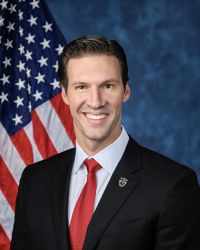
Pat Harrigan
RRepublicanNC-10 · Representative
50
/ 100
Average
Attendance98
Avg: 96
Independence8
Avg: 4
Bipartisan Tone4
Avg: 15
Ethics Record100
Avg: 99
Transparency22
Avg: 53
Accountability Score — composite of attendance, independence, bipartisan tone, ethics record & transparency.
Methodology24
Bills Sponsored
0
Enacted into Law
1
Passed a Chamber
23
In Committee
All Sponsored Bills
HR10822In Committee
To restrict the usage of automated license plate reader system by governmental entities, and for other purposes.
HR10440In Committee
REACH Act
HR10092In Committee
GATE Act of 2026
HR9804In Committee
SAFE Rural Act
The bill would set aside federal disaster relief money specifically for rural communities to help them prepare for and recover from floods, distributing the funds through a formula-based grant program rather than requiring communities to compete for limited resources. This would give smaller, less-resourced rural areas a dedicated source of funding to build flood defenses and resilience measures. The program would be managed through FEMA's existing disaster relief infrastructure.
HR8790Passed House
Next-Generation Geothermal Research and Development Act
Next-Generation Geothermal Research and Development Act This bill directs the Department of Energy (DOE) to support the development of next-generation geothermal systems, such as closed-loop geothermal systems in supercritical conditions. Specifically, the bill expands the Energy Independence and Security Act of 2007 to modify and establish geothermal energy programs, such as programs concerning research and development, grants, and data management. DOE must support a program of research, development, demonstration, and commercial application for next-generation geothermal systems. DOE may administer grants for carrying out certain focus areas of the program. DOE must also ensure that at least one Frontier Observatory for Research in Geothermal Energy (FORGE) field research site has the capabilities to include next-generation geothermal testing. Additionally, DOE must provide grants for (1) the continuation and expansion of research, development, demonstration, testing, and commercial application activities applicable to FORGE sites; and (2) the establishment of a next-generation geothermal systems center of excellence. DOE must also provide grants to accelerate the development, testing, and implementation of innovative technologies to improve the commercial-readiness of geothermal energy projects using next-generation geothermal systems. DOE must expand its repository of geothermal drilling information to include publicly available subsurface data, including data reported as part of fossil fuel and mining operations. DOE must also periodically update the repository to improve its functionality and usability. The bill authorizes the Department of the Interior to commission the drilling of supercritical geothermal exploration boreholes in certain areas to provide control points for deep heat mapping and geothermal development.
HR9707In Committee
GAP Act
The proposal would give the government stronger authority to review and block investments in small aircraft companies and general aviation businesses if those investments come from foreign countries considered adversaries to the United States. This would help prevent potentially hostile nations from gaining access to aviation technology or infrastructure that could pose security risks. The measure affects aircraft manufacturers, aviation companies, and foreign investors interested in the U.S. aviation sector.
HR9516In Committee
To codify Executive Order 14412, entitled "Securing the Nation Against Advanced Cryptographic Attacks".
The federal government would establish new rules to protect computer systems and sensitive data from advanced encryption-breaking attacks that could emerge in the future. This would require federal agencies and potentially contractors working with the government to upgrade their cybersecurity defenses and transition away from encryption methods that might become vulnerable to new technology. The measure affects government agencies, defense contractors, and companies that handle classified or sensitive federal information.
HR9351In Committee
COMPASS Act
Military members who homeschool their children would receive certain legal protections and relief under this proposal, similar to protections already available to service members in other areas of life. The changes would help ensure that military families aren't penalized or face unnecessary legal complications when they choose homeschooling as an educational option for their dependents. The bill is currently being reviewed by the House Committee on Veterans' Affairs.
HR9466In Committee
Foreign Medical Program Integrity and Improvement Act
The Department of Veterans Affairs operates a program that helps veterans receive medical care from foreign doctors and hospitals, and this proposal would strengthen the rules and monitoring systems to ensure the program works properly and protects veterans' safety. The changes would likely include better tracking of which foreign providers are qualified, clearer standards for what care can be covered, and improved oversight to prevent fraud or abuse. Veterans using this program and the VA itself would be affected by these new requirements.
HR9430In Committee
American Drone Manufacturing Dominance Act of 2026
The bill would require organizations receiving federal grants to stop using drones made by certain foreign countries and would push law enforcement agencies to buy American-made drones instead. It would also use tariff money collected on foreign drones to help boost domestic drone manufacturing and reduce America's dependence on foreign drone technology. The goal is to strengthen U.S. drone production while improving security for police and other government agencies.
HR9244In Committee
Business Activity Tax Simplification Act of 2026
The legislation would set federal limits on how states can tax businesses and individuals engaged in interstate commerce, preventing states from imposing taxes that unfairly burden out-of-state companies or residents. This would affect businesses that operate across multiple states, online retailers, and consumers by establishing clearer rules about which state can collect sales taxes and other levies on interstate transactions. The bill aims to reduce tax conflicts between states and create more uniform taxation rules for commerce that crosses state lines.
HR8332In Committee
Special Operations Forces Concealed Carry Act
This bill would allow certain military special operations personnel and veterans with special operations training to carry concealed firearms across state lines without needing individual state permits. The measure aims to recognize the firearms training and security clearances of these specialized operators by granting them federal concealed carry privileges similar to those given to law enforcement officers. The bill affects active-duty special operators, retired special operations veterans, and potentially their families, while raising questions about how states' gun laws would interact with this federal authority.
HRES1230In Committee
Addressing the politicization of war crimes allegations against allied Special Operations Forces.
This resolution honors the service and sacrifice of the armed forces of the United Kingdom, Australia, and other partner nations that fought alongside U.S. troops in Afghanistan, Iraq, and other collective security and counterterrorism missions. The resolution expresses concern that retrospective, politically motivated accusations and investigations of war crimes against the forces of U.S. allies are harmful to alliance unity and servicemember confidence.
HR8482In Committee
To amend the Internal Revenue Code of 1986 to modify certain investment credit rules with respect to nuclear facilities.
The proposal would change tax credit rules to make it more financially attractive for companies to invest in nuclear power plants and related facilities. By modifying how these investment credits work, the legislation aims to encourage businesses to build or upgrade nuclear energy infrastructure, potentially lowering the cost of nuclear power development for energy companies.
HRES1137In Committee
Recognizing the 100th anniversary of the creation of the Sporting Arms and Ammunition Manufacturers' Institute, Inc., and commending its work establishing industry standards that ensure the safe interoperability of firearms and ammunition.
This resolution honors the 100-year history of the Sporting Arms and Ammunition Manufacturers' Institute, a trade organization that sets safety standards for firearms and ammunition to make sure different brands work together safely and reliably. The resolution recognizes the institute's role in establishing industry guidelines that help prevent accidents and ensure products function as intended. It's a ceremonial measure with no direct impact on laws or regulations.
HR7958In Committee
Expatriate Terrorists Act of 2026
This bill would allow the U.S. government to strip citizenship from Americans who engage in certain activities that support terrorism, treating such actions as a voluntary renunciation of nationality. Currently, the government has limited ability to revoke citizenship, but this change would expand those grounds to include supporting terrorist organizations or activities. The measure would affect U.S. citizens suspected of providing material support to designated terrorist groups.
HR7873In Committee
Taiwan Energy Security and Anti-Embargo Act of 2026
This bill aims to strengthen Taiwan's ability to access energy resources and protect it from economic embargoes that could cut off its power supplies. The legislation would likely establish agreements or mechanisms to ensure Taiwan can obtain fuel and energy from international markets even if other countries try to block those supplies. The bill affects U.S.-Taiwan relations, energy security policy, and potentially American companies involved in energy trade.
HR6962In Committee
Families First Housing Act of 2026
This bill would likely make it easier and more affordable for families to buy homes by adjusting lending rules, down payment requirements, or housing assistance programs. The changes would probably affect first-time homebuyers, low-income families, and possibly mortgage lenders or government housing agencies. The specific details of how it would help families aren't yet clear since the bill is still in early stages of review.
HR5800In Committee
SAFE Drivers Act
The SAFE Drivers Act would establish new safety standards or requirements for drivers on highways and public roads, likely focusing on training, licensing, or vehicle safety measures. The bill aims to reduce traffic accidents and improve road safety for all travelers. It has been sent to a congressional subcommittee for further review and discussion.
HR6263In Committee
No Free Pass for Felons Act of 2025
The proposal would restrict certain benefits and privileges for people convicted of felonies, potentially affecting their access to government programs, licenses, or other federal benefits depending on the specific crimes involved. The bill targets individuals with serious criminal convictions and aims to prevent them from receiving what supporters view as unwarranted government assistance. The measure is currently under review by a congressional subcommittee focused on counterterrorism and intelligence matters.
HR4081In Committee
Foreign Adversary Federal Offense Act of 2025
The legislation would create a new federal crime for individuals who knowingly work on behalf of foreign adversaries like China, Russia, Iran, or North Korea to harm U.S. national security, with penalties including fines and imprisonment. It would apply to people engaged in espionage, sabotage, or other hostile activities directed by these countries against American interests. The law aims to give federal prosecutors stronger tools to prosecute foreign agents and their collaborators operating within the United States.
HR3588In Committee
Real Estate Reciprocity Act
Real Estate Reciprocity Act This bill establishes a federal excise tax and information reporting requirements related to the acquisition of real property in the United States by certain persons from countries that prohibit U.S. citizens from owning property (disqualified country). The excise tax is 50% of the amount paid for the real property by a disqualified person. A disqualified person is a citizen of a disqualified country (other than a U.S. citizen or lawful permanent resident); an entity domiciled in a disqualified country; a disqualified country; and a political subdivision, agency, or instrumentality of a disqualified country. Under the bill, a disqualified person includes an entity if disqualified persons own (in the aggregate) more than 10% of the entity’s stock. For such an entity, if no more than 50% of the entity’s stock is owned (in the aggregate) by disqualified persons, the excise tax is prorated. The bill provides exceptions from the excise tax for (1) persons in the United States due to diplomatic obligations or a grant of asylum, and (2) certain corporations with stock traded on an established U.S. securities market. The bill requires information related to the acquisition of U.S. real property by a presumptively disqualified person to be reported to the Internal Revenue Service by persons responsible for closing the transaction or the transferor of the property. Additional reporting requirements apply. A presumptively disqualified person is any person unless an affidavit is submitted (under penalty of perjury) that such person is not a disqualified person.
HR1695In Committee
Guarding Readiness Resources Act
Guarding Readiness Resources Act This bill modifies the treatment of funds received by the National Guard Bureau as a reimbursement from a state or other U.S. territory (e.g., Guam) for the use of military property. Specifically, the funds must be credited to (1) the appropriation, fund, or account used in incurring the obligation; or (2) an appropriation, fund, or account currently available for the purposes of which the expenditures were made. Further, the funds may only be used by the Department of Defense for the repair, maintenance, replacement, or other similar functions related directly to assets used by National Guard units while operating under state active duty status.
HR511In Committee
AMERICANS Act
Allowing Military Exemptions, Recognizing Individual Concerns About New Shots Act of 2025 or the AMERICANS Act This bill prohibits the Department of Defense (DOD) from issuing any COVID-19 vaccine mandate as a replacement for the rescinded vaccine mandate of August 24, 2021, unless the mandate is expressly authorized by Congress. The bill also provides that DOD must establish an application process for remedies for members of the Armed Forces who were discharged or subject to adverse action under the rescinded mandate. Any administrative discharge of a member on the sole basis of a failure to receive a COVID-19 vaccine must be categorized as an honorable discharge, and DOD is prohibited from taking any adverse action against such a member for that reason. DOD must try to retain unvaccinated members and provide such members with professional development, promotion and leadership opportunities, and consideration equal to that of their peers. Additionally, DOD may only consider the COVID-19 vaccination status of members in making certain decisions (e.g., deployments in countries where it is the law) and must establish a process to provide exemptions to certain members for such decisions. Members who were separated from the Armed Forces for refusing to receive a COVID-19 vaccine are not required to repay any bonuses and must be reimbursed if they repaid any portion of a bonus prior to this bill's enactment. This bill applies to all members of the Armed Forces, regardless of whether they sought an accommodation to any DOD COVID-19 vaccination policy.