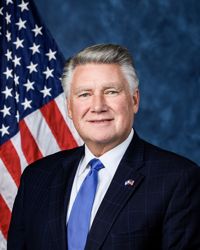
Mark Harris
RRepublicanNC-8 · Representative
56
/ 100
Average
Attendance100
Avg: 96
Independence8
Avg: 4
Bipartisan Tone24
Avg: 15
Ethics Record100
Avg: 99
Transparency33
Avg: 53
Accountability Score — composite of attendance, independence, bipartisan tone, ethics record & transparency.
Methodology12
Bills Sponsored
0
Enacted into Law
4
Passed a Chamber
8
In Committee
All Sponsored Bills
HR4499Passed House
To make technical amendments to update statutory references to provisions reclassified to title 34, United States Code, and to correct related technical errors.
This bill makes technical amendments to the U.S. Code to revise references to statutory provisions reclassified to Title 34 (Crime Control and Law Enforcement).
HR9611In Committee
Less Bureaucracy, Better Higher Education Act
Less Bureaucracy, Better Higher Education Act This bill transfers specified functions relating to postsecondary education programs from the Department of Education (ED) to the Department of Labor's Employment and Training Administration (ETA). Specifically, the bill transfers to the ETA all the functions and authorities exercised by ED before the bill's effective date related to postsecondary education programs. These programs include, among others, TRIO programs and the Fund for the Improvement of Postsecondary Education. (On November 18, 2025, ED announced an interagency agreement with Labor for Labor to manage grant funds, provide technical assistance, and integrate ED's programs with Labor's existing programs, while ED must maintain its statutory responsibilities and program oversight.) The bill also repeals the Leveraging Educational Assistance Partnership Program, the Robert C. Byrd Honors Scholarship Program, the College Access Challenge Grant Program, and the Project GRAD program. Additionally, the bill transfers to the ETA all personnel and appropriations related to the functions that are transferred under this bill. The bill outlines the authority of the Office of Management and Budget (OMB) related to the functions that are transferred under this bill, including that OMB must ensure that this bill does not create a net increase in full-time equivalent employees at the ETA or ED. Further, OMB must certify compliance with the bill to specified congressional committees. The transfer of these functions does not affect any suits, proceedings, or applications for benefits, services, licenses, permits, certificates, or financial assistance that are pending on the date of this bill's enactment.
HR9610In Committee
Less Bureaucracy, Better K–12 Education Act
Less Bureaucracy, Better K-12 Education Act This bill transfers specified functions relating to elementary and secondary education from the Department of Education (ED) to the Department of Labor. Specifically, the bill transfers to Labor all the functions and authorities exercised by ED before the bill's effective date related to elementary and secondary education programs. These programs include, among others, programs for disadvantaged students, migratory students, at-risk students, and English language learners, as well as programs for teacher development, literacy, and charter schools. (On November 18, 2025, ED announced an interagency agreement with Labor for Labor to manage competitions, provide technical assistance, and integrate ED's programs with Labor's existing employment and training programs, while ED must maintain its statutory responsibilities and program oversight.) Additionally, the bill transfers to Labor all personnel and appropriations related to the functions that are transferred under this bill. The bill outlines the authority of the Office of Management and Budget (OMB) related to the functions that are transferred under this bill, including that OMB must ensure that this bill does not create a net increase in full-time equivalent employees at Labor or ED. Further, OMB must certify compliance with the bill to specified congressional committees. The transfer of these functions does not affect any suits, proceedings, or applications for benefits, services, licenses, permits, certificates, or financial assistance that are pending on the date of this bill's effective date.
HR9580In Committee
PARITY Act
The proposal would eliminate a federal rule that requires for-profit colleges to get at least 10 percent of their revenue from sources other than federal student aid programs. Removing this rule would allow proprietary schools to rely almost entirely on government-funded student loans and grants to operate, which could make it easier for these schools to expand but might increase the risk that federal money goes to lower-quality educational programs.
HR5625Passed House
Cashless Bail Reporting Act
Cashless Bail Reporting Act This bill requires the Department of Justice to publish annually a list of state and local governments that permit individuals who are charged with certain criminal offenses that pose a clear threat to public safety and order to be released pending trial on personal recognizance or upon execution of an unsecured appearance bond. Under the bill, the criminal offenses that pose a threat to public safety and order include criminal offenses involving a violent or sexual act (e.g., burglary, murder, or rape) and offenses that promote public disorder (e.g., looting or vandalism). On August 25, 2025, President Donald Trump issued an executive order that required the Department of Justice to submit to the Assistant to the President for Homeland Security a list of state and local jurisdictions that have substantially eliminated cash bail as a potential condition for pretrial release for crimes that pose a clear threat to public safety and order, including offenses involving violent, sexual, or indecent acts, or burglary, looting, or vandalism.
HR8374In Committee
Equal Treatment for Farmers Act
This bill would remove federal laws and programs that provide special assistance to farmers and ranchers from disadvantaged backgrounds, including minority-owned farms and those owned by women or veterans. The changes would affect loan programs, grants, and other support services currently available through the U.S. Department of Agriculture to help these groups start or expand their farming operations.
HR6392Passed House
Home School Graduation Recognition Act
Home School Graduation Recognition Act This bill clarifies that students who complete their secondary education in a home school setting recognized under state law are high school graduates for purposes of eligibility for federal student aid.
HR6715Passed House
Child Predators Accountability Act
Child Predators Accountability Act of 2025 This bill broadens the scope of prohibited conduct under two federal criminal statutes related to the production of child pornography. Under current law, both statutes prohibit employing, using, persuading, inducing, enticing, or coercing a minor to engage in sexually explicit conduct for the purpose of producing a visual depiction or transmitting a live visual depiction of the conduct. This bill expands prohibited conduct to include employing, using, persuading, inducing, enticing, or coercing a minor to be depicted engaging in sexually explicit conduct. The bill also defines the term engage in to include a minor's presence in a such a depiction regardless of whether or not the minor is participating in the sexually explicit conduct.
HR6191In Committee
No Taxpayer Funded Abortion Travel for Illegal Aliens Act
This bill would prohibit federal funds from being used to pay for travel expenses related to abortion services for undocumented immigrants. The measure targets government spending on transportation costs for people without legal immigration status who seek abortion care, affecting both the immigrants themselves and federal agencies that administer health and immigration programs.
HR2501In Committee
Free Speech Fairness Act
Despite its title, this bill addresses tax policy rather than free speech issues. Based on its referral to the tax committee, it likely proposes changes to how certain organizations or activities are taxed, though the specific provisions would need to be reviewed to determine which taxpayers or business types would be affected.
HR1312In Committee
No Asylum for Criminals Act of 2025
This bill would make it harder for people with criminal records to seek asylum in the United States by expanding the types of crimes that automatically disqualify someone from receiving asylum protection. The changes would affect immigrants and asylum seekers who have been convicted of certain offenses, potentially sending them back to their home countries even if they face danger there.
HR729In Committee
Teleabortion Prevention Act of 2025
Teleabortion Prevention Act of 2025 This bill restricts the use of telehealth for chemical abortions (also known as medication abortions). Specifically, it requires a provider who dispenses or prescribes medication for a chemical abortion to physically examine the patient, be physically present at the location of the chemical abortion, and schedule a follow-up visit for the patient. The bill provides an exception for a chemical abortion that is necessary to save the life of a mother whose life is endangered by a physical disorder, illness, injury, or condition. The bill establishes criminal penalties—a fine, a prison term of up to two years, or both—for a provider who does not comply with the requirements. A patient who undergoes a chemical abortion may not be prosecuted.