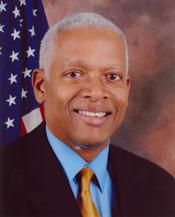
Henry C. "Hank" Johnson, Jr.
DDemocratGA-4 · Representative
51
/ 100
Average
Attendance98
Avg: 96
Independence3
Avg: 4
Bipartisan Tone5
Avg: 15
Ethics Record100
Avg: 99
Transparency32
Avg: 53
Accountability Score — composite of attendance, independence, bipartisan tone, ethics record & transparency.
Methodology20
Bills Sponsored
0
Enacted into Law
0
Passed a Chamber
20
In Committee
All Sponsored Bills
HRES1517In Committee
Expressing support for the recognition of September 7, 2026, as "Liturgical Dance Day" and the International Dance Commission, and for other purposes.
HRES1516In Committee
Expressing support for the designation of September 9 as "National African Immigrant and Refugee HIV/AIDS and Hepatitis Awareness (NAIRHHA) Day".
HJRES209In Committee
Supporting the designation of November 9 of each year as "Gold Star Father's Day".
This joint resolution expresses support for the designation of Gold Star Father's Day.
HR9784In Committee
Justice is BLIND Act of 2026
Federal judges and justices would be required to place certain financial assets into blind trusts—accounts they cannot see or control—to prevent conflicts of interest, with the same requirement applying to their spouses and dependent children. This rule aims to ensure that judges make decisions based on the law rather than personal financial gain by keeping them unaware of which companies or investments their money is in. The requirement would apply to Supreme Court justices, federal judges, magistrate judges, and bankruptcy judges across the country.
HR9408In Committee
Open Meetings Act of 2026
The proposal would change federal rules about what paperwork and documentation is required when certain government conferences and councils hold meetings. This affects how federal agencies organize and record their official gatherings, potentially making the process simpler or more transparent depending on the specific changes made. The bill is currently being reviewed by the House Judiciary Committee.
HR7766In Committee
Stop Militarizing Law Enforcement Act
The Department of Defense would be required to follow new rules about which military equipment and property it can give to police departments, state agencies, and other government organizations. The bill aims to limit or control these transfers of military gear, though the specific restrictions aren't detailed in the available information. This would affect how local law enforcement and state agencies obtain surplus military equipment.
HRES1081In Committee
Raising awareness for the sarcoma cancer chordoma.
This resolution expresses the sense of the House of Representatives of the need for increased funding and support for diagnosis, treatments, and cures for chordoma (a bone cancer of the skull and spine).
HR6091In Committee
Bivens Act of 2025
This bill would likely expand or clarify legal protections that allow people to sue federal government employees for violating their constitutional rights, particularly in cases involving civil rights violations. The legislation appears aimed at strengthening remedies for individuals—especially minorities—who experience misconduct by federal agents, by making it easier to hold those employees and agencies accountable in court. The bill has been referred to the House Judiciary Committee for review.
HR6092In Committee
Constitutional Accountability Act
The proposal would establish new legal mechanisms to hold government officials accountable when their actions violate constitutional rights, particularly affecting minority communities and civil rights protections. It aims to make it easier for citizens to sue federal officials and potentially recover damages when constitutional violations occur. The measure targets systemic issues in how government agencies enforce laws and policies that may disproportionately harm protected groups.
HRES751In Committee
Expressing support for the recognition of September 7, 2025, as "Liturgical Dance Day" and the International Dance Commission, and for other purposes.
This resolution recognizes Liturgical Dance Day and the International Dance Commission and its contributions to the creative arts and worship in communities across Georgia.
HR5350In Committee
FAIR Act of 2025
Forced Arbitration Injustice Repeal Act of 2025 or the FAIR Act of 2025 This bill prohibits a predispute arbitration agreement from being valid or enforceable if it requires arbitration of an employment, consumer, antitrust, or civil rights dispute.
HRES693In Committee
Expressing support for the designation of September 9 as "National African Immigrant and Refugee HIV/AIDS and Hepatitis Awareness Day" or "NAIRHHA Day".
This resolution supports the designation of National African Immigrant and Refugee HIV/AIDS and Hepatitis Awareness (NAIRHHA) Day. The resolution also recognizes the importance of dedicating more attention and resources to addressing HIV/AIDS and viral hepatitis in African immigrant and refugee communities across the United States.
HR4678In Committee
RAP Act of 2025
I don't have enough information to write an accurate summary. The title "RAP Act of 2025" is too vague without knowing what "RAP" stands for, and the subject line only says "Law" without specifying which area of law this bill addresses. To provide a meaningful summary, I would need to know the bill's actual provisions or what policy problem it's intended to solve.
HR3544In Committee
Supreme Court Tenure Establishment and Retirement Modernization Act of 2025
This bill would limit how long Supreme Court justices can serve by establishing 18-year term limits, after which justices would move to a senior status with reduced duties rather than retiring completely. The change would mean each president gets to appoint roughly one new justice every two years instead of waiting for justices to voluntarily retire, which could make the Court's composition more predictable and less dependent on individual justices' life expectancy. This would affect the nine current justices and reshape how the Supreme Court operates going forward.
HR3513In Committee
Supreme Court Ethics, Recusal, and Transparency Act of 2025
This bill would establish new ethics rules for Supreme Court justices, including requirements that they disclose financial interests and recuse themselves from cases where they have conflicts of interest, similar to rules that apply to lower court judges. It would also increase transparency by making justices' financial disclosures public and potentially creating consequences if they fail to follow these ethics guidelines. The changes would affect how the Supreme Court operates and could influence which cases justices participate in deciding.
HR3449In Committee
Stronger Communities through Better Transit Act
Stronger Communities through Better Transit Act This bill requires the Department of Transportation (DOT) to establish a grant program to support operating projects for public transportation and related service improvements, particularly in underserved communities and areas of persistent poverty. Specifically, the bill requires DOT to allocate funding under the program for urbanized areas, states, and Indian tribes that are recipients of funds under either the Federal Transit Administration's (FTA's) Urbanized Area Formula Funding program or Formula Grants for Rural Areas program. Eligible recipients may use funding for operating costs associated with projects that improve public transportation service for transit-dependent populations and support increased transit ridership (e.g., service expansion, information technology enhancements, and workforce development). DOT must apportion the funding so that recipients receive funds that are proportional to their share of operating costs. The bill also provides for an increased federal cost share for operating assistance for projects or programs carried out in areas of persistent poverty or underserved communities. DOT must set up a multimodal access measurement interface for public agencies to aid transit agencies in determining and reporting on access to jobs and essential services. A grant recipient must (1) report specific information to the FTA for inclusion in the National Transit Database, and (2) survey transit riders and non-riding residents regarding transit service improvements. Further, the bill expands the purposes of the public transportation programs to include supporting public transportation's role in combating climate change through growing/retaining transit ridership.
HRES362In Committee
Expressing support for the designation of April 30, 2025, as "National Adult Hepatitis B Vaccination Awareness Day".
This resolution supports the designation of National Adult Hepatitis B Vaccination Awareness Day.
HR1929In Committee
JUDGES Act of 2025
Judicial Understaffing Delays Getting Emergencies Solved Act of 2025 or the JUDGES Act of 2025 This bill creates 64 U.S. district court judgeships—63 permanent and 1 temporary—and expands the jurisdictional coverage of two district courts. Specifically, the bill creates 63 new permanent judgeships across 14 states over a 10-year period beginning in 2029. The state and total number of judgeships added over the 10-year period are as follows: Arizona (1), California (20), Colorado (2), Delaware (2), Florida (9), Georgia (2), Idaho (1), Indiana (1), Iowa (1), Nebraska (1), New Jersey (3), New York (5), Oklahoma (2), and Texas (13). Additionally, the bill creates one temporary judgeship in the Eastern District of Oklahoma in 2029. Finally, the bill adds locations where court must be held in two district courts—one in California and one in Texas. Specifically, the bill adds College Station to the list of places where court must be held in the Houston Division of the Southern District of Texas. Also, the bill adds El Centro to the list of places where court must be held in the Southern District of California. The bill directs the Government Accountability Office to submit reports to Congress on judicial caseloads and detention space. The bill also directs the Administrative Office of the U.S. Courts to make available on its website the biennial report by the Judicial Conference of the United States on judgeship recommendations.
HRES172In Committee
Raising awareness for the sarcoma cancer chordoma.
This resolution expresses the sense of the House of Representatives of the need for increased funding and support for diagnosis, treatments, and cures for chordoma (a bone cancer of the skull and spine).
HR945In Committee
To award a Congressional Gold Medal to the Freedom Riders, collectively, in recognition of their unique contribution to Civil Rights, which inspired a revolutionary movement for equality in interstate travel.
The proposal would award a Congressional Gold Medal to the Freedom Riders, a group of civil rights activists who challenged racial segregation on interstate buses in the 1960s and helped spark the broader civil rights movement. This honor recognizes their courage and the lasting impact their actions had on ending discriminatory travel laws across the country. The medal is a symbolic award that Congress gives to individuals or groups for outstanding contributions to American history and values.