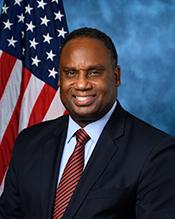
Jonathan L. Jackson
DDemocratIL-1 · Representative
52
/ 100
Average
Attendance92
Avg: 96
Independence3
Avg: 4
Bipartisan Tone5
Avg: 15
Ethics Record100
Avg: 99
Transparency50
Avg: 53
Accountability Score — composite of attendance, independence, bipartisan tone, ethics record & transparency.
Methodology7
Bills Sponsored
0
Enacted into Law
1
Passed a Chamber
6
In Committee
All Sponsored Bills
HR10624In Committee
To prohibit the use of Federal funds to carry out Executive Order 14253.
HR9548In Committee
Blair Holt Firearm Owner Licensing and Record of Sale Act of 2026
The legislation would require firearm owners to obtain a federal license before purchasing guns and establish a national registry to track gun sales and ownership. Gun buyers would need to pass a background check, complete a safety training course, and renew their license periodically, similar to how driver's licenses work. The law would affect anyone who wants to purchase or own firearms in the United States.
HJRES196In Committee
Proposing an amendment to the Constitution of the United States regarding the right to vote.
A proposed constitutional amendment that would establish a federal right to vote for all eligible citizens and give Congress the power to enforce voting protections through legislation. The amendment would limit states' ability to restrict voting access and could override certain state voting laws that Congress determines are discriminatory. This would affect all voters and election officials across the country by potentially standardizing voting rules nationwide.
HCONRES105In Committee
Directing the President, pursuant to section 5(c) of the War Powers Resolution, to remove United States Armed Forces from hostilities with Iran.
This concurrent resolution directs the President to remove U.S. Armed Forces from hostilities against Iran or any part of its government or military unless a declaration of war or authorization to use military force for such purpose has been enacted. The resolution specifies that it shall not be construed to prevent the United States from defending itself, its Armed Forces, its diplomatic facilities, or allied states from imminent attack.
HR8301In Committee
RSF Terrorist Designation Act
The government would be required to thoroughly examine whether Sudan's Rapid Support Forces should be officially labeled as a terrorist organization, which would trigger international sanctions and restrictions on their activities and finances. This designation would affect how the U.S. government can interact with the group and would signal to other countries that the organization poses a serious security threat. The decision would ultimately rest with the State Department after completing this review.
HR1998Passed House
Sanction Sea Pirates Act of 2025
Sanction Sea Pirates Act of 2025 This bill requires the President to impose visa- and property-blocking sanctions on any foreign person (individual or entity) that the President determines knowingly engages in piracy. The bill also applies civil and criminal penalties to persons that violate, attempt to violate, conspire to violate, or cause a violation of the regulations promulgated to carry out such sanctions.
HR3685In Committee
JUST Act of 2025
Just USDA Standards and Transparency Act of 2025 or the JUST Act of 2025 This bill increases Department of Agriculture (USDA) oversight and enforcement of civil rights-related violations and actions. USDA must take appropriate corrective action regarding any USDA official or employee who engages in certain discriminatory actions, retaliatory actions, harassment, or civil rights violations (e.g., failure to provide appropriate information regarding relevant USDA programs and services). A corrective action (1) is any action that would enhance civil rights at USDA, including policy or programmatic changes; and (2) may include disciplinary actions (e.g., removal from federal service or a letter of reprimand). The bill shifts the burden of proof from a farmer or rancher to USDA in an appeal to the USDA National Appeals Division. Specifically, USDA must prove by substantial evidence the validity of a USDA adverse decision. Further, a farmer or rancher who fails to comply fully with the requirements to receive a loan may be eligible for equitable relief if the USDA determines the individual made a good faith effort to comply with the loan requirements. The bill also directs USDA to establish an Office of the Legal Advisor for Civil Rights and Office of the Civil Rights Ombudsperson; creates the required position of Assistant Secretary of Agriculture for Civil Rights (currently an optional USDA position); and allows the Assistant Secretary to grant relief, without prior approval, to farmers or ranchers who file certain civil rights complaints, including complaints regarding direct farm ownership, operating, or emergency loans.