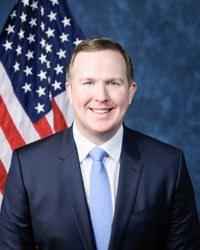
Brian Jack
RRepublicanGA-3 · Representative
51
/ 100
Average
Attendance100
Avg: 96
Independence3
Avg: 4
Bipartisan Tone12
Avg: 15
Ethics Record100
Avg: 99
Transparency22
Avg: 53
Accountability Score — composite of attendance, independence, bipartisan tone, ethics record & transparency.
Methodology8
Bills Sponsored
0
Enacted into Law
7
Passed a Chamber
1
In Committee
All Sponsored Bills
HR6330Passed House
Federal Relocation Payment Improvement Act
Federal Relocation Payment Improvement Act This bill permanently authorizes all federal agencies to pay employees' relocation expenses using lump-sum payments rather than reimbursements for expenses incurred. Under current law, several federal agencies currently participate in a pilot program that allows the agencies to pay relocation expenses using lump-sum payments rather than reimbursements. This bill expands the program by permanently authorizing all federal agencies to pay employees who relocate in the interest of the government a one-time, lump-sum relocation payment instead of any payment otherwise authorized or required for such purposes. The bill directs the General Services Administration to issue regulations to implement this bill, including regulations establishing (1) when agencies may authorize a one-time, lump sum payment under this bill or the payments otherwise authorized or required by law; (2) how agencies will calculate the lump-sum amount; and (3) the process for employees to dispute and appeal agency decisions.
HRES1377In Committee
Providing for consideration of the bill (H.R. 1181) to prohibit payment card networks and covered entities from requiring the use of or assigning merchant category codes that distinguish a firearms retailer from general-merchandise retailer or sporting-goods retailer, and for other purposes; providing for consideration of the bill (H.R. 9022) making appropriations for energy and water development and related agencies for the fiscal year ending September 30, 2027, and for other purposes; providing for consideration of the bill (H.R. 8595) making appropriations for national security, Department of State, and related programs for the fiscal year ending September 30, 2027, and for other purposes; and providing for consideration of the bill (H.R. 9237) to amend titles 10 and 38, United States Code, and other Federal laws, to improve benefits for veterans and the administration of the Department of Veterans Affairs.
This resolution provides for the consideration of the bill (H.R. 1181) to prohibit payment card networks and covered entities from requiring the use of or assigning merchant category codes that distinguish a firearms retailer from general-merchandise retailer or sporting-goods retailer, and for other purposes; providing for consideration of the bill (H.R. 9022) making appropriations for energy and water development and related agencies for the fiscal year ending September 30, 2027, and for other purposes; providing for consideration of the bill (H.R. 8595) making appropriations for national security, Department of State, and related programs for the fiscal year ending September 30, 2027, and for other purposes; and providing for consideration of the bill (H.R. 9237) to amend titles 10 and 38, United States Code, and other Federal laws, to improve benefits for veterans and the administration of the Department of Veterans Affairs.
HRES1300Passed House
Providing for consideration of the bill (H.R. 1041) to amend title 38, United States Code, to prohibit the Secretary of Veterans Affairs from transmitting certain information to the Department of Justice for use by the national instant criminal background check system; providing for consideration of the bill (H.R. 6047) to amend title 38, United States Code, to direct the Secretary of Veterans Affairs to increase the dollar amounts for the payment of certain disability compensation and dependency and indemnity compensation under the laws administered by the Secretary; providing for consideration of the bill (H.R. 1329) to permit the Smithsonian American Women’s History Museum to be located within the Reserve of the National Mall, and for other purposes; and waiving a requirement of clause 6(a) of rule XIII with respect to consideration of certain resolutions reported from the Committee on Rules.
This resolution provides for the consideration of the bill (H.R. 1041) to amend title 38, United States Code, to prohibit the Secretary of Veterans Affairs from transmitting certain information to the Department of Justice for use by the national instant criminal background check system; providing for consideration of the bill (H.R. 6047) to amend title 38, United States Code, to direct the Secretary of Veterans Affairs to increase the dollar amounts for the payment of certain disability compensation and dependency and indemnity compensation under the laws administered by the Secretary; providing for consideration of the bill (H.R. 1329) to permit the Smithsonian American Women's History Museum to be located within the Reserve of the National Mall, and for other purposes; and waiving a requirement of clause 6(a) of rule XIII with respect to consideration of certain resolutions reported from the Committee on Rules.
HR4624Passed House
Muhammad Ali American Boxing Revival Act of 2026
Muhammad Ali American Boxing Revival Act of 2026 This bill authorizes the establishment of private-sector Unified Boxing Organizations (UBOs) and otherwise expands the regulatory framework for professional boxing. (See CRS Report IF12982 for an overview of the federal regulation of professional boxing in the United States.) Under the bill, UBOs may organize matches involving boxers contracted with the UBO and must comply with other regulations with respect to such matches (e.g., conduct matches under the authority of a state boxing commission). UBOs also operate alongside existing professional boxing organizations (e.g., World Boxing Council (WBC)). UBOs must meet certain additional requirements, for example the UBO must implement an anti-doping program that includes drug testing in advance of matches, boxers age 40 or older must receive supplemental physical examinations, each match must have at least two ambulances on site, and boxers must have access to equipment and facilities that are operated by the UBO for training and rehabilitation. The bill also expands the required health insurance coverage and minimum pay for all professional boxers. Further, the bill requires state boxing commissions to establish procedures to ensure that drug tests are administered for title matches and at random for all other matches.
HRES1095Passed House
Providing for consideration of the bill (H.R. 7744) making appropriations for the Department of Homeland Security for the fiscal year ending September 30, 2026, and for other purposes.
This resolution provides for the consideration of the bill (H.R. 7744) making appropriations for the Department of Homeland Security for the fiscal year ending September 30, 2026, and for other purposes.
HRES1032Passed House
Providing for consideration of the Senate amendments to the bill (H.R. 7148) making further consolidated appropriations for the fiscal year ending September 30, 2026, and for other purposes; providing for consideration of the joint resolution (H.J. Res. 142) disapproving the action of the District of Columbia Council in approving the D.C. Income and Franchise Tax Conformity and Revision Temporary Amendment Act of 2025; and providing for consideration of the bill (H.R. 4090) to codify certain provisions of certain Executive Orders relating to domestic mining and hardrock mineral resources, and for other purposes.
This resolution provides for the consideration of the Senate amendments to the bill (H.R. 7148) making further consolidated appropriations for the fiscal year ending September 30, 2026, and for other purposes; providing for consideration of the joint resolution (H.J. Res. 142) disapproving the action of the District of Columbia Council in approving the D.C. Income and Franchise Tax Conformity and Revision Temporary Amendment Act of 2025; and providing for consideration of the bill (H.R. 4090) to codify certain provisions of certain Executive Orders relating to domestic mining and hardrock mineral resources, and for other purposes.
HRES668Passed House
Directing the Committee on Oversight and Government Reform to continue its ongoing investigation into the possible mismanagement of the Federal government’s investigation of Mr. Jeffrey Epstein and Ms. Ghislaine Maxwell, and for other purposes.
This resolution directs the Committee on Oversight and Government Reform to continue its investigation into the federal government's investigation of Jeffrey Epstein and Ghislaine Maxwell and to release to the public committee records relating to the committee's investigation, subject to limited exceptions. Under the resolution, the committee records to be publicly disclosed include unclassified records referring or relating to Epstein's detention and death; flight logs of aircraft owned or used by Epstein; individuals named in connection with Epstein’s criminal activities, civil settlements, or immunity or plea agreements; immunity deals, sealed settlements, or plea bargains of Epstein or his associates; entities with ties to Epstein’s trafficking or financial networks; and internal Department of Justice communications concerning decisions to investigate or charge Epstein or his associates. The resolution provides that the committee may withhold or redact portions of records with written justification that such portions contain (1) victims' personally identifiable information; (2) child sexual abuse materials; (3) images of death, physical abuse, or injury; (4) information which would jeopardize an active federal investigation or prosecution; or (5) classified information. The committee may not withhold or redact records on the basis of embarrassment, reputational harm, or political sensitivity. The resolution states support for the committee's subpoenas and investigatory actions and encourages timely compliance with them. Additionally, the committee shall issue investigative reports as it deems necessary.
HRES580Passed House
Providing for consideration of the bill (H.R. 4016) making appropriations for the Department of Defense for the fiscal year ending September 30, 2026, and for other purposes; providing for consideration of the bill (H.R. 3633) to provide for a system of regulation of the offer and sale of digital commodities by the Securities and Exchange Commission and the Commodity Futures Trading Commission, and for other purposes; providing for consideration of the bill (H.R. 1919) to amend the Federal Reserve Act to prohibit the Federal reserve banks from offering certain products or services directly to an individual, to prohibit the use of central bank digital currency for monetary policy, and for other purposes; providing for consideration of the bill (S. 1582) to provide for the regulation of payment stablecoins, and for other purposes; and waiving a requirement of clause 6(a) of rule XIII with respect to consideration of certain resolutions reported from the Committee on Rules.
This resolution allows the House to consider four separate bills: one funding the Defense Department through 2026, two bills regulating digital assets and cryptocurrencies through different federal agencies, and one restricting the Federal Reserve from offering certain services directly to individuals and from creating a digital dollar. The resolution passed the House along party lines, enabling debate and votes on these measures that would affect defense spending, cryptocurrency markets, and how Americans interact with the Federal Reserve.