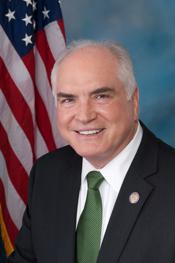
Mike Kelly
RRepublicanPA-16 · Representative
63
/ 100
Average
Attendance98
Avg: 96
Independence1
Avg: 4
Bipartisan Tone16
Avg: 15
Ethics Record100
Avg: 99
Transparency100
Avg: 53
Accountability Score — composite of attendance, independence, bipartisan tone, ethics record & transparency.
Methodology30
Bills Sponsored
0
Enacted into Law
2
Passed a Chamber
28
In Committee
All Sponsored Bills
HR10521In Committee
MA STARS Act
HR9098In Committee
Congressional Records Protection Act of 2026
The bill would restrict federal law enforcement and intelligence agencies from conducting surveillance on members of Congress without meeting stricter legal requirements and oversight procedures. It aims to prevent what supporters view as politically motivated investigations targeting lawmakers and to reinforce constitutional limits on executive power over the legislative branch. The measure has been sent to the House Judiciary Committee for review.
HR9911In Committee
Shipbuilding Investment and Workforce Act
The proposal would allow certain maritime areas—regions focused on shipping, fishing, and ocean-related industries—to qualify for special tax incentives currently available only to economically distressed inland communities. Investors who put money into businesses and projects in these designated maritime zones would receive tax breaks, potentially encouraging economic development in coastal areas and supporting jobs in shipping, fishing, and related industries.
HR3514In Committee
Improving Seniors’ Timely Access to Care Act of 2025
Improving Seniors' Timely Access to Care Act of 2025 This bill establishes several requirements and standards relating to prior authorization processes under Medicare Advantage (MA) plans. Specifically, MA plans must (1) establish an electronic prior authorization program that meets specified standards; (2) annually submit to the CMS for publication specified prior authorization information, including the percentage of requests approved and the average response time; and (3) meet other standards, as set by the Centers for Medicare & Medicaid Services (CMS), relating to the quality and timeliness of prior authorization determinations. The CMS and the Office of the National Coordinator for Health Information Technology must publish on the CMS' website a report that analyzes the information received from MA plans, the feasibility of implementing real-time decision making with respect to prior authorization requests, and the impact of decisions that are made using artificial intelligence on patient access.
HRES1426In Committee
Remembering the life of Corey Comperatore who passed away on Saturday, July 13, 2024.
This resolution honors Corey Comperatore, a firefighter and volunteer who was killed during an assassination attempt at a political rally in Pennsylvania on July 13, 2024. The measure recognizes his service to his community and his sacrifice, paying tribute to his memory and the impact he had on those around him.
HR9353In Committee
To amend the Internal Revenue Code of 1986 to exempt qualified religious institutions from the excise tax on investment income.
Religious organizations like churches, synagogues, and mosques would be excused from paying a federal tax on their investment income, such as money earned from stocks, bonds, or endowments. Currently, certain tax-exempt organizations have to pay a small excise tax on their net investment earnings, but this change would remove that requirement for qualified religious institutions. The proposal would reduce the tax burden on these organizations, allowing them to keep more of their investment earnings for their religious and charitable activities.
HR9173In Committee
Charitable Deductions for Digital Asset Donations Act
The proposal would allow people and businesses to claim tax deductions when they donate digital assets like cryptocurrency and NFTs to qualified charities, similar to how donors currently get tax breaks for donating cash or property. This change would make it easier and more financially attractive for cryptocurrency holders to support charitable organizations. The measure affects donors with digital assets and charities that accept these types of donations.
HR7959Passed House
IRS Whistleblower Program Improvement Act
IRS Whistleblower Program Improvement Act This bill modifies provisions of the Internal Revenue Code relating to whistleblower awards and protections. Specifically, the bill revises the standard for review of whistleblower awards in the Tax Court to require a de novo review (rather than the current abuse of discretion review) based on the administrative record established at the time of the whistleblower award determination and any new or previously unavailable evidence, allows whistleblowers anonymity in proceedings before the Tax Court (unless a societal interest in disclosing a whistleblower's identity outweighs potential harm to the whistleblower), modifies the Internal Revenue Service (IRS) whistleblower report to require inclusion of a list and description of up to 10 of the top tax avoidance schemes disclosed by whistleblowers, and requires payment of interest on mandatory whistleblower awards if the IRS fails to provide timely notice to a whistleblower of an award recommendation. The bill also allows payments of the attorney fees of whistleblowers to be deducted when calculating adjusted gross income for tax purposes regardless of whether the whistleblower award was paid through the mandatory or the discretionary whistleblower award program. (Under current law, the deduction is limited to attorney fees paid in connection with mandatory awards.)
HR8376In Committee
Concurrent Care for Comfort Act
The bill would clarify Medicare's coverage rules for palliative dialysis—a gentler form of kidney dialysis focused on comfort rather than extending life—for patients who choose hospice care. It would also establish separate payment rates for dialysis facilities and providers that offer this service to these patients, ensuring they are reimbursed appropriately for this specialized care. This affects Medicare beneficiaries with kidney disease who are nearing the end of life and their healthcare providers.
HRES1156Passed House
Expressing support for tax policies that support working families.
This resolution expresses support for tax policies that support working families and recognizes the tax relief enacted as part of the 2025 reconciliation act.
HR6446In Committee
To modify the procedures for investigating claims of evasion of antidumping and countervailing duty orders.
The bill would change how the government investigates whether foreign companies are illegally avoiding antidumping and countervailing duties—taxes imposed on imported goods that are sold at unfairly low prices or receive government subsidies. These changes would likely affect how quickly and thoroughly the government can catch companies trying to circumvent these trade protections, which could impact both American manufacturers competing against cheap imports and consumers who buy imported goods. The bill has been sent to the House Ways and Means Committee, which handles trade and tax policy.
HRES732In Committee
Expressing support for the designation of September 30, 2025, as "Rare Cancer Day" to highlight the challenges patients with rare cancers face and to raise awareness and support efforts to improve early diagnosis and treatment.
This resolution expresses support for the designation of Rare Cancer Day.
HR5275In Committee
Diagnostic Accuracy in Sepsis Act of 2025
The proposal would improve how doctors diagnose sepsis, a life-threatening blood infection, by supporting better testing methods and training for healthcare providers. This would help hospitals and clinics catch sepsis faster and more accurately, potentially saving lives by allowing patients to receive treatment sooner. The measure affects patients with infections, healthcare workers, and medical facilities that treat sepsis cases.
HR4566In Committee
Washington’s Trail—1753 National Historic Trail Feasibility Study Act of 2025
The federal government would study whether to establish a new national historic trail that follows George Washington's route from 1753, which would involve examining the historical significance of the path and determining if it meets the standards for official designation. If approved after the study, the trail could become a protected historic route that attracts visitors, supports local communities through tourism, and preserves important Revolutionary War-era history. The study would help Congress decide whether this project is worth the investment and management resources needed to maintain it as a national historic trail.
HRES571In Committee
A resolution solemnly marking the one-year anniversary of the attempted assassination of President Donald J. Trump, condemning the multiple attempts against the President's life, condemning those who incite violence against political officials, and honoring the victims of the shooting.
This resolution commemorates the one-year anniversary of an assassination attempt on President Trump and condemns violence against political leaders and those who encourage such attacks. It also honors the victims of the shooting incident. The measure is a formal statement of the House rather than a law that would change policy or create new rules.
HR4231In Committee
Treat and Reduce Obesity Act of 2025
Treat and Reduce Obesity Act of 2025 This bill expands Medicare coverage of intensive behavioral therapy for obesity. Specifically, the bill allows coverage for therapy that is provided by (1) a physician who is not a primary care physician; or (2) other health care providers (e.g., physician assistants and nurse practitioners) and approved counseling programs, if provided upon a referral from, and in coordination with, a physician or primary care practitioner. Currently, such therapy is covered only if provided by a primary care practitioner. The bill also allows coverage under Medicare's prescription drug benefit of drugs used for the treatment of obesity or for weight loss management for individuals who are overweight.
HR4184In Committee
To amend the Internal Revenue Code of 1986 to exclude from gross income certain compensation to clinical trial participants, and for other purposes.
HR3105In Committee
Promotion and Expansion of Private Employee Ownership Act of 2025
This bill would likely create tax incentives and other financial benefits to encourage workers to buy ownership stakes in the companies where they work, making employee ownership more affordable and attractive. The changes would affect small businesses, workers considering ownership opportunities, and potentially large companies setting up employee ownership programs. By expanding private employee ownership, the bill aims to give workers a direct financial stake in their company's success.
HR3006In Committee
To amend title XVIII of the Social Security Act to limit the coinsurance amount for certain services furnished in an ambulatory surgical center.
This bill limits the amount of coinsurance that may be assessed under Medicare for services performed in ambulatory surgical centers. Specifically, if the applicable coinsurance amount exceeds the inpatient hospital deductible, the Centers for Medicare & Medicaid Services must reduce the coinsurance amount so that it is equal to the amount of the deductible and pay the difference to the service provider.
HR2854In Committee
Neighborhood Homes Investment Act
This bill would likely create tax incentives or credits to encourage investment in residential housing in underserved neighborhoods, making it easier and cheaper for developers and investors to build or renovate homes in lower-income areas. The goal would be to increase affordable housing availability and neighborhood revitalization while giving investors financial benefits through the tax code. Homebuyers, renters, developers, and communities with housing shortages would be the main groups affected.
HR2369In Committee
PHIT Act of 2025
The proposal would allow people to deduct the cost of fitness and sports memberships, equipment, and related health expenses from their taxable income, similar to how some medical expenses are currently treated. This would primarily benefit individuals and families who pay for gym memberships, sports league fees, or fitness classes by reducing the amount of income they owe taxes on. The change would affect millions of Americans who spend money on physical fitness activities.
HR2199In Committee
Restore Protections for Dialysis Patients Act
Restore Protections for Dialysis Patients Act This bill specifies certain requirements for private health insurers regarding coverage of individuals with end stage renal disease (ESRD) who are also covered under Medicare. In particular, the bill specifies that insurers may not limit benefits, including limiting network composition, in a manner that will affect ESRD Medicare beneficiaries differently compared to others without ESRD. The bill additionally specifies that insurers are not required to include a particular renal dialysis provider or a particular number of such providers as part of their networks.
HR2062In Committee
To amend the Internal Revenue Code of 1986 to treat membership in a health care sharing ministry as a medical expense, and for other purposes.
This bill provides that amounts paid for membership in a health care sharing ministry, including amounts paid for the sharing of medical expenses and administrative fees, are a tax-deductible medical expense. (Health care sharing ministries are faith-based organizations with members who share a common set of ethical or religious beliefs and who contribute regular payments to cover the medical expenses of other members.)
HR2002In Committee
MATCH IT Act of 2025
Patient Matching And Transparency in Certified Health IT Act of 2025 or the MATCH IT Act of 2025 This bill requires the Department of Health and Human Services (HHS) to establish a definition and standards for patient matching (i.e., the process of accurately matching patients with their medical records, including when records are exchanged between health care providers). It also requires the development of (1) a minimum data set for technology standards to increase patient matching, and (2) incentives for patient matching under Medicare. Specifically, the bill requires HHS to develop a uniform definition and standards for patient matching to track patient match rates and document improvement over time. The definition and standards must account for certain situations, including duplicate records and multiple matches. The bill also requires the Office of the National Coordinator for Health Information Technology (ONC) to adopt a minimum data set to help health care providers or health information systems achieve a patient match rate of 99.9%. The minimum data set and related standards must be incorporated into the U.S. Core Data for Interoperability and the Medicare Promoting Interoperability Program for health information technology. Additionally, the Centers for Medicare & Medicaid Services (CMS) must establish a voluntary bonus measure within the Medicare Promoting Interoperability Program to allow health care providers who have a patient match rate over a certain percentage to receive a payment adjustment. The ONC and CMS must develop a voluntary reporting program for providers to anonymously submit patient matching data to HHS.
HR1873In Committee
Broadband Grant Tax Treatment Act
Broadband Grant Tax Treatment Act This bill excludes from gross income (for federal tax purposes) certain grants received for broadband deployment. As background, contributions of capital to a corporation generally are not taxable income. However, under an exception enacted in 2017 by the Tax Cuts and Jobs Act, grants from a government or civic organization are not contributions to capital and, thus, treated as taxable income. Prior to the Tax Cuts and Jobs Act, the Internal Revenue Service (IRS) considered certain grants from a government or civic organization contributions of capital and, thus, not taxable income. The bill specifically excludes from gross income grants received for broadband deployment from the National Telecommunications and Information Administration (NTIA) Broadband Equity, Access, and Deployment Program; NTIA State Digital Equity Capacity Grant Program; NTIA Digital Equity Competitive Grant Program; NTIA Enabling Middle Mile Broadband Infrastructure Program; Department of Agriculture ReConnect Program; Coronavirus State and Local Fiscal Recovery Funds and the Coronavirus Capital Projects Fund; and NTIA Tribal Broadband Connectivity Program and the Broadband Infrastructure Program. The bill also requires the IRS to issue guidance on the exclusion from gross income of such grants. The bill applies to funds received in tax years ending after March 11, 2023.
HR1705In Committee
Supporting Innovation in Agriculture Act of 2025
The legislation would provide tax incentives and credits to farmers and agricultural companies that invest in new farming technologies, sustainable practices, and research and development. These tax breaks aim to encourage innovation in agriculture by making it more affordable for farmers to adopt things like precision farming equipment, renewable energy systems, and drought-resistant crops. The bill would primarily benefit farmers, agricultural businesses, and rural communities by reducing their tax burden when they modernize their operations.
HR1614In Committee
To amend title XVIII of the Social Security Act to expand practitioners eligible to furnish telehealth services under the Medicare program.
This bill permanently allows audiologists, physical therapists, occupational therapists, and speech-language pathologists to furnish telehealth services under Medicare.
HR1529In Committee
Access Technology Affordability Act of 2025
This bill would likely make assistive technology devices—such as hearing aids, screen readers, mobility aids, and other equipment that helps people with disabilities—more affordable by reducing their cost through tax breaks or subsidies. The changes would help disabled individuals and seniors access the tools they need to work and live independently without facing such high out-of-pocket expenses. Companies that manufacture or sell these devices could also be affected depending on how the tax provisions are structured.
HR682In Committee
Heartbeat Protection Act of 2025
Heartbeat Protection Act of 2025 This bill makes it a crime for a physician to knowingly perform an abortion (1) without determining whether the unborn child has a detectable heartbeat, (2) without informing the mother of the results, or (3) after determining that an unborn child has a detectable heartbeat. A physician who performs a prohibited abortion is subject to criminal penalties—a fine, up to five years in prison, or both. The bill provides an exception for an abortion that is necessary to save the life of a mother whose life is endangered by a physical (but not psychological or emotional) disorder, illness, or condition. It also provides exceptions for certain pregnancies that are the result of rape or incest. A physician who performs or attempts to perform an abortion under an exception must comply with specified requirements. A woman who undergoes a prohibited abortion may not be prosecuted for violating or conspiring to violate the provisions of this bill.
HR516In Committee
To amend the Internal Revenue Code of 1986 to modify the railroad track maintenance credit.
This bill increases the annual limit on the tax credit for qualified railroad track maintenance expenses (also referred to as the short line railroad tax credit) and expands eligibility for claiming the credit. Under current law, the tax credit is limited each tax year to $3,500 multiplied by the sum of the number of miles of railroad track owned or leased by the taxpayer (miles owned or leased) and the number of railroad track miles assigned to the taxpayer by a Class II or III railroad (miles assigned). This bill increases the annual limit to $6,100 multiplied by the sum of miles owned or leased and miles assigned. The $6,100 amount used in the calculation of the tax credit limit is adjusted for inflation for tax years beginning after 2025. The bill also expands eligibility for the tax credit to include gross expenses for maintaining railroad tracks owned or leased as of January 1, 2024. Under current law, the tax credit is limited to gross expenses for maintaining railroad tracks owned or leased as of January 1, 2015.