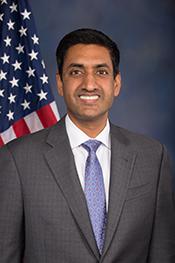
Ro Khanna
DDemocratCA-17 · Representative
55
/ 100
Average
Attendance98
Avg: 96
Independence3
Avg: 4
Bipartisan Tone18
Avg: 15
Ethics Record100
Avg: 99
Transparency39
Avg: 53
Accountability Score — composite of attendance, independence, bipartisan tone, ethics record & transparency.
Methodology40
Bills Sponsored
1
Enacted into Law
1
Passed a Chamber
38
In Committee
Bills That Became Law
All Sponsored Bills
HCONRES124In Committee
Directing the President pursuant to section 5(c) of the War Powers Resolution to remove United States Armed Forces from hostilities against the Houthis in Yemen that have not been authorized by Congress.
HR10761In Committee
Campus Accountability and Safety Act of 2026
HR10741In Committee
To enhance the supply of child care, and for other purposes.
HR10568In Committee
Protecting Biological Data as Critical Infrastructure Act
HR10569In Committee
Protecting Biotechnology and Biomanufacturing as Critical Infrastructure Act
HR10498In Committee
Illegal War Refund Act
HRES1471In Committee
Expressing the sense of the House of Representatives that every American and community impacted by the construction or operation of an artificial intelligence data center should have the right to transparency and local autonomy.
The House is expressing support for the idea that communities and residents affected by artificial intelligence data centers should have the right to know what's happening with these facilities and have a say in local decisions about them. This is a statement of principle rather than a law that would enforce new requirements, but it signals that Congress believes people deserve transparency about how these large computing facilities operate in their neighborhoods and should have some control over whether and how they're built.
HR9985In Committee
AI Ads Act
This bill would update campaign finance laws to make it illegal for political campaigns and candidates to use AI-generated content to deceive voters or trick people into donating money. The law would specifically target fake videos, images, or messages created with artificial intelligence that misrepresent a candidate's positions or falsely claim to represent their campaign. This protects voters and donors from being manipulated by deepfakes and other AI-created deceptions during elections.
HR9961In Committee
No Campaign Funded Cover-Ups Act
This legislation would ban politicians and candidates from using money raised for their campaigns or legal defense to pay settlements, judgments, or penalties in cases involving sexual assault, sexual abuse, or sexual harassment. The measure affects federal elected officials and candidates who currently may use campaign funds for these purposes, potentially forcing them to pay such costs from personal funds instead. The bill was referred to the House Committee on House Administration for consideration.
HR9962In Committee
Green New Deal for Health Act
The proposal would direct the health care industry to reduce its environmental impact and prepare for climate-related health threats by setting sustainability standards, investing in green infrastructure at hospitals and clinics, and training health workers on climate resilience. It would affect hospitals, doctors' offices, pharmaceutical companies, and health care workers while aiming to lower pollution from medical facilities and help the health system better respond to climate-related emergencies like heat waves and disease outbreaks.
HR9912In Committee
Industrial Bank for American Manufacturing Act of 2026
The Department of Commerce would create a new program to help American companies expand and upgrade their facilities and equipment for making advanced technologies like semiconductors, batteries, and other critical products domestically. This program would provide financial support and resources to help these technology manufacturers grow their operations in the United States rather than overseas. The goal is to strengthen America's ability to produce cutting-edge technology and reduce dependence on foreign suppliers.
HR9857In Committee
Protecting Americans from Doxing and Political Violence Act
The legislation would enhance security measures for members of Congress, their families, and congressional staff by providing additional protective resources and security protocols. It aims to address safety concerns for these individuals both at their offices and in their home districts or states. The bill would likely increase funding for security details, threat assessment programs, and other protective measures to keep lawmakers and their staff safe from potential threats.
HR9284In Committee
Foreign Investment Review Monitoring and Commitment Tracking Oversight Board Act
The proposal would create a new government agency to track whether foreign countries are keeping their promises to invest money in the United States and to investigate when they fail to do so. This would affect American businesses and workers by potentially holding foreign investors accountable for pledged investments, though it could also impact international trade relationships. The agency would have the power to review foreign investment deals and determine compliance with commitments made to the U.S. government.
HR9283In Committee
Critical Defense Ownership Review Act
The government would be required to review when investment companies buy controlling stakes in major defense contractors to ensure national security isn't compromised. This would give federal officials a chance to examine whether foreign investors or financial firms with questionable ties could gain influence over companies that make weapons and military equipment for the U.S. Armed Forces.
HR8107Passed House
Government Audit and Accountability of Federally Funded State-Administered Programs Act
Government Audit and Accountability of Federally Funded State-Administered Programs Act This bill requires the Government Accountability Office to report on federally funded state-administered programs (including programs subject to federal single audit requirements) that are at high risk for waste, fraud, and abuse. Specifically, the report must identify program areas and administrative practices that make such programs systematically vulnerable to waste, fraud, and abuse; assess best practices that strengthen the administration of federally funded programs and prevent such vulnerabilities; identify federal tools, resources, and assistance to address vulnerability patterns; and include recommendations for addressing high-risk program areas and administrative practices.
HR8930In Committee
Federal Biotechnology Workforce Assessment Act
The federal government would study which biotechnology jobs and skills are needed across agencies like the National Institutes of Health, the Department of Defense, and the Department of Energy to better understand current workforce gaps. This assessment would help these agencies plan for hiring, training, and retaining scientists and researchers in critical biotech fields. The findings could inform decisions about recruiting talent and developing programs to meet the nation's biotechnology workforce demands.
HRES1207In Committee
Stop Private Equity Harms Resolution
This resolution expresses opposition to certain practices by private equity firms—companies that buy up other businesses and restructure them for profit—that critics argue harm workers, consumers, and communities. The measure targets concerns about how private equity ownership can lead to job cuts, reduced services, higher prices, and increased debt loads at acquired companies. Workers in industries targeted by private equity buyouts, along with consumers who depend on services from these companies, would be the primary groups affected by any policies this resolution might encourage.
HCONRES87In Committee
Directing the President, pursuant to section 5(c) of the War Powers Resolution, to remove United States Armed Forces from hostilities with Iran.
This concurrent resolution directs the President to remove U.S. Armed Forces from hostilities against Iran or any part of its government or military unless a declaration of war or authorization to use military force for such purpose has been enacted. The resolution specifies that it shall not be construed to prevent the United States from defending itself, its Armed Forces, its diplomatic facilities, or allied states from imminent attack.
HR8377In Committee
Stop Deadly Denials Act of 2026
This bill would eliminate "prior authorization" requirements for Medicare Advantage plans, which currently require doctors to get insurance company approval before providing certain treatments or procedures to patients. It would also restrict the federal government's ability to test prior authorization systems in traditional Medicare. The change would affect millions of seniors on Medicare by potentially speeding up access to medical care, though it could increase costs for the insurance plans involved.
HR8266In Committee
Gasoline Export Ban Act of 2026
Gasoline Export Ban Act of 2026 This bill prohibits the exportation of gasoline produced in the United States during certain periods of high gasoline prices. Specifically, the bill directs the President to prohibit the exportation of gasoline produced in the United States during periods when the average price for gasoline in the United States has been equal to or higher than $3.12 per gallon for each of the preceding seven days. The President may exempt from the prohibition exports of gasoline as the President determines to be consistent with the national interest and the purposes of the bill.
HR8108In Committee
End Polluter Welfare for Enhanced Oil Recovery Act of 2026
This bill would set an expiration date for a tax credit that currently allows companies to deduct costs for capturing and storing carbon dioxide, a greenhouse gas. The change would affect energy companies and industrial facilities that use carbon capture technology, potentially making the tax benefit temporary rather than permanent. The bill has been sent to the House Ways and Means Committee for review.
HR7960In Committee
Big Oil Windfall Profits Tax Act
The bill would add a special tax on oil companies' profits when crude oil prices spike unusually high, then return the money collected to regular taxpayers through rebates. This aims to prevent oil companies from making excessive profits during supply shortages or price surges while putting cash back in Americans' pockets. The proposal is currently under review by the House committee that handles tax legislation.
HR7907In Committee
AI-Ready Bio-Data Standards Act
This bill would establish standardized formats and rules for how biological data is collected, stored, and shared so that artificial intelligence systems can more easily analyze it for medical research and development. The standards would help researchers, hospitals, and biotech companies work with genetic and health information in a consistent way, potentially speeding up discoveries in medicine and disease treatment. The bill affects scientists, healthcare providers, technology companies, and patients whose data might be used in AI-powered medical research.
HR7832In Committee
America’s Living Library Act
Without specific subjects listed, this bill likely aims to create a national program that preserves and protects natural spaces, wildlife habitats, or public lands across America, possibly by establishing new conservation areas or expanding existing ones. The referral to multiple committees suggests it involves coordination between natural resources management, agriculture, government administration, and energy policy. The bill would probably affect landowners, conservation groups, outdoor enthusiasts, and communities near protected areas.
HR7767In Committee
Make Billionaires Pay Their Fair Share Act
This proposal would create a new annual tax on wealthy individuals based on the total value of their assets rather than just their income, affecting people with substantial net worth. The tax would apply each year to the net value of things like investments, real estate, and other property that taxpayers own. The bill has been referred to multiple congressional committees to review how it would work with existing tax laws and financial regulations.
HRES1092In Committee
Condemning Israeli settlement expansion, settler violence, and related human rights abuses in the West Bank, and calling for accountability and specific United States policy responses to deter further violations and protect the viability of a negotiated two-State solution.
This resolution expresses Congress's opposition to Israeli settlement expansion in the West Bank and calls on the U.S. government to take action against settler violence and human rights abuses through sanctions or other deterrents. It aims to protect the possibility of a two-state solution to the Israeli-Palestinian conflict by pressuring Israel to stop activities the resolution views as obstacles to peace. The measure has been sent to two House committees for review.
HRES1093In Committee
Acknowledging oppression, forced eviction, and suffering experienced by tens of thousands of Bhutanese citizens during the late 1980s and early 1990s, and encouraging steps toward justice, reconciliation, and lasting peace.
This resolution acknowledges the forced evictions and suffering experienced by tens of thousands of Bhutanese people in the late 1980s and early 1990s, and calls for efforts toward justice, reconciliation, and peace between affected communities. The measure expresses support for addressing this historical injustice and encourages steps to help those who were displaced or harmed during that period. It has been referred to the House Committee on Foreign Affairs for consideration.
HR7138In Committee
Stop Wall Street Landlords Act of 2026
This legislation would impose new taxes or restrictions on large investment firms and corporations that buy up residential properties to rent them out, with the goal of making housing more affordable for regular renters and homebuyers. The bill targets Wall Street investors and big real estate companies rather than individual landlords, and would affect how these large institutional investors can operate in the housing market. The proposal is currently being reviewed by congressional committees that handle tax policy and financial regulation.
HRES1005In Committee
Expressing the sense of the House of Representatives that creators and digital workers, as a distinct and growing class of small businesses and independent economic contributors, deserve fair treatment, transparency, and economic opportunity in the modern platform-based economy.
This resolution expresses support for treating content creators and digital workers—like YouTubers, streamers, and freelancers who work through online platforms—fairly by ensuring they have access to transparent information about how platforms operate and better economic opportunities. The measure recognizes these workers as a growing group of small business owners who deserve protections and clarity similar to traditional employees or business owners. While it's a statement of intent rather than a law that would directly change rules, it signals that Congress believes digital platforms should treat creators more equitably.
HR4405Enacted
Epstein Files Transparency Act
Epstein Files Transparency Act This act requires the Department of Justice (DOJ) to publish (in a searchable and downloadable format) all unclassified records, documents, communications, and investigative materials in DOJ's possession that relate to the investigation and prosecution of Jeffrey Epstein. This includes (1) materials that relate to Ghislaine Maxwell, (2) flight logs and travel records, and (3) individuals named or referenced (including government officials) in connection with the investigation and prosecution of Jeffrey Epstein. DOJ is permitted to withhold certain information such as the personal information of victims and materials that would jeopardize an active federal investigation. Additionally, not later than 15 days after the required publication, DOJ must report to Congress (1) all categories of information released and withheld, (2) a summary of any redactions made, and (3) a list of all government officials and politically exposed individuals named or referenced in the published materials.
HR5400In Committee
To amend title 10, United States Code, to require the Secretary of Defense to annually review the amount of financial assistance for child care and youth program services providers provided by the Secretary.
HR5190In Committee
To expand the contested logistics demonstration and prototyping program to include commercial additive manufacturing facilities in contested logistics environments, and for other purposes.
HR4685In Committee
ICBM Act
The ICBM Act addresses policies and funding related to intercontinental ballistic missiles, which are long-range nuclear weapons systems used by the U.S. military. The bill affects military personnel, defense contractors, and taxpayers by potentially changing how these weapons are developed, maintained, or deployed. Congress is currently reviewing the proposal to determine what changes, if any, should be made to existing ICBM programs.
HR4406In Committee
State-Based Universal Health Care Act of 2025
This bill would allow individual states to create their own universal health care systems that cover all residents, rather than requiring a one-size-fits-all national approach. It would give states flexibility to design programs tailored to their needs while potentially exempting them from certain federal health care requirements. The proposal affects everyone with health insurance, state governments, employers, and federal health programs like Medicare and the military's health system.
HR3546In Committee
Prescription Drug Price Relief Act of 2025
Prescription Drug Price Relief Act of 2025 This bill requires the Department of Health and Human Services (HHS) to review brand-name drugs annually for excessive pricing and, if a drug is found to be priced excessively, to void any exclusivity granted to its sponsor. Specifically, HHS must review all brand-name drug prices at least annually and upon petition. If any such drugs are found to be excessively priced, HHS must (1) void any government-granted exclusivity; (2) issue open, nonexclusive licenses for the drugs; and (3) expedite the review of corresponding applications for generic drugs and biosimilar biological products. HHS must also create a public database with its determinations for each drug. An entity accepting an open, nonexclusive license under these provisions must pay a reasonable royalty to the holder of the relevant patent or approved new drug application, and must price the generic drug or biosimilar below the excessive rate. Under the bill, a price is considered excessive if the domestic average manufacturing price exceeds the median price for the drug in Canada, the United Kingdom, Germany, France, and Japan. If a price does not meet this criteria, or if pricing information is unavailable in at least three of these countries, the price is still considered excessive if it is higher than reasonable in light of specified factors, including development cost, revenue, and the size of the affected patient population. The bill also requires drug manufacturers to report specified financial information for brand-name drugs, including research and advertising expenditures.
HR3493In Committee
Global Fairness in Drug Pricing Act
This bill would allow the federal government to negotiate drug prices more aggressively and potentially tie what Americans pay for medications to prices charged in other developed countries, aiming to reduce prescription drug costs for patients and the government. The legislation would affect pharmaceutical companies, Medicare and Medicaid programs, and anyone who takes prescription drugs. It has been referred to multiple House committees for review but has not yet been voted on.
HR2263In Committee
Telehealth Coverage Act of 2025
Telehealth Coverage Act of 2025 This bill permanently extends coverage of telehealth services and other coverage flexibilities under Medicare. Specifically, the bill permanently extends certain flexibilities that were initially authorized during the public health emergency relating to COVID-19. Among other things, the bill allows (1) rural health clinics and federally qualified health centers to serve as the distant site (i.e., the location of the health care practitioner); (2) the home of a beneficiary to serve as the originating site (i.e., the location of the beneficiary) for all services (rather than for only certain services); and (3) audiologists, physical therapists, occupational therapists, and speech-language pathologists to furnish telehealth services. The bill also permanently extends programs that provide added flexibility to treat Medicare beneficiaries at home, including the Acute Hospital Care at Home Program. The program allows hospitals to treat certain patients from emergency departments or inpatient hospital beds at home. Additionally, the Centers for Medicare & Medicaid Services must (1) issue guidance for telehealth providers on how to support those with limited English proficiency, and (2) conduct outreach to providers to support screenings for medication-induced movement disorders that are associated with treating mental health disorders in at-risk patients, including telehealth screenings.
HR1074In Committee
Supreme Court Term Limits and Regular Appointments Act of 2025
Supreme Court Term Limits and Regular Appointments Act of 2025 This bill establishes staggered, 18-year terms for Supreme Court Justices and limits the Senate's advice and consent authority in relation to the appointment of Justices. Specifically, the bill requires the President to appoint a Supreme Court Justice every two years. If the appointment of a Justice would result in more than nine Justices on the Court, then the nine most junior Justices shall make up the panel of Justices exercising judicial power in cases and controversies. Further, any Justice who has served a total of 18 years is deemed retired from regular service and may continue to serve as a Senior Justice. Senior Justices may continue to perform judicial duties assigned to them by the Chief Justice. However, no Justice appointed before the date of enactment shall be counted towards such panel, nor shall they be required to retire from regular active service. In the event of a vacancy on the Court, the Chief Justice must assign the Justice most recently designated as a Senior Justice to serve on the Court until the appointment of a new Justice. Additionally, the Senate's advice and consent authority is waived if the Senate does not act within 120 days of a Justice's nomination.
HR564In Committee
Repeal the TikTok Ban Act
Repeal the TikTok Ban Act This bill repeals the prohibition on distributing, maintaining, updating, or providing internet hosting services for a foreign adversary controlled application (e.g., TikTok) and nullifies any existing designation of a website or application as a foreign adversary controlled application. Under current law, a foreign adversary controlled application is a website or application directly or indirectly operated by (1) ByteDance, Ltd., TikTok, their subsidiaries, successors, or related entities they control; or (2) a social media company that is controlled by a foreign adversary country and determined by the President to present a significant threat to national security. (Here, the term social media company excludes any website or application primarily used to post product reviews, business reviews, or travel information and reviews. The term foreign adversary country means North Korea, China, Russia, and Iran.) Current law generally prohibits the distribution, maintenance, implementation of updates, or provision of hosting services for a foreign adversary controlled application, unless an approved divestiture transaction results in the application no longer being controlled by a foreign adversary country, among other requirements.
HR391In Committee
Extend the TikTok Deadline Act
The legislation would delay the deadline for TikTok to divest its U.S. operations or face a ban, giving the company additional time to sell itself to a non-Chinese owner. This affects millions of American TikTok users who could lose access to the app, the company's employees, and investors who have stakes in the platform. The bill essentially extends a previously set deadline that was intended to address national security concerns about Chinese government access to American user data.