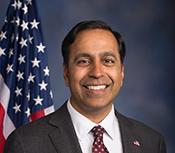
Raja Krishnamoorthi
DDemocratIL-8 · Representative
52
/ 100
Average
Attendance98
Avg: 96
Independence3
Avg: 4
Bipartisan Tone15
Avg: 15
Ethics Record100
Avg: 99
Transparency23
Avg: 53
Accountability Score — composite of attendance, independence, bipartisan tone, ethics record & transparency.
Methodology33
Bills Sponsored
0
Enacted into Law
1
Passed a Chamber
32
In Committee
All Sponsored Bills
HR10742In Committee
LESSONS from Ukraine Act
HR10627In Committee
Animal Welfare Enforcement Improvement Act
HR5773Passed House
To designate the facility of the United States Postal Service at 1300 East Northwest Highway in Palatine, Illinois, as the "Bernie Bluestein Post Office Building".
This bill designates the facility of the United States Postal Service at 1300 East Northwest Highway in Palatine, Illinois, as the "Bernie Bluestein Post Office Building".
HR10366In Committee
NO FLOCK Act
HR9748In Committee
Protecting Students from Worthless Degrees Act
The proposal would establish new rules to protect students from unfair or deceptive practices by schools, colleges, and education-related companies. It would likely give students stronger rights to challenge misleading claims about programs, costs, job placement rates, or other educational services, and could include penalties for institutions that violate these protections. Students and their families would benefit from clearer information and stronger recourse if they feel misled about their educational investments.
HR9747In Committee
Welcome Back to the Health Care Workforce Act
The federal government would provide grants to help internationally trained doctors, nurses, and other healthcare workers get the credentials and support they need to work in the United States. This program aims to address healthcare worker shortages by making it easier for skilled foreign-trained professionals to enter the American healthcare system. The grants would cover things like licensing exams, credential verification, and job training programs.
HR9596In Committee
Federal Jobs for STARs Act of 2026
The federal government would be allowed to hire workers for certain jobs based on skills they've learned outside traditional four-year college degrees, such as through apprenticeships, trade schools, or on-the-job training programs. This change would make it easier for people who developed expertise through alternative education routes to qualify for federal positions without requiring a college diploma. The measure aims to expand the talent pool available to federal agencies and create more employment opportunities for skilled workers regardless of how they obtained their training.
HRES1322In Committee
Condemning racist rhetoric targeting Indian and Chinese Americans, reaffirming that immigrants from all backgrounds are vital to the United States, and calling on all elected officials to refrain from language that promotes racial or ethnic division.
This resolution expresses disapproval of racist language directed at Indian and Chinese Americans and emphasizes that immigrants from all countries contribute importantly to the United States. It calls on elected officials to avoid using language that divides people along racial or ethnic lines. The measure has been sent to the House Judiciary Committee for consideration.
HR8932In Committee
Hate Crimes Commission Act of 2026
The proposal would create a new federal commission to research hate crimes, understand what causes them, and recommend ways to prevent them from happening. The commission would study patterns in hate crimes across the country and provide guidance to lawmakers and law enforcement agencies on how to better protect communities targeted by these crimes. This would affect law enforcement officials, community organizations, and people in communities that experience hate crimes.
HR8577In Committee
Disaster Declaration Transparency Act of 2026
This bill would let Congress override a President's decision to reject a governor's request for federal disaster relief funds. If a state governor asks for federal help after a major disaster and the President says no, Congress could vote to reverse that decision and provide the assistance anyway. This would give lawmakers a way to ensure disaster aid reaches affected states even if the President disagrees.
HR8429In Committee
Baby Food Safety Act of 2026
The proposal would establish new safety standards and testing requirements for baby food products sold in the United States, requiring manufacturers to test for contaminants like heavy metals and pesticides before products reach store shelves. It would give the FDA stronger authority to inspect baby food facilities and recall unsafe products more quickly. Parents and baby food companies would be the main groups affected, as manufacturers would need to meet stricter safety rules while families could have more confidence in the products they feed their infants.
HR7909In Committee
Medicare Expansion and Lowering Costs Now Act
Medicare Expansion and Lowering Costs Now Act This bill establishes a Medicare buy-in option for certain qualifying individuals and makes a series of other changes relating to health care costs. It also repeals the health provisions that were enacted under what is commonly known as the One Big Beautiful Bill Act. Specifically, the bill allows individuals aged 50 to 64 to enroll in Medicare if such individuals would otherwise qualify for Medicare at the age of 65. The Centers for Medicare & Medicaid Services (CMS) must determine enrollment periods and set premiums for the buy-in option established under the bill, in accordance with specified requirements. The CMS must also award grants to states and nonprofit organizations for outreach and enrollment activities relating to the buy-in option. Additionally, the bill repeals the health provisions that were enacted under what is commonly known as the One Big Beautiful Bill Act. Among other provisions, the act required individuals who are eligible for Medicaid as part of the Medicaid expansion population to engage in community service, work, or other activities in order to qualify for Medicaid. (For more information about these and other health provisions in the act, see CRS Report R48633 .) The bill also (1) establishes a supplemental option under Medicare to cover cost-sharing for beneficiaries; (2) establishes an individual market reinsurance program relating to coverage of high-cost individuals, as specified; and (3) expands eligibility for the premium tax credit.
HR7833In Committee
Puerto Rican People’s Power Restoration Act of 2026
This bill would give Puerto Rico greater control over its energy system and infrastructure, likely addressing how the island manages its power generation and distribution. The proposal has been sent to two congressional committees to review different aspects—one focusing on natural resources and energy matters, and the other on legal and jurisdictional questions about Puerto Rico's authority. The bill appears aimed at restoring local decision-making power over Puerto Rico's energy sector.
HR7542In Committee
Kids Need Lunch Act
This bill would expand access to free or reduced-price school lunches for more children, likely by increasing funding or loosening income requirements that determine which students qualify. The changes would affect school districts, families with school-age children, and the agriculture industry that supplies food to schools. The goal is to ensure more kids have access to nutritious meals during the school day.
HR7161In Committee
No Private Bounty Hunters for Immigration Enforcement Act
This bill would prohibit private companies from being hired to enforce immigration laws or apprehend people for immigration violations, keeping those duties exclusively with government agencies. It would prevent immigration enforcement from being outsourced to private bounty hunters or contractors, ensuring that immigration-related arrests and enforcement actions are handled only by official government personnel. The bill affects immigration enforcement practices and could impact private security companies that currently contract with immigration authorities.
HR7160In Committee
First Home Affordability Act
This bill would likely create tax benefits or credits to help first-time homebuyers afford to purchase their first home, such as reducing taxes owed or providing direct financial assistance at tax time. The changes would primarily affect young adults and families trying to buy a home for the first time by making down payments and closing costs more manageable. The proposal is currently under review by the House committee that handles tax policy.
HR6576In Committee
SAFE LiDAR Act
The bill would establish safety standards and regulations for LiDAR technology, which uses laser pulses to create detailed 3D maps and is commonly used in self-driving cars, drones, and mapping systems. It aims to ensure that LiDAR devices don't pose safety risks to people or interfere with other equipment, affecting manufacturers of autonomous vehicles and tech companies that develop this technology. The proposal has been sent to multiple congressional committees to review different aspects, including how it relates to commerce, government oversight, and transportation.
HR6528In Committee
Tracking and Restricting Adversarial Circumvention of Embargoes Act of 2025
This bill would strengthen enforcement of U.S. trade embargoes by giving the government better tools to track and stop companies and individuals from finding ways around sanctions against hostile countries. It targets people and businesses that try to circumvent restrictions on trade with embargoed nations, likely through shell companies, third-party transactions, or other indirect methods. The measure would affect international businesses, importers, exporters, and enforcement agencies responsible for monitoring compliance with U.S. sanctions.
HR6305In Committee
High-skilled Immigration Reform for Employment Act
This legislation would make it easier for U.S. companies to hire highly skilled foreign workers by reforming immigration rules for jobs that require advanced education or specialized expertise. The changes would affect both employers looking to fill technical positions and foreign professionals seeking to work in the United States, potentially making the visa process faster or expanding the number of available work visas for skilled positions.
HR6202In Committee
Brand USA Restoration Act
This bill would restore federal funding and support for Brand USA, the nonprofit organization that promotes American tourism and travel destinations to international visitors. The legislation aims to help the travel and tourism industry attract more foreign tourists to the United States, which benefits hotels, restaurants, airlines, and local communities that depend on visitor spending. The bill has been referred to the House Committee on Appropriations, which handles decisions about federal spending.
HR5912In Committee
DISRUPT Act
The bill addresses international affairs and national security matters related to disrupting threats or adversaries, likely involving coordination between the State Department, military, and intelligence agencies. Based on its referral to multiple committees overseeing foreign policy, defense, and intelligence operations, it probably proposes new strategies or authorities for responding to international challenges, though the specific details would depend on the bill's full text.
HRES824In Committee
Recognizing the religious and historical significance of the festival of Diwali.
This resolution recognizes the religious and historical significance of Diwali.
HR5434In Committee
988 LGBTQ+ Youth Access Act of 2025
This bill would require the 988 Suicide and Crisis Lifeline to ensure LGBTQ+ youth have access to affirming mental health support and crisis counselors trained in LGBTQ+ issues. The measure aims to improve how the national suicide prevention hotline serves young people who identify as LGBTQ+, addressing concerns that they face higher rates of suicidal thoughts and need culturally competent care. It affects mental health service providers, the 988 hotline network, and LGBTQ+ youth seeking crisis support.
HRES635In Committee
Expressing the sense of the House of Representatives that Ghislaine Maxwell should not receive a pardon, commutation, or other form of clemency from the President of the United States.
The House is expressing its official position that President Biden should not pardon, reduce the sentence of, or grant any other form of clemency to Ghislaine Maxwell, who was convicted of sex trafficking crimes. This is a non-binding statement of the House's opinion rather than a law that would prevent a pardon, and it reflects lawmakers' view that Maxwell's serious convictions warrant her serving her full sentence.
HR4806In Committee
College Transparency Act
College Transparency Act This bill requires the National Center for Education Statistics (NCES) to establish a secure and privacy-protected data system that contains information about postsecondary students. Specifically, the data system must evaluate student enrollment patterns, progression, completion, and postcollegiate outcomes, and higher education costs and financial aid; provide complete and customizable information for students and families making decisions about postsecondary education; reduce the requirements for reporting by institutions of higher education; and periodically match with other federal systems of data. The bill also establishes a postsecondary student data system advisory committee.
HR4688In Committee
COOL OFF Act
Choosing Our Own Lives Over Fast Firearms Act or the COOL OFF Act This bill establishes a three-day waiting period for certain handgun transfers. Specifically, the bill makes it unlawful for a licensed importer, manufacturer, or dealer to sell or transfer a handgun to an unlicensed individual unless three business days have elapsed since the licensee initiated a background check. A violator is subject to criminal penalties—a fine, up to one year in prison, or both. Additionally, the bill makes it unlawful for an unlicensed individual to receive a handgun from another unlicensed individual unless at least three business days have elapsed since the recipient most recently offered to take possession of the handgun. A violator is subject to criminal penalties—a fine, up to five years in prison, or both. The three-day waiting period does not apply to certain handgun transfers, such as for a loan between spouses for a lawful purpose.
HR4597In Committee
To direct the United States Postal Service to designate a single, unique ZIP Code for Pingree Grove, Illinois.
The proposal would require the U.S. Postal Service to assign Pingree Grove, Illinois its own distinct ZIP Code instead of sharing one with neighboring communities. This change would give the village its own postal identity, which could improve mail delivery efficiency and help residents and businesses have a clearer address designation. The request is currently under review by the House Committee on Oversight and Government Reform.
HR4508In Committee
BURDEN Act
HR4409In Committee
Fair Pharmacies for Federal Employees Act of 2025
Federal employees would be allowed to use any pharmacy of their choice when filling prescriptions under their health insurance plans, rather than being limited to a specific network of pharmacies. The legislation aims to give federal workers the same flexibility that many private insurance plans offer, potentially reducing out-of-pocket costs and travel time for those in areas with limited pharmacy options. This change would affect millions of federal employees and retirees who currently use the Federal Employees Health Benefits Program.
HR4186In Committee
Connecting Students with Mental Health Services Act
The bill would help schools connect students with mental health services by improving how schools identify students who need support and making it easier for them to access counseling and treatment. It affects students, school staff, and mental health providers by creating better coordination between schools and mental health professionals. The goal is to address the growing mental health challenges among young people by removing barriers that prevent students from getting the help they need.
HR3452In Committee
Six Assurances to Taiwan Act
This bill would reaffirm the United States' commitment to supporting Taiwan's defense and security through six key pledges, likely including continued military aid, diplomatic recognition, and support for Taiwan's participation in international organizations. The legislation aims to strengthen the U.S.-Taiwan relationship and signal American resolve to maintain stability in the region, affecting U.S. foreign policy toward China and Taiwan as well as defense contractors and military suppliers involved in Taiwan's security.
HR2559In Committee
Taiwan Allies Fund Act
This bill would create a fund to provide financial support and aid to countries that are allies of Taiwan, helping strengthen their economies and security partnerships in the region. The money would be used to assist these nations in areas like infrastructure, defense, and economic development, with the goal of building closer relationships with Taiwan and countering China's influence in the Indo-Pacific. The bill affects U.S. foreign policy and relationships with Taiwan's diplomatic partners.
HRES41In Committee
Expressing support for the designation of the month of January, as "Tamil Language and Heritage Month".
This resolution recognizes that Tamil Americans enhance the rich diversity of the United States and supports the designation of Tamil Language and Heritage Month.