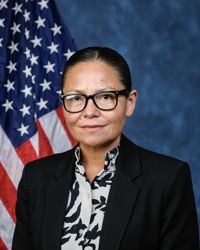
Kimberlyn King-Hinds
RRepublicanMP · Representative
62
/ 100
Average
Attendance78
Avg: 96
Independence35
Avg: 4
Bipartisan Tone3
Avg: 15
Ethics Record100
Avg: 99
Transparency100
Avg: 53
Accountability Score — composite of attendance, independence, bipartisan tone, ethics record & transparency.
Methodology15
Bills Sponsored
0
Enacted into Law
2
Passed a Chamber
12
In Committee
All Sponsored Bills
HR6448In Committee
TASA Act of 2025
HR10341In Committee
Marianas Tourism Advancement Act of 2026
HR10318In Committee
PACMESA
HR10074In Committee
Affordable Power for the Northern Marianas Act
HR9652In Committee
Northern Marianas VA Community-Based Outpatient Clinic Authorization Act of 2026
The Department of Veterans Affairs would be allowed to build or improve a small medical facility in Saipan to serve veterans in the Northern Mariana Islands. This would give veterans in that territory better access to healthcare services without having to travel far from home. The bill is currently under review by the House Committee on Veterans' Affairs.
HR9787In Committee
Northern Mariana Islands Labor Stabilization Act
The Northern Mariana Islands, a U.S. territory in the Pacific, would modify how it transitions its labor stabilization program, which controls who can work there and for how long. The changes would adjust the rules and timeline for this transition period to better manage the territory's workforce needs. This affects workers seeking employment in the Northern Mariana Islands and businesses operating there.
HR9316In Committee
Travel Assistance for Veterans in Medical Deserts Act
Veterans with service-connected disabilities who live in U.S. territories or freely associated states like Palau and the Marshall Islands would become eligible for travel payments to help them get to medical appointments, similar to benefits already available to veterans in the 50 states. Currently, these veterans often have to pay their own travel costs to reach VA medical facilities, which can be expensive given the remote locations where they live. The change would help ensure veterans in these areas can access the healthcare they've earned through their military service without facing financial hardship.
HR8931In Committee
Northern Mariana Islands Workforce Improvement Act
This bill would remove a requirement that certain workers from Commonwealth territories (like Puerto Rico, the U.S. Virgin Islands, and Guam) must leave the United States and return to their home territory before being allowed to work in the country. The change would make it easier for these workers to obtain employment authorization without having to go through the process of leaving and re-entering the U.S.
HR6652Reported
U.S. Vets of the FAS Act
This bill would provide benefits and support services to veterans who served in the Foreign Agricultural Service or similar civilian roles supporting U.S. armed forces abroad. The legislation aims to ensure these veterans receive recognition and access to healthcare, disability benefits, or other veteran services comparable to those available to military personnel. The bill is currently being reviewed by a congressional committee to determine its final form before a full vote.
HR7795In Committee
VA SUBCON Act
The VA SUBCON Act likely aims to improve how the Department of Veterans Affairs handles subcontracting—the practice of hiring other companies to perform work on VA contracts. The bill probably seeks to ensure that veterans and veteran-owned businesses have fair opportunities to compete for these subcontracts, or to increase transparency and accountability in how VA awards work to smaller contractors. This would affect veterans looking to start businesses, companies bidding for VA work, and ultimately the veterans who receive services from the VA.
HR3496Passed House
Northern Mariana Islands Small Business Access Act
Northern Mariana Islands Small Business Access Act This bill expands eligibility for the Small Business Administration microloan program to include entities in the Commonwealth of the Northern Mariana Islands. The microloan program provides loans up to $50,000 for small businesses and certain nonprofit childcare centers.
HR5640In Committee
Northern Mariana Islands and American Samoa Criminal Justice Support Act
Northern Mariana Islands and American Samoa Criminal Justice Support Act This bill increases the amount of state formula grant funds allocated to American Samoa and the Northern Mariana Islands under the Edward Byrne Memorial Justice Assistance Grant (JAG) program. Currently, American Samoa and the Northern Mariana Islands are considered to be one state, and they split one JAG allocation with 67% going to American Samoa and 33% going to the Northern Mariana Islands. This bill considers American Samoa and the Northern Mariana Islands to be separate states, which entitles each of them to a full JAG allocation.
HR3400Passed House
TRAVEL Act of 2025
The Territorial Response and Access to Veterans' Essential Lifecare Act or the TRAVEL Act of 2025 This bill authorizes the Department of Veterans Affairs (VA) to assign a physician who has been appointed in the Veterans Health Administration to serve as a traveling physician for a period of not more than one year. Such physician must provide health care to veterans at VA facilities located in American Samoa, Guam, the Northern Mariana Islands, Puerto Rico, the U.S. Virgin Islands, and any other territory or possession of the United States. Traveling physicians must coordinate with non-VA providers when necessary to ensure high quality and coordinated care for veterans receiving hospital care and medical services. The VA must provide a relocation or retention bonus to traveling physicians.
HR3720In Committee
HOME Act of 2025
The HOME Act of 2025 would likely provide housing assistance or benefits to military members and veterans, addressing their access to affordable housing or home ownership. The bill has been referred to a subcommittee focused on economic opportunity, suggesting it aims to improve financial stability and quality of life for service members and their families. Without more specific details, the exact provisions remain unclear, but the focus appears to be on removing barriers that prevent military personnel from securing stable housing.
HR1797In Committee
Employment Services and Jobs Parity Act
This bill would likely aim to improve job training and employment services for people with disabilities or other barriers to work, ensuring they have equal access to job placement assistance and skills training as other workers. The legislation would probably require coordination between government agencies and employers to create more opportunities for underrepresented groups in the job market. It affects workers seeking employment services, employers, and government agencies that administer job training programs.