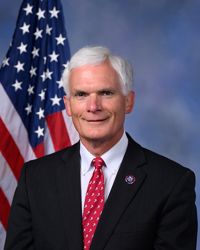
Robert E. Latta
RRepublicanOH-5 · Representative
60
/ 100
Average
Attendance100
Avg: 96
Independence1
Avg: 4
Bipartisan Tone27
Avg: 15
Ethics Record100
Avg: 99
Transparency60
Avg: 53
Accountability Score — composite of attendance, independence, bipartisan tone, ethics record & transparency.
Methodology18
Bills Sponsored
0
Enacted into Law
6
Passed a Chamber
12
In Committee
All Sponsored Bills
HR7257Passed House
SECURE Grid Act
Securing Community Upgrades for a Resilient Grid Act or the SECURE Grid Act This bill extends through FY2031 and modifies requirements for state energy security plans. Under current law, states are required to submit to the Department of Energy (DOE) state energy security plans that meet certain requirements in order to be eligible to receive federal financial assistance for state energy conservation programs. The bill specifies that DOE is not required to approve the plans. The bill requires DOE to provide information, technical assistance, and other assistance in the development, implementation, or revision of a state energy security plan upon the request of a state. The bill also requires states to address additional factors in their energy security plans, such as (1) weather-related threats and vulnerabilities; (2) supply chain risks for equipment for the generation, transmission, and distribution of electricity; and (3) the security of local distribution systems and the bulk-power system. A local distribution system is energy infrastructure owned and operated by an electric utility at a voltage of 100 kilovolts or less. In addition, the bill directs the Government Accountability Office to report to Congress on the efficacy of state energy security plans.
HR10164In Committee
BEDROCK Act
HR9914In Committee
Collaboration on Adversarial Threats and Security Risks Act
The proposal would allow companies developing advanced artificial intelligence systems to share information about potential risks and safety concerns with each other without violating antitrust laws that normally prevent competitors from collaborating. This would let AI developers work together to identify and address dangers from cutting-edge AI models while protecting them from legal liability for that cooperation. The measure affects major tech companies and AI developers who are currently hesitant to share safety information due to concerns about breaking competition laws.
HR7970In Committee
STOP Nitazenes Act
This bill would make nitazenes, a class of powerful synthetic opioids, illegal drugs under federal law and subject to criminal penalties similar to those for other dangerous controlled substances. Nitazenes are increasingly appearing on the street drug market and have been linked to overdose deaths, so the legislation aims to give law enforcement tools to prosecute their manufacture, distribution, and possession. The bill would affect drug traffickers, manufacturers, and potentially users caught with these substances.
HR9774In Committee
To amend the Federal Food, Drug, and Cosmetic Act to provide for expedited approval of priority nonprescription drugs, and for other purposes.
The proposal would speed up the approval process for over-the-counter medications that address serious health needs or offer significant advantages over existing treatments, allowing drugmakers to get these products to consumers faster. This would affect pharmaceutical companies developing nonprescription drugs and potentially benefit patients who need access to new over-the-counter remedies more quickly. The bill also includes other provisions related to drug regulation under federal food and drug laws.
HR3978In Committee
Nuclear REFUEL (Recycling Efficient Fuels Utilizing Expedited Licensing) Act
This bill would speed up the government approval process for recycling used nuclear fuel and developing new nuclear fuel technologies, allowing companies to bring these projects to market faster. By streamlining licensing requirements, the legislation aims to help the nuclear energy industry reduce waste and potentially lower costs for utilities and consumers who rely on nuclear power. The changes would primarily affect nuclear power plant operators, fuel manufacturers, and the Nuclear Regulatory Commission that oversees safety.
HR9151In Committee
Advancing American Wi-Fi Against Foreign Adversaries Act
The bill aims to strengthen America's wireless internet technology and infrastructure to reduce dependence on foreign companies, particularly those from countries considered adversaries. It would likely involve measures to support domestic development of Wi-Fi technology, secure networks against foreign interference, and ensure that critical communications systems remain under American control. This affects technology companies, internet service providers, and consumers who rely on wireless networks.
HR9126In Committee
HCBS Anti-Fraud Reporting Act of 2026
The legislation would require states to report suspected fraud and abuse in home and community-based services (HCBS) programs to federal authorities, helping catch cases where providers or recipients misuse Medicaid funds meant for elderly people and those with disabilities. By creating clearer reporting requirements and tracking systems, the bill aims to prevent waste and protect vulnerable people who depend on these services to live independently in their homes rather than institutions. States and healthcare providers would need to establish better monitoring procedures to identify and report suspicious activity.
HR7390In Committee
SELF DRIVE Act of 2026
This bill would establish federal rules and safety standards for self-driving vehicles on American roads, likely setting requirements for how autonomous cars must be tested and what safety features they need before manufacturers can sell them to the public. The legislation would affect car companies developing self-driving technology, state governments that currently regulate vehicles, and eventually consumers who might purchase or ride in autonomous vehicles. By creating uniform national standards, the bill aims to speed up the development and deployment of self-driving cars while protecting public safety.
HR3638Passed House
Electric Supply Chain Act
Electric Supply Chain Act This bill requires the Department of Energy (DOE) to periodically assess the supply chain that supports the generation and transmission of electricity and report on the assessment to the appropriate congressional committees. Specifically, DOE must periodically assess and report on information including trends and vulnerabilities in the supply of components needed for generating or transmitting electricity, barriers to expanding U.S. capacity to process critical materials, and domestic policies that deter greater investment into the supply chain; emerging issues in the supply chain; and recommendations to address these emerging issues and to secure and expand the supply chain. The initial report must be submitted no later than one year after the date of enactment of this bill.
HR6577In Committee
Stop Penalizing Working Seniors Act
This bill would eliminate or reduce the earnings limit that currently reduces Social Security benefits for seniors who continue working and earning income before reaching full retirement age. Currently, beneficiaries under full retirement age lose $1 in benefits for every $2 they earn above a certain threshold, which discourages older workers from staying in the workforce. The change would allow seniors to keep more of their Social Security payments while still working without facing these penalties.
HR3109Passed House
REFINER Act
Researching Efficient Federal Improvements for Necessary Energy Refining Act or the REFINER Act This bill requires the Department of Energy to direct the National Petroleum Council to publish a report on petrochemical refineries located in the United States. The report must include information concerning (1) the contributions of such refineries to U.S. energy security, (2) analyses and projections with respect to opportunities for expanding the capacities of the refineries and the risks to such refineries, (3) any federal or state executive actions that have contributed to a decline in their capacities, and (4) any recommendations to increase such capacities.
HR4273In Committee
Over-the-Counter Monograph Drug User Fee Amendments
Over-the-Counter Monograph Drug User Fee Amendments This bill reauthorizes the Over-the-Counter (OTC) Monograph Drug User Fee Program (OMUFA) through FY2030 and revises certain aspects of the program, including total fees to be collected and fee due dates. Under current law, many OTC drugs are marketed through compliance with an OTC monograph issued by the Food and Drug Administration (FDA), rather than through an approved new drug application. Monographs establish the conditions under which OTC drugs are generally recognized as safe and effective, and include ingredients, dosages, and other requirements. OMUFA permits the FDA to collect fees from OTC drug facilities and entities requesting changes to a monograph. The bill makes certain changes to OMUFA, including by revising the total facility fee revenue amount to be collected for FY2026-FY2030, revising due dates for facility fees, permitting the FDA to implement a one-time adjustment to facility fees if certain conditions exist, and requiring the FDA to publish facility and order request fee amounts at least 60 days before the start of each fiscal year. Finally, the bill adds as a Tier 2 OTC monograph order request a request for the addition or modification of a testing procedure applicable to a monograph drug, provided the testing procedure reflects a voluntary consensus standard with respect to pharmaceutical quality. (Requestors seeking certain kinds of changes to a monograph are awarded a period of market exclusivity if the FDA makes the requested changes; tier 2 requests are not eligible for market exclusivity.)
HR5147In Committee
WIRELESS Leadership Act
Winning the International Race for Economic Leadership and Expanding Service to Support Leadership Act or the WIRELESS Leadership Act This bill imposes limits on state and local review and regulation of requests to construct wireless telecommunication facilities. Specifically, states and localities must grant or deny requests to place, modify, or construct personal wireless service (PWS) facilities by a specified deadline. This deadline varies based on the nature of the request and the proposed facility. If a state or locality fails to act on a request within that timeframe, the request is deemed granted. On the day a decision to deny a request is made, the state or locality must publish the decision and provide it to the requesting party. Further, the bill expands an existing prohibition on unreasonable discrimination in the regulation of such requests. Under the bill, any discrimination among PWS facilities or communications service providers is prohibited. For example, a state or locality may not grant preferential or exclusive use of facilities to a particular provider or class of providers. However, states and localities may establish objective, reasonable, and nondiscriminatory engineering standards, safety requirements, or aesthetic requirements. Finally, the bill establishes requirements for fees imposed by states and localities for consideration of a request. For example, such fees must be (1) competitively neutral, technology neutral, and nondiscriminatory; (2) established in advance and publicly disclosed; and (3) based on actual and direct costs to the state or locality.
HR1618Passed House
Precision Agriculture Satellite Connectivity Act
Precision Agriculture Satellite Connectivity Act This bill requires the Federal Communications Commission (FCC) to review and recommend changes to its satellite rules to promote precision agriculture. Precision agriculture is a general term describing various crop management tools and practices that leverage technology like Global Positioning System (GPS) equipment and uncrewed aircraft systems (commonly known as drones) to optimize production and sustainability. In conducting its review, the FCC must consult with the Task Force for Reviewing the Connectivity and Technology Needs of Precision Agriculture, which advises the FCC on methods to assess and advance broadband internet on unserved agricultural land and promote precision agriculture.
HR866Passed House
ROUTERS Act
Removing Our Unsecure Technologies to Ensure Reliability and Security Act or the ROUTERS Act This bill requires the National Telecommunications and Information Administration to conduct a study on the national security risks posed by consumer routers and modems (including devices that combine a modem and router) and provide the results of the study to Congress. The study must address devices developed, manufactured, or supplied by persons (i.e., individuals and entities) owned by, controlled by, or subject to the influence of China, Iran, North Korea, or Russia.
HR2482Passed House
NTIA Reauthorization Act of 2025
National Telecommunications and Information Administration Reauthorization Act of 2025 or the NTIA Reauthorization Act of 2025 This bill reauthorizes the National Telecommunications and Information Administration (NTIA) through FY2026 and makes certain changes to its leadership structure. Specifically, the bill promotes the head of the NTIA, currently the Assistant Secretary of Commerce for Communications and Information, to the role of Under Secretary of Commerce for Communications and Information. The bill also promotes the Deputy Assistant Secretary of Commerce for Communications and Information to Deputy Under Secretary of Commerce for Communications and Information. Further, the bill provides statutory authority for two existing offices within NTIA—the Office of Spectrum Management and the Office of International Affairs. The bill also repeals certain outdated or expired NTIA reporting requirements and consolidates certain remaining reporting requirements into one annual report to Congress. Finally, the bill extends the obligation of the Office of the Inspector General for the Department of Commerce to audit the Connecting Minority Communities Pilot Program through FY2024.
HR685In Committee
SAVE Moms and Babies Act of 2025
Support And Value Expectant Moms and Babies Act of 2025 or the SAVE Moms and Babies Act of 2025 This bill prohibits the Food and Drug Administration (FDA) from approving any new drug (either as a brand-name drug or a generic) intended to terminate a pregnancy and imposes additional restrictions on such drugs that are already approved. Under the bill, an already-approved drug intended to terminate a pregnancy may be dispensed to a patient only with a prescription. Furthermore, the FDA may not approve any labeling change that would authorize (1) using the drug after 70 days of gestation, or (2) dispensing the drug by any means other than in-person administration by the prescribing health care practitioner. The FDA must also impose additional restrictions on such already-approved drugs, including by (1) requiring the prescribing health care practitioner to receive a special certification, (2) prohibiting the practitioner from also acting as the dispensing pharmacist, and (3) requiring the practitioner to have the ability to provide surgical intervention to the patient. The bill also rescinds any investigational use exemption already granted to such a drug if the bill would have prohibited the FDA from granting the exemption. (Currently, the FDA may grant an exemption to certain market approval requirements if a drug is intended solely for use in safety and effectiveness investigations.)