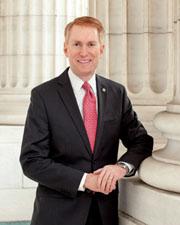
James Lankford
RRepublicanOK · Senator
56
/ 100
Average
Attendance99
Avg: 97
Independence23
Avg: 23
Bipartisan Tone16
Avg: 14
Ethics Record100
Avg: 100
Transparency20
Avg: 47
Accountability Score — composite of attendance, independence, bipartisan tone, ethics record & transparency.
Methodology50
Bills Sponsored
1
Enacted into Law
1
Passed a Chamber
33
In Committee
All Sponsored Bills
S5667In Committee
Ending Birthright Citizenship in U.S. Territories Act
S5573In Committee
Religious Education Fairness Act
SRES912In Committee
A resolution recognizing the 50th anniversary of the Hyde Amendment and its enduring legacy of saving the lives of more than 2,600,000 unborn children and respecting the conscience rights of the American people.
SRES915Introduced
A resolution recognizing the nationwide impact of Prison Fellowship on the occasion of its 50th anniversary.
S5562In Committee
Jimmy Lai Internet Freedom Act
SRES890In Committee
A resolution remembering, on the 105th anniversary of the Chinese Communist Party, the countless lives the Chinese Communist Party has destroyed and the people currently living in fear of its tyrannical ambitions.
SRES896Introduced
A resolution expressing the sense of the Senate regarding the importance of religious freedom, authoritative texts, and transparency in artificial intelligence systems.
SRES861Introduced
A resolution congratulating the University of Oklahoma baseball team for winning the 2026 National Collegiate Athletic Association Division I Baseball Championship, the third national championship in program history.
S3175Reported
CIPZIP Act of 2025
The proposal would establish new procedures and requirements for how federal agencies handle cybersecurity incidents and information protection within government operations. It aims to strengthen coordination between different government departments when dealing with cyber threats and data breaches that could affect national security or public services. The legislation would affect federal employees, government contractors, and potentially the public by setting standards for how quickly agencies must report and respond to cybersecurity problems.
S1051Passed Senate
Historic Greenwood District—Black Wall Street National Monument Establishment Act
This bill would establish a national monument in Tulsa, Oklahoma to honor the historic Greenwood District, also known as Black Wall Street, which was a thriving African American business and cultural center in the early 1900s before being destroyed during the 1921 Tulsa Race Massacre. The monument would preserve and interpret this important but often overlooked chapter of American history for visitors and future generations. The designation would bring federal recognition and resources to commemorate the district's significance and the experiences of the Black community that built and lost this prosperous neighborhood.
SRES845Introduced
A resolution designating September 2026 as "National Child Awareness Month" to promote awareness of charities that benefit children as well as youth-serving organizations throughout the United States and recognizing the efforts made by those charities and organizations on behalf of children and youth as critical contributions to the future of the United States.
S5355In Committee
Ballots by Election Day Act
S5255In Committee
Military Chaplains Modernization Act of 2026
S5272In Committee
Recover COVID Unemployment Fraud in Banks Act
S5109In Committee
Training Rural Law Enforcement Officers Act of 2026
The Department of Justice would be allowed to give money to nonprofit organizations that help train police officers in rural and smaller towns where resources are limited. These grants would help local law enforcement get better access to professional training programs they might not otherwise afford. The funding aims to improve policing standards across communities that typically have fewer resources than larger cities.
S4632Introduced
Prevent Government Shutdowns Act of 2026
Prevent Government Shutdowns Act of 2026 This bill provides continuing appropriations to prevent a government shutdown if the appropriations bills for a fiscal year have not been enacted before the fiscal year begins and continuing appropriations are not in effect. Specifically, the bill provides appropriations at the rate of operations that was provided for the prior fiscal year to continue programs, projects, and activities that were funded in the preceding fiscal year. The bill also limits official travel, congressional recesses or adjournments, and the consideration of legislation that is unrelated to appropriations after the beginning of a fiscal year if the appropriations process has not been completed.
SRES733Introduced
A resolution expressing the sense of the Senate that public servants should be commended for their dedication and continued service to the United States during Public Service Recognition Week and throughout the year.
The Senate passed a resolution recognizing and thanking government workers for their service to the country, both during Public Service Recognition Week and year-round. The resolution honors federal, state, and local employees across all agencies who work in public service. This is a ceremonial measure with no legal requirements or changes to policy.
SRES725Introduced
A resolution congratulating the University of Oklahoma women's gymnastics team for winning the 2026 National Collegiate Athletic Association Championship, the eighth national title in program history.
The Senate is officially recognizing and congratulating the University of Oklahoma women's gymnastics team for winning the 2026 NCAA Championship, marking their eighth national title in the program's history. This is a ceremonial resolution that honors the team's athletic achievement without creating any new laws or policies. The resolution passed unanimously in the Senate.
S4398In Committee
CDL Act
States would be required to add a marking to driver's licenses and ID cards showing whether the holder is a U.S. citizen in order for those documents to be accepted for federal purposes like boarding airplanes or entering federal buildings. The bill also sets new standards that states must follow when issuing commercial driver's licenses to be recognized by the federal government. This would affect anyone who needs a state ID for federal activities and states that issue these documents.
SRES681Introduced
A resolution relating to the life and death of Chuck Norris.
This resolution honors the life and legacy of Chuck Norris, the actor, martial artist, and television personality known for his roles in action films and the "Walker, Texas Ranger" series. The measure recognizes his contributions to entertainment and popular culture, as well as his philanthropic work and advocacy efforts throughout his career. Congress is expressing its respect for Norris's impact on American entertainment and society through this formal recognition.
S4323In Committee
Ensuring Access to Lower-Cost Medicines for Seniors Act
Ensuring Access to Lower-Cost Medicines for Seniors Act This bill requires prescription drug plans under the Medicare prescription drug benefit to include generic drugs and biosimilars on their formularies. Specifically, the bill requires plans that use formularies to include generic drugs and biosimilars on the formularies and without any requirements (e.g., prior authorization requirements) that are more restrictive as compared to those for brand-name drugs and biologics. Plans that use cost-sharing tiers must also have specific tiers for generic drugs and biosimilars, in accordance with certain limitations.
S4290In Committee
Retirement Annuity Supplement Clarity Act
This bill would require that when a court orders someone to receive a supplemental annuity payment (extra retirement income), the court's written decision must explicitly state that this payment is required. The change affects federal employees and retirees whose retirement benefits might be modified through legal proceedings, ensuring there's no confusion about whether courts actually intended to order these additional payments.
S1756In Committee
Conscience Protection Act of 2025
Conscience Protection Act of 2025 This bill explicitly prohibits penalizing health care entities (e.g., health care providers, insurers) for declining to participate in or facilitate abortion services. It also allows individuals to bring civil actions for violations of certain federal conscience laws, and it specifically authorizes Department of Health and Human Services (HHS) rulemaking and enforcement relating to such laws. (In general, the existing federal conscience laws referenced in the bill prohibit entities that receive federal funds from requiring providers or patients to participate in health care services they find religiously or morally objectionable.) Specifically, the bill prohibits the federal government and entities receiving federal health-related funding (e.g., states) from penalizing health care entities that decline to provide, refer for, provide insurance coverage for, or facilitate abortions. The bill does not (1) affect federal requirements for providing emergency stabilizing treatment for pregnant women or unborn children, or (2) prevent health care entities from voluntarily participating in or providing coverage for abortions where not prohibited by law. Also, the bill authorizes individuals or entities adversely affected by a violation of a federal conscience law to bring a civil action for relief, including against state governmental entities. Additionally, the bill provides broad statutory authority for HHS to induce compliance with federal conscience laws by terminating HHS funding or referring violations to the Department of Justice for civil actions. It also explicitly authorizes HHS to issue regulations and resolve complaints under such laws. (HHS' Office for Civil Rights currently handles such complaints.)
S2859In Committee
Equal Campus Access Act of 2025
Equal Campus Access Act of 2025 This bill prohibits funding made available under the Higher Education Act of 1965 from being provided to any public institution of higher education (IHE) that denies certain campus rights to religious student organizations. Specifically, the bill prohibits a public IHE from receiving these funds if it denies a religious student organization any right, benefit, or privilege that is otherwise afforded to other student organizations at the IHE because of the religious student organization's beliefs, practices, speech, leadership standards, or standards of conduct.
SRES649Introduced
A resolution commemorating the 250th anniversary of the passage of the resolution of March 16, 1776, which declared May 17 as a day of humiliation, fasting, and prayer.
Congress is recognizing the 250th anniversary of a 1776 resolution that set aside May 17 as a day for humiliation, fasting, and prayer, which was a significant moment in American history related to civil rights and religious freedom. The resolution has passed the Senate without any changes and serves as a commemorative statement rather than creating new laws or policies. This marks a historical acknowledgment of an important date in the nation's past.
S4016In Committee
Stop Unemployment Fraud Act
This bill would create new measures to detect and prevent people from fraudulently claiming unemployment benefits they're not entitled to, likely through improved verification systems and data-sharing between government agencies. The changes would affect both unemployed workers seeking benefits and the state agencies that administer these programs. By reducing fraudulent claims, the bill aims to protect the unemployment insurance system and ensure benefits reach only eligible recipients.
SRES606In Committee
A resolution condemning the Government of Iran for its suppression of the right of Iranians to peacefully assemble.
This resolution expresses Congress's disapproval of Iran's government for preventing Iranian citizens from gathering peacefully and exercising their right to protest. The measure does not create new laws or impose penalties, but rather serves as an official statement condemning Iran's restrictions on freedom of assembly and calling attention to human rights concerns. It reflects U.S. opposition to authoritarian practices that limit basic freedoms in Iran.
S2283Enacted
A bill to designate the facility of the United States Postal Service located at 201 West Oklahoma Avenue in Guthrie, Oklahoma, as the "Oscar J. Upham Post Office".
This bill designates the facility of the United States Postal Service located at 201 West Oklahoma Avenue in Guthrie, Oklahoma, as the "Oscar J. Upham Post Office".
S3238In Committee
Conscience Protections for Medical Residents Act
This bill would allow medical residents and fellows to refuse to perform or participate in certain medical procedures—such as abortion or assisted suicide—based on their personal or religious beliefs, without facing penalties like dismissal or loss of training opportunities. The law would protect these doctors-in-training from retaliation by hospitals and medical schools while they complete their education, though it would need to balance patient access to care in emergency situations.
S3159In Committee
Preserving Patient Access to Long-Term Care Pharmacies Act
This bill would protect patients' ability to use specialized pharmacies that deliver medications for long-term care settings like nursing homes and assisted living facilities, likely by preventing insurance companies or government programs from restricting which pharmacies patients can use. The measure aims to ensure that elderly and disabled residents continue to have access to the pharmacy services they depend on without facing new barriers or forced changes to their current providers.
S81Reported
Guidance Clarity Act of 2025
Guidance Clarity Act of 2025 This bill requires federal agencies to state on the first page of guidance documents that such guidance (1) does not have the force and effect of law, and (2) is intended only to provide clarity to the public about existing legal requirements or agency policies.
S2721In Committee
Prevent Government Shutdowns Act of 2025
Prevent Government Shutdowns Act of 2025 This bill provides continuing appropriations to prevent a government shutdown if the appropriations bills for a fiscal year have not been enacted before the fiscal year begins and continuing appropriations are not in effect. Specifically, the bill provides appropriations at the rate of operations that was provided for the prior fiscal year to continue programs, projects, and activities that were funded in the preceding fiscal year. The bill also limits official travel, congressional recesses or adjournments, and the consideration of legislation that is unrelated to appropriations after the beginning of a fiscal year if the appropriations process has not been completed.
S2249In Committee
Border Patrol Supervisors Retention Act
The legislation would improve pay and benefits for Border Patrol supervisors to help the agency retain experienced managers and leaders. By making these positions more competitive with other federal law enforcement jobs, the bill aims to reduce turnover among supervisors who oversee border security operations and manage frontline agents.
SRES52Reported
A resolution recognizing religious freedom as a fundamental right, expressing support for international religious freedom as a cornerstone of United States foreign policy, and expressing concern over increased threats to and attacks on religious freedom around the world.
This resolution recognizes religious freedom as a fundamental human right and expresses concern over threats to religious freedom around the world, such as through harassment, violence, and imprisonment.
SRES296In Committee
A resolution condemning antisemitism and recent antisemitic attacks in the United States.
SRES196Introduced
A resolution congratulating the University of Oklahoma women's gymnastics team for winning the 2025 National Collegiate Athletic Association Championship, the seventh national title in program history.
The Senate is formally recognizing the University of Oklahoma women's gymnastics team for winning the 2025 NCAA national championship, marking their seventh national title in program history. This resolution celebrates the athletic achievement of the student-athletes and coaching staff. The measure passed unanimously in the Senate without any changes.
SRES174Introduced
A resolution commemorating the 30th anniversary of the attack on the Alfred P. Murrah Federal Building.
This resolution honors the 30th anniversary of the 1995 Oklahoma City bombing, which killed 168 people including 19 children in one of the deadliest domestic terrorist attacks in U.S. history. The Senate formally recognizes the victims, survivors, and first responders who were affected by the attack on the Alfred P. Murrah Federal Building. The resolution passed unanimously and serves as an official statement of remembrance and respect for those impacted by this tragedy.
S1429In Committee
POWER Act of 2025
Promoting Opportunities to Widen Electrical Resilience Act of 2025 or the POWER Act of 2025 This bill authorizes electric utilities receiving certain emergency assistance for the restoration of power to also carry out cost-effective hazard mitigation activities in combination with the power restoration activities. Additionally, the bill specifies that electric utilities receiving such assistance for a facility may, if otherwise eligible, also receive hazard mitigation assistance for the same facility under the Federal Emergency Management Agency's Public Assistance program.
S1390In Committee
Physician Led and Rural Access to Quality Care Act
Physician Led and Rural Access to Quality Care Act This bill expands flexibilities for physicians and physician-owned hospitals under the Stark law (i.e., the Physician Self-Referral Law). The Stark law generally prohibits physicians from referring patients to receive services that are payable under Medicare or Medicaid from entities in which the physician or an immediate family member has a financial relationship. The bill allows physicians or their immediate family members to have financial interests in rural hospitals that are located more than 35 miles (or 15 miles in certain mountainous areas or areas with only secondary roads) from a hospital or critical access hospital. The Stark law also generally prohibits physician-owned hospitals from expanding the number of operating rooms, procedure rooms, or beds beyond the number in existence as of March 23, 2010, in order to be excepted under the Stark law. The bill removes this restriction.
S1012In Committee
SOIL Act of 2025
Security and Oversight for International Landholdings Act of 2025 or the SOIL Act of 2025 This bill establishes and expands requirements for reviewing and disclosing transactions regarding foreign investments in agricultural land. The Committee on Foreign Investment in the United States (CFIUS) must review certain investments in agricultural land held by a person (i.e., individual or entity) that is a national of, or subject to the jurisdiction of, a country (1) designated as a nonmarket economy, or (2) identified as posing a risk to the national security of the United States. Under current law, CFIUS reviews the national security implications of certain foreign investments in U.S. businesses or real estate, including critical infrastructure or technologies. CFIUS must also review certain real estate acquisitions or transfers of an interest, other than a security, for nonresidential properties that are located within 50 miles of a military installation. The bill also prohibits federal assistance, including subsidies, from being provided to a person for an agricultural real estate holding which is owned by any of the foreign persons specified above. The bill requires any foreign person who enters into a leasing agreement for agricultural land that is longer than five years to report the lease to the Department of Agriculture (USDA). Current requirements only apply to agriculture land acquired or transferred. Further, USDA must prepare and make publicly available an annual report describing agricultural land holdings by foreign persons, including specific information related to foreign persons from China and Russia.
S962In Committee
Protecting Children Over Profits Act
S578In Committee
BEST Facilitation Act
Border Enforcement, Security, and Trade Facilitation Act of 2025 or the BEST Facilitation Act This bill establishes a pilot program for positions within U.S. Customs and Border Protection (CBP) to review inspection images of vehicles and cargo entering or exiting the United States. Specifically, the bill establishes the position of image technician 1 within the CBP Office of Field Operations. An image technician must (1) review nonintrusive inspection images of vehicles and cargo entering or exiting the United States; (2) assess whether such vehicles and cargo contain contraband, illicit drugs, weapons, or persons seeking to unlawfully enter the United States; and (3) refer suspicious vehicles and cargo for further inspection by a CBP officer. These reviews must take place at one of five regional command centers established pursuant to this pilot program. The bill also establishes the position of image technician 2 with additional responsibilities, including receiving and reporting intelligence to the National Targeting Center about techniques used by malign actors to transport contraband, illicit drugs, weapons, and persons seeking to unlawfully enter the United States. Image technicians must be supervised by a supervisory CBP officer. The bill establishes annual training requirements for both positions, including training on privacy and civil liberties and how to analyze inspection images. This pilot program ends five years after the date of enactment of this bill. Individuals employed as image technicians at the end of the pilot program may transfer to comparable positions within CBP or the Department of Homeland Security.
S514In Committee
MERP Clarifications Act of 2025
Methane Emissions Reduction Program Clarifications Act of 2025 or the MERP Clarifications Act of 2025 This bill modifies the Methane Emissions Reduction Program, including by exempting certain facilities from methane emission reporting requirements and fees. Under the program, the Environmental Protection Agency (EPA) must (1) provide financial and technical assistance to measure and reduce greenhouse gas emissions, and (2) collect a fee on methane emissions that exceed certain thresholds. The bill exempts certain small upstream facilities from the program's reporting requirements and fees. Specifically, the exemption applies to a facility that, as of August 16, 2022, (1) was emitting less than 25,000 metric tons of carbon dioxide equivalent of greenhouse gases per year, and (2) had 2,500 or fewer full-time employees. The bill also prohibits the EPA from imposing a fee on certain facilities during any period in which the facilities (1) comply with specified emission standards, and (2) are located in states that are complying with their state implementation plans. Further, the bill requires the EPA to disburse all incentive grants under the program and finalize revisions to certain emissions reporting regulations before it collects fees. The EPA must also propose a rule to establish an expedited process for certain facilities to appeal or dispute the amount of fees. Additionally, the EPA must publish specified information about the program, including a clear explanation of the reporting requirements and calculations necessary to understand them. Finally, the bill automatically terminates the program on December 31, 2034.
S471In Committee
No Deductions for Marijuana Businesses Act
This bill would prevent marijuana businesses from claiming standard tax deductions and credits that other legal businesses can use, effectively increasing their tax burden. Currently, federal tax law already restricts some deductions for marijuana companies due to the drug's illegal status under federal law, but this bill would go further by eliminating additional deductions these businesses might otherwise claim. The change would primarily affect marijuana retailers, growers, and distributors operating in states where the drug is legal.
S378In Committee
Expediting Hazard Mitigation Assistance Projects Act
Expediting Hazard Mitigation Assistance Projects Act This bill authorizes the Federal Emergency Management Agency (FEMA) to waive or reduce environmental or historic preservation requirements for property acquisition and structure demolition or relocation projects receiving assistance under certain hazard mitigation programs. Specifically, this authority applies to such projects receiving funding under FEMA's Hazard Mitigation Grant Program, Building Resilient Infrastructure and Communities, or Flood Mitigation Assistance program. The bill authorizes FEMA to waive or reduce environmental and historic preservation requirements for these projects as FEMA determines appropriate, such as requirements under the National Environmental Policy Act of 1969 or the National Historic Preservation Act. Before waiving or reducing such requirements, the bill requires FEMA to consult with state and local officials, for no more than 30 days, on the necessity of the waiver or reduction. Also, before making such a determination, FEMA must consider factors including details of the acquisition and demolition or relocation project, the implications for disaster recovery, and whether the waiver or reduction could cause serious environmental issues. FEMA must report annually to Congress for five years on topics including FEMA's use of its authority under the bill, the extent to which this authority expedited or enhanced the acquisition process under FEMA's programs, and related recommendations.
S285In Committee
Fairness for Crime Victims Act of 2025
Fairness for Crime Victims Act of 2025 This bill establishes budget points of order in the House of Representatives and the Senate against considering provisions in appropriations legislation that contain changes in mandatory programs (CHIMPs) that would cause the amount available for obligation during the fiscal year from the Crime Victims Fund to be less than the annual average for the three previous fiscal years. A CHIMP is a provision that (1) would have been estimated as affecting direct spending or receipts if the provision were included in legislation other than an appropriations bill; and (2) results in a net decrease in budget authority in the current year or the budget year, but does not result in a net decrease in outlays over the period of the total of the current year, the budget year, and all fiscal years covered under the most recently adopted budget resolution. The points of order do not apply if the difference between the amount in the Crime Victims Fund as of September 30 of the fiscal year immediately preceding the fiscal year to which the CHIMP relates and the amount available for obligation under the CHIMP is not more than $2 billion.
S6Introduced
Born-Alive Abortion Survivors Protection Act
Born-Alive Abortion Survivors Protection Act This bill establishes requirements for the degree of care a health care practitioner must provide in the case of a child born alive following an abortion or attempted abortion. Specifically, a health care practitioner who is present must (1) exercise the same degree of care as would reasonably be provided to any other child born alive at the same gestational age, and (2) ensure the child is immediately admitted to a hospital. Additionally, a health care practitioner or other employee who has knowledge of a failure to comply with the degree-of-care requirements must immediately report such failure to law enforcement. A health care practitioner who fails to provide the required degree of care, or a health care practitioner or other employee who fails to report such failure, is subject to criminal penalties—a fine, up to five years in prison, or both. An individual who intentionally kills or attempts to kill a child born alive is subject to prosecution for murder. The bill bars the criminal prosecution of a mother of a child born alive under this bill and allows her to bring a civil action against a health care practitioner or other employee for violations.
S121In Committee
Recover Fraudulent COVID Funds Act
Recover Fraudulent COVID Funds Act This bill extends the statute of limitations (i.e., time limit for bringing a legal action) to 10 years for criminal and civil violations involving specified COVID-19 pandemic relief programs, such as violations involving fraudulent activity. Under current law, the statute of limitations is generally five years for violations concerning these pandemic-era programs. The Paycheck Protection Program and the Economic Injury Disaster Loan Program currently have 10-year statutes of limitations relating to program fraud.
S75In Committee
Improving Federal Financial Management Act
Improving Federal Financial Management Act This bill requires the Office of Management and Budget (OMB) to take certain actions to improve financial management systems across the federal government and expands the responsibilities of federal agency Chief Financial Officers (CFOs). The bill requires OMB to submit a four-year governmentwide financial management plan to Congress within six months of enactment and thereafter with the budget submitted in the first full fiscal year following the start of a presidential term. Such plans must address certain topics, including strategies for (1) improving financial management systems; (2) strengthening the financial management workforce; and (3) reporting performance and cost information. OMB must annually submit related status reports to Congress and the Government Accountability Office. Each agency CFO is assigned new responsibilities, including preparing the agency plan to implement OMB's governmentwide financial management plan; overseeing and providing leadership in the areas of budget formulation and execution, planning and performance, risk management, internal controls, financial systems, accounting, and other areas designated by OMB; coordinating with designated agency personnel on the strategic planning, performance measurement and reporting, and risk management functions of the agency; managing the formulation and financial execution of the agency budget; linking performance and cost information; and preparing annual reports on progress in implementing the governmentwide financial management plan and transmitting such reports to the agency head, OMB, and Congress. The bill establishes new requirements for audits of agency accounts, such as having auditors evaluate the design of the agency's internal controls over financial reporting.
S78In Committee
TRUE Accountability Act
Taxpayer Resources Used in Emergencies Accountability Act or the TRUE Accountability Act This bill requires the Office of Management and Budget (OMB) to issue guidance to certain executive branch agencies for the development of internal control plans that are available for immediate use in future emergencies or crises. ( Internal control refers to a process that provides reasonable assurance of achieving effective and efficient operations, reliable financial reporting, and legal compliance.) This guidance must be in alignment with the Government Accountability Office reports entitled A Framework for Managing Improper Payments in Emergency Assistance Programs and A Framework for Managing Fraud Risks in Federal Programs . Periodically, the agencies subject to this guidance must submit their internal control plan to OMB and OMB must submit such agency plans to Congress.