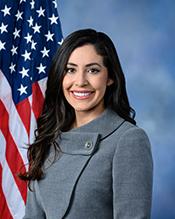
Anna Paulina Luna
RRepublicanFL-13 · Representative
54
/ 100
Average
Attendance89
Avg: 96
Independence10
Avg: 4
Bipartisan Tone33
Avg: 15
Ethics Record100
Avg: 99
Transparency21
Avg: 53
Accountability Score — composite of attendance, independence, bipartisan tone, ethics record & transparency.
Methodology29
Bills Sponsored
0
Enacted into Law
1
Passed a Chamber
28
In Committee
All Sponsored Bills
HRES1536In Committee
Recommending that the House of Representatives find Neville Singham in contempt of Congress for refusal to comply with a subpoena duly issued by the Committee on Oversight and Government Reform.
HR10211In Committee
To codify Executive Order 14418 (relating to continuing to protect the meaning and value of American citizenship).
HR10166In Committee
Foreign Propaganda Disclosure Act
HR9988In Committee
FASTER Act of 2026
The proposal would require food companies to clearly label products containing barley, rye, and oats as major allergens, similar to how they currently must label peanuts, milk, and shellfish. This change would help people with celiac disease and gluten sensitivity more easily identify foods that could make them sick. Food manufacturers and restaurants would need to update their labeling practices to comply with the new requirement.
HRES1453In Committee
Directing the Committee on Ethics to publicly release certain final reports prepared during the One Hundred Nineteenth Congress.
The House Committee on Ethics would be required to publicly release final reports it prepares during the current congressional session, making investigations and findings available to the general public rather than keeping them confidential. This would increase transparency around ethics investigations involving members of Congress and their conduct. The measure affects lawmakers and the public's ability to see what the ethics committee has investigated and concluded.
HR9807In Committee
Americans vs. Poisonous Pesticides Act
This bill would allow states to enforce their own laws against pesticide companies for misleading product labels, even if federal law already regulates those same products. Currently, federal pesticide rules can prevent states from suing companies for false advertising, but this change would let states pursue their own legal claims as long as they match federal standards for what counts as mislabeling. The change would give consumers and states more power to hold pesticide manufacturers accountable for deceptive marketing practices.
HR9357In Committee
Paraquat Prevention Act
The government would ban the pesticide paraquat from being used or sold in the United States, removing all current approvals for this weedkiller. This would affect farmers, agricultural companies, and landscapers who currently use paraquat on crops and other land, forcing them to switch to alternative pesticides. The ban aims to address health and safety concerns associated with the chemical.
HRES1386In Committee
Providing for the consideration of the bill (H.R. 2003) to amend the Higher Education Act of 1965 to lower the interest rate on Federal student loans to 2 percent.
This bill would reduce the interest rate on federal student loans from their current rates down to 2 percent, making it cheaper for borrowers to repay their loans over time. The change would primarily benefit college students and recent graduates who have taken out federal loans to pay for their education. The bill is currently being reviewed by the House Committee on Rules to determine whether it should be debated and voted on by the full House.
HR8795In Committee
American Families Gas Tax Relief Act
The proposal would temporarily eliminate or reduce the federal tax on gasoline and diesel fuel, lowering prices at the pump for drivers and businesses that rely on fuel. This would affect everyone who drives a car, trucks, and companies that transport goods, though it would reduce tax revenue that normally funds highway maintenance and infrastructure projects. The measure is currently under review by the House Committee on Ways and Means.
HRES1166In Committee
Providing for the expulsion of Representative Eric Swalwell from the United States House of Representatives.
This resolution would remove Representative Eric Swalwell from the House of Representatives through an expulsion vote, which requires a two-thirds majority of voting members. The proposal has been sent to the House Ethics Committee for review and investigation before any expulsion vote would occur. If approved, it would force Swalwell to immediately lose his seat in Congress.
HR7981In Committee
Stop Secret Counseling of Students Act
This bill would require schools to notify parents when their children receive counseling or mental health services at school, and would give parents the right to be involved in or opt out of such services. The measure aims to ensure parents know what guidance their children are receiving from school counselors and therapists. It would affect students, parents, school counselors, and school administrators.
HRES1102In Committee
Removing Representative Tony Gonzalez of Texas from certain standing committees of the House of Representatives.
This resolution would remove Representative Tony Gonzalez from his assigned committees in the House of Representatives. The action would strip him of his committee positions and the influence that comes with them, though it would not remove him from Congress entirely. The proposal has been sent to the House Ethics Committee for review.
HRES1101In Committee
Censuring Representative Tony Gonzales of Texas.
This resolution would formally reprimand Representative Tony Gonzales for his conduct, which is a statement of disapproval from the House of Representatives but does not remove him from office or impose legal penalties. The measure has been sent to the House Ethics Committee, which investigates misconduct allegations against members of Congress and would determine whether to recommend the censure move forward.
HR7580In Committee
Nutrition First Act of 2026
The bill would likely establish or modify federal nutrition standards and requirements for food products, agricultural programs, or school meals to prioritize healthier eating options. It could affect food manufacturers, farmers, schools, and consumers by changing how foods are labeled, produced, or distributed through government nutrition assistance programs. The specific details would determine whether it impacts grocery store shelves, school lunch menus, or how farms receive support.
HR7433In Committee
Kids Off Social Media Act
Kids Off Social Media Act This bill limits children’s access to social media platforms and requires both platforms and schools to implement certain restrictions on children’s social media usage. Specifically, the bill prohibits social media platforms from knowingly allowing children under the age of 13 to create or maintain accounts. Platforms must delete existing accounts held by children and any personal data collected from child users. Platforms are also generally prohibited from using automated systems to suggest or promote content based on personal data collected from users under the age of 17. The bill directs the Federal Trade Commission to enforce these provisions. States may also bring civil actions against platforms whose violations of these provisions have adversely affected their residents. Further, as a condition of receiving discounted telecommunications service under the Schools and Libraries Universal Service Support (E-Rate) program, schools must enforce policies preventing the use of E-Rate-supported services, networks, and devices to access social media, and must use blocking or filtering technology to prevent such access. Schools that do not make a good faith effort to comply and correct known violations are required to reimburse any E-Rate support they received for the applicable period. Schools must also submit copies of their internet safety policies to the Federal Communications Commission for publication. Under the bill, social media platforms are defined as public-facing sites that function primarily as forums for user-generated content. Some categories of online platforms are explicitly excluded, including sites that provide primarily videoconferencing, emailing, or educational services.
HR7399In Committee
Kids Off Social Media Act
Kids Off Social Media Act This bill limits children’s access to social media platforms and requires both platforms and schools to implement certain restrictions on children’s social media usage. Specifically, the bill prohibits social media platforms from knowingly allowing children under the age of 13 to create or maintain accounts. Platforms must delete existing accounts held by children and any personal data collected from child users. Platforms are also generally prohibited from using automated systems to suggest or promote content based on personal data collected from users under the age of 17. The bill directs the Federal Trade Commission to enforce these provisions. States may also bring civil actions against platforms whose violations of these provisions have adversely affected their residents. Further, as a condition of receiving discounted telecommunications service under the Schools and Libraries Universal Service Support (E-Rate) program, schools must enforce policies preventing the use of E-Rate-supported services, networks, and devices to access social media, and must use blocking or filtering technology to prevent such access. Schools that do not make a good faith effort to comply and correct known violations are required to reimburse any E-Rate support they received for the applicable period. Schools must also submit copies of their internet safety policies to the Federal Communications Commission for publication. Under the bill, social media platforms are defined as public-facing sites that function primarily as forums for user-generated content. Some categories of online platforms are explicitly excluded, including sites that provide primarily videoconferencing, emailing, or educational services.
HR7313In Committee
To designate the facility of the United States Postal Service located at 3135 1st Avenue North in St. Petersburg, Florida, as the "Poul Hornsleth Post Office".
This bill designates the facility of the United States Postal Service located at 3135 1st Avenue North in St. Petersburg, Florida, as the "Poul Hornsleth Post Office".
HR7221In Committee
Stopping Wall Street From Competing With Main Street Homebuyers Act
This bill would restrict large investment firms and Wall Street companies from buying up single-family homes in residential neighborhoods, aiming to reduce competition between wealthy investors and ordinary families trying to purchase homes. The legislation targets the practice of institutional investors buying homes as rental properties or for resale, which supporters argue drives up housing prices and makes homeownership less affordable for average Americans. The bill would likely affect real estate investors, hedge funds, and large corporations that currently purchase residential properties.
HR5196In Committee
Protect Our Farmers and Families Act of 2025
The legislation would modify environmental protections and regulations affecting agricultural operations, with the goal of reducing compliance burdens on farmers while maintaining conservation standards. The bill would impact farming families and agricultural businesses by potentially changing how they manage land, water, and natural resources on their properties. It has been sent to a congressional subcommittee for review and discussion.
HR6754In Committee
To exempt Members of the House of Representatives and Senators of the Senate from certain Federal passenger and baggage screening, and for other purposes.
Members of Congress would be exempted from standard security screening procedures that regular passengers must go through at airports, including baggage checks and passenger screening. This exemption would apply to both House Representatives and Senators when they travel by air. The proposal is currently being reviewed by a congressional subcommittee that handles transportation and security matters.
HR6534In Committee
To repeal a restriction on assistance to Azerbaijan.
This bill would remove a current ban on U.S. military and financial aid to Azerbaijan, a country in the South Caucasus region. The change would allow the U.S. government to provide assistance to Azerbaijan for defense and development purposes, which is currently prohibited by law. The bill affects U.S. foreign policy toward the region and could impact diplomatic relationships with Azerbaijan and neighboring countries.
HRES725In Committee
Providing for consideration of the bill (H.R. 1908) to prohibit stock trading and ownership by Members of Congress and their spouses and dependent children, and for other purposes.
This resolution provides for the consideration of the bill (H.R. 1908) to prohibit stock trading and ownership by Members of Congress and their spouses and dependent children, and for other purposes.
HRES883In Committee
Providing for consideration of the bill (H.R. 2003) to amend the Higher Education Act of 1965 to lower the interest rate on Federal student loans to 2 percent.
This resolution provides for the consideration of the bill (H.R. 2003) to amend the Higher Education Act of 1965 to lower the interest rate on Federal student loans to 2 percent.
HRES665In Committee
Providing for consideration of the bill (H.R. 1908) to prohibit stock trading and ownership by Members of Congress and their spouses and dependent children, and for other purposes.
This resolution provides for the consideration of the bill (H.R. 1908) to prohibit stock trading and ownership by Members of Congress and their spouses and dependent children, and for other purposes.
HRES293Passed House
Providing for the announcement of pairs from a written list furnished to the Clerk, and for other purposes.
This resolution allows members of Congress to announce pairs—agreements where two lawmakers with opposite views on a vote agree to both be absent, canceling out each other's votes—using a written list submitted to the House Clerk rather than requiring individual announcements. The change streamlines House procedures by making the pairing process more efficient for members who need to be away from Washington. This affects how Congress conducts its daily voting operations and record-keeping.
HRES164In Committee
Providing for the consideration of the resolution (H. Res. 23) permitting parental remote voting by proxy, and for other purposes.
This resolution would allow members of Congress who are pregnant or caring for a newborn to vote remotely through a designated proxy (another representative who votes on their behalf) without having to be physically present in the House chamber. The measure aims to make it easier for new and expectant parents in Congress to balance their legislative duties with family responsibilities during a critical time. This affects current and future members of Congress and their ability to participate in votes while managing parental leave.
HR395In Committee
Justice for Rape Survivors Act
Justice for Rape Survivors Act This bill establishes a 30-year statutory mandatory minimum prison term for the following federal sexual abuse offenses: causing another person to engage in a sexual act by using force against that person or by threatening or placing that person in fear, engaging in or attempting to engage in a sexual act with another person by rendering the other person unconscious or intoxicated, causing or attempting to cause another person to engage in a sexual act by threatening or placing that person in fear, engaging or attempting to engage in a sexual act if the other person is incapacitated, and engaging or attempting to engage in a sexual act without the other person's consent.
HR393In Committee
No Repeat Child Sex Offenders Act
The legislation would establish stricter penalties and monitoring requirements for individuals convicted of child sexual abuse offenses to prevent them from committing additional crimes. It would affect convicted sex offenders, law enforcement agencies, and the criminal justice system by potentially increasing prison sentences, extending supervision periods, or implementing enhanced tracking measures. The bill aims to protect children by making it harder for repeat offenders to reoffend.
HR394In Committee
Holding Child Predators Accountable Act
The legislation would strengthen federal laws against child sexual abuse and exploitation by increasing penalties for offenders and expanding law enforcement tools to investigate and prosecute these crimes. It aims to protect children by making punishments more severe for predators and giving federal agencies better resources to track and stop child exploitation. The bill would affect law enforcement agencies, federal prosecutors, and ultimately help protect children from abuse.