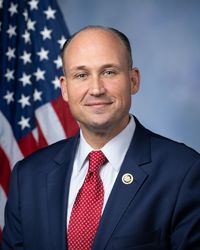
Nicholas A. Langworthy
RRepublicanNY-23 · Representative
54
/ 100
Average
Attendance98
Avg: 96
Independence2
Avg: 4
Bipartisan Tone7
Avg: 15
Ethics Record100
Avg: 99
Transparency52
Avg: 53
Accountability Score — composite of attendance, independence, bipartisan tone, ethics record & transparency.
Methodology42
Bills Sponsored
0
Enacted into Law
10
Passed a Chamber
30
In Committee
All Sponsored Bills
HR10628In Committee
Biosimilars Access and Affordability Act
HR10571In Committee
Surge to Save Newborns Act
HR10522In Committee
Companion Animal Protection Against Cruel Testing Act
Companion Animal Protection Against Cruel Testing Act This bill prohibits the use of funds made available to covered federal agencies for any biomedical research activity involving a live dog or cat. Covered agencies are agencies or offices within the Department of Health and Human Services (HHS) that award, administer, or expend federal funds for biomedical research. This prohibition also applies to activities that materially facilitate biomedical research involving a live dog or cat (e.g., salaries, facility maintenance, and administrative support primarily related to such research). It does not apply to transportation and rehousing of animals previously used in biomedical research or observational activities that do not involve alteration of an animal’s normal environment or medical care. The prohibition applies to federal funds obligated or expended beginning 180 days after the bill is enacted. HHS may waive the prohibition in limited circumstances if necessary to respond to a specified emergency. Recipients of funding from covered agencies must make reasonable efforts to transfer dogs and cats no longer needed for research to rescue organizations or other appropriate entities. Further, recipients may only euthanize an animal if a veterinarian has determined euthanasia is necessary for animal welfare or public safety. If HHS determines that a recipient has violated a provision of the bill, it may withhold further funding to the recipient, recover funds expended in violation, and impose other administrative remedies. Finally, the Government Accountability Office must report to Congress on the bill's implementation within three years after the bill takes effect.
HR10163In Committee
American Quantum Competitiveness Act
HR5517Passed House
Northern Border Security Enhancement and Review Act
Northern Border Security Enhancement and Review Act This bill requires the Department of Homeland Security (DHS) to regularly perform a threat analysis of the northern U.S. border. The analysis must be performed every two years and include terroristic and criminal threats, improvements needed to prevent terrorism and reduce criminal activity, and whether preclearance and advance inspection operations at northern ports of entry could prevent terrorists from entering in the United States. DHS must (1) update its northern border strategy after performing each threat analysis, and (2) provide a classified briefing to Congress. If DHS determines no update is required, DHS must notify Congress. U.S. Customs and Border Protection’s Air and Marine Operations (AMO) must develop performance measures to assess the AMO’s effectiveness at securing the northern border between ports of entry in air and maritime environments.
HR7502Reported
Recycled Materials Attribution Act of 2026
This bill would make it illegal for companies to falsely claim that their products are made from recycled materials in advertisements or marketing, protecting consumers from being misled about how environmentally friendly a product actually is. The law would apply to any product sold to regular shoppers and would be enforced by federal agencies that oversee consumer protection and fair business practices. Companies that violate the rule could face penalties for deceiving customers about recycled content.
HR9806In Committee
FLOWS Act
The proposal would update federal rules for hydroelectric dams and water projects to clarify when companies need permission to make changes or repairs, and would create a new licensing process for small-scale water power systems that generate electricity from flowing water. This affects hydroelectric dam operators, utility companies, and developers interested in building small renewable energy projects in rivers and streams. The changes aim to streamline regulations while maintaining safety and environmental standards for these water-based power facilities.
HR9317In Committee
BUSES Act
The proposal would prevent states and local governments from enforcing anti-idling rules against long-distance buses and school buses when their engines run for less than 15 minutes without moving. This would allow bus operators more flexibility to keep engines running during short stops for passenger boarding, air conditioning, or heating without facing fines or penalties. The change primarily affects bus companies and school districts that operate these vehicles.
HR9661In Committee
Expedited Access to Biosimilars Act
The bill would change the rules for approving generic versions of complex biological drugs (called biosimilars) by making it the standard expectation that companies don't need to conduct expensive clinical studies comparing how well these drugs work compared to the original drug. This would likely make it faster and cheaper for biosimilar manufacturers to get their products approved, potentially lowering costs for patients and insurance companies, though it could raise questions about whether the drugs are truly equivalent to the originals.
HRES1345Passed House
Providing for consideration of the bill (H.R. 8312) to establish fraud prevention and program integrity functions and data sharing authorities within the Department of Treasury and a permanent governmentwide Inspector General for Fraud, Accountability, and Recovery, and for other purposes; providing for consideration of the bill (H.R. 8464) to amend title 31, United States Code, to authorize pausing and segmenting payments, and for other purposes; providing for consideration of the resolution (H. Res. 1335) condemning actors seeking to defraud the United States Government, and expressing the sense of the House of Representatives that governmentwide fraud and improper payment prevention reforms will meaningfully improve the financial prosperity of the United States, and that Federal program eligibility should be verified before payment; and providing for consideration of the bill (S. 2) to provide for reconciliation pursuant to title II of S. Con. Res. 33.
This resolution provides for the consideration of the bill (H.R. 8312) to establish fraud prevention and program integrity functions and data sharing authorities within the Department of Treasury and a permanent governmentwide Inspector General for Fraud, Accountability, and Recovery, and for other purposes; providing for consideration of the bill (H.R. 8464) to amend title 31, United States Code, to authorize pausing and segmenting payments, and for other purposes; providing for consideration of the resolution (H. Res. 1335) condemning actors seeking to defraud the United States Government, and expressing the sense of the House of Representatives that governmentwide fraud and improper payment prevention reforms will meaningfully improve the financial prosperity of the United States, and that Federal program eligibility should be verified before payment; and providing for consideration of the bill (S. 2) to provide for reconciliation pursuant to title II of S. Con. Res. 33.
HR9117In Committee
CHECK Act of 2026
The bill aims to make certain health care information more accessible to the public, though the specific details of what information and how it would be shared are not yet clear from the title alone. The proposal has been sent to three congressional committees that handle health care, labor, and budget matters to review their respective areas of responsibility. Once these committees examine the bill, they will determine whether changes are needed before it moves forward for a full vote.
HR4690Passed House
Reliable Federal Infrastructure Act
Reliable Federal Infrastructure Act This bill repeals certain energy efficiency performance standards for new federal buildings and federal buildings undergoing major renovations. Specifically, the bill repeals the performance standards that phase out fossil fuel use in such buildings by FY2030. The bill directs the Department of Energy to implement the standards as though such phase-out requirements had never taken effect until it issues regulations with revised performance standards. The bill also specifies that certain systems that certify green buildings may not prohibit federal buildings from obtaining a certification as a green building or high-performance green building solely based on direct or indirect consumption of fossil fuels.
HRES1176Passed House
Electing Members to certain standing committees of the House of Representatives.
This resolution allows the House of Representatives to elect members to fill open positions on its standing committees, which are the permanent groups that handle specific policy areas like healthcare, defense, and taxes. The resolution has already passed the House and is now finalized, meaning committee assignments can proceed as planned.
HRES1174Passed House
Providing for consideration of the bill (H.R. 6387) to amend the Clean Air Act to require revisions to regulations governing the review and handling of air quality monitoring data influenced by exceptional events or actions to mitigate wildfire risk; providing for consideration of the bill (H.R. 6398) to amend the Clean Air Act relating to review by the Environmental Protection Agency of proposed legislation; providing for consideration of the bill (H.R. 6409) to amend the Clean Air Act to clarify standards for emissions emanating from outside of the United States, and for other purposes; and providing for consideration of the resolution (H. Res. 1156) expressing support for tax policies that support working families.
This resolution provides for the consideration of the bill (H.R. 6387) to amend the Clean Air Act to require revisions to regulations governing the review and handling of air quality monitoring data influenced by exceptional events or actions to mitigate wildfire risk; providing for consideration of the bill (H.R. 6398) to amend the Clean Air Act relating to review by the Environmental Protection Agency of proposed legislation; providing for consideration of the bill (H.R. 6409) to amend the Clean Air Act to clarify standards for emissions emanating from outside of the United States, and for other purposes; and providing for consideration of the resolution (H. Res. 1156) expressing support for tax policies that support working families.
HRES707Passed House
Providing for consideration of the bill (H.R. 4922) to limit youth offender status in the District of Columbia to individuals 18 years of age or younger, to direct the Attorney General of the District of Columbia to establish and operate a publicly accessible website containing updated statistics on juvenile crime in the District of Columbia, to amend the District of Columbia Home Rule Act to prohibit the Council of the District of Columbia from enacting changes to existing criminal liability sentences, and for other purposes; providing for consideration of the bill (H.R. 5143) to establish standards for law enforcement officers in the District of Columbia to engage in vehicular pursuits of suspects, and for other purposes; providing for consideration of the bill (H.R. 5140) to lower the age at which a minor may be tried as an adult for certain criminal offenses in the District of Columbia to 14 years of age; providing for consideration of the bill (H.R. 5125) to amend the District of Columbia Home Rule Act to terminate the District of Columbia Judicial Nomination Commission, and for other purposes; providing for consideration of the bill (H.R. 1047) to require the Federal Energy Regulatory Commission to reform the interconnection queue process for the prioritization and approval of certain projects, and for other purposes; providing for consideration of the bill (H.R. 3015) to reestablish the National Coal Council in the Department of Energy to provide advice and recommendations to the Secretary of Energy on matters related to coal and the coal industry, and for other purposes; providing for consideration of the bill (H.R. 3062) to establish a more uniform, transparent, and modern process to authorize the construction, connection, operation, and maintenance of international border-crossing facilities for the import and export of oil and natural gas and the transmission of electricity; and for other purposes.
This is a procedural resolution that allows the House to consider multiple bills affecting Washington D.C.'s criminal justice system (including changes to how juveniles are tried as adults and rules for police car chases), energy infrastructure (including reforms to how power projects get approved and a new coal advisory council), and border crossing facilities for oil, gas, and electricity. The resolution has already passed the House and sets the rules for debating and voting on these various bills. It essentially clears the way for these separate proposals to move forward in the legislative process.
HR7941In Committee
Pay TSA Act of 2026
The bill would likely increase or adjust the pay and benefits for Transportation Security Administration (TSA) officers who screen passengers and baggage at airports. This could help the TSA attract and keep experienced security workers by making the job more competitive with other government positions. The changes would affect thousands of airport security screeners across the country.
HR7065In Committee
Seneca Nation Law Enforcement Efficiency Act
This bill would improve how law enforcement operates within Seneca Nation territory by streamlining procedures and potentially increasing resources or coordination between tribal police and other agencies. The changes would affect how crimes are investigated and prosecuted on Seneca lands, potentially making the justice system more efficient for both law enforcement officers and community members. The bill is currently being reviewed in subcommittee hearings to determine what specific reforms are needed.
HRES1042Passed House
Providing for consideration of the bill (H.R. 2189) to modernize Federal firearms laws to account for advancements in technology and less-than-lethal weapons, and for other purposes; providing for consideration of the bill (H.R. 261) to amend the National Marine Sanctuaries Act to prohibit requiring an authorization for the installation, continued presence, operation, maintenance, repair, or recovery of undersea fiber optic cables in a national marine sanctuary if such activities have previously been authorized by a Federal or State agency; providing for consideration of the bill (H.R. 3617) to amend the Department of Energy Organization Act to secure the supply of critical energy resources, including critical minerals and other materials, and for other purposes; and for other purposes.
This resolution provides for the consideration of the bill (H.R. 2189) to modernize Federal firearms laws to account for advancements in technology and less-than-lethal weapons, and for other purposes; providing for consideration of the bill (H.R. 261) to amend the National Marine Sanctuaries Act to prohibit requiring an authorization for the installation, continued presence, operation, maintenance, repair, or recovery of undersea fiber optic cables in a national marine sanctuary if such activities have previously been authorized by a Federal or State agency; providing for consideration of the bill (H.R. 3617) to amend the Department of Energy Organization Act to secure the supply of critical energy resources, including critical minerals and other materials, and for other purposes; and for other purposes.
HR3699Reported
Energy Choice Act
Energy Choice Act This bill prohibits a state or local government from banning or limiting the connection, reconnection, modification, installation, transportation, distribution, expansion, or access to an energy service based on the type or source of energy (e.g., natural gas) that is sold.
HR7366In Committee
Dietary Supplement Regulatory Uniformity Act
This bill would create consistent federal rules for how dietary supplements like vitamins and herbal products are regulated across the country, rather than allowing each state to set its own standards. The change would make it easier for companies to sell supplements nationwide without navigating different state requirements, while potentially giving the federal government more authority to oversee product safety and labeling. Consumers, supplement manufacturers, and retailers would all be affected by these new uniform standards.
HR7256In Committee
Federal Workforce Early Separation Incentives Act
The bill would allow the federal government to offer buyout packages and early retirement incentives to encourage federal employees to voluntarily leave their jobs, helping agencies reduce their workforce without layoffs. This would give workers who meet certain age and service requirements the option to take a financial incentive to resign early, while allowing the government to manage staffing levels and potentially save money. The measure affects federal employees across all agencies and departments.
HRES951Passed House
Providing for consideration of the bill (H.R. 4776) to amend the National Environmental Policy Act of 1969 to clarify ambiguous provisions and facilitate a more efficient, effective, and timely environmental review process; providing for consideration of the bill (H.R. 1366) to provide for the location of multiple hardrock mining mill sites, to establish the Abandoned Hardrock Mine Fund, and for other purposes; providing for consideration of the bill (H.R. 845) to require the Secretary of the Interior to reissue regulations removing the gray wolf from the list of endangered and threatened wildlife under the Endangered Species Act of 1973; providing for consideration of the bill (H.R. 3616) to require the Federal Energy Regulatory Commission to review regulations that may affect the reliable operation of the bulk-power system; providing for consideration of the bill (H.R. 3632) to amend the Federal Power Act to adjust the requirements for orders, rules, and regulations relating to furnishing adequate service, to require owners or operators of generating facilities to provide notice of planned retirements of certain electric generating units, and for other purposes; and providing for consideration of the bill (H.R. 4371) to amend the William Wilberforce Trafficking Victims Protection Reauthorization Act of 2008 to enhance efforts to combat the trafficking of children.
This resolution provides for the consideration of the bill (H.R. 4776) to amend the National Environmental Policy Act of 1969 to clarify ambiguous provisions and facilitate a more efficient, effective, and timely environmental review process; providing for consideration of the bill (H.R. 1366) to provide for the location of multiple hardrock mining mill sites, to establish the Abandoned Hardrock Mine Fund, and for other purposes; providing for consideration of the bill (H.R. 845) to require the Secretary of the Interior to reissue regulations removing the gray wolf from the list of endangered and threatened wildlife under the Endangered Species Act of 1973; providing for consideration of the bill (H.R. 3616) to require the Federal Energy Regulatory Commission to review regulations that may affect the reliable operation of the bulk-power system; providing for consideration of the bill (H.R. 3632) to amend the Federal Power Act to adjust the requirements for orders, rules, and regulations relating to furnishing adequate service, to require owners or operators of generating facilities to provide notice of planned retirements of certain electric generating units, and for other purposes; and providing for consideration of the bill (H.R. 4371) to amend the William Wilberforce Trafficking Victims Protection Reauthorization Act of 2008 to enhance efforts to combat the trafficking of children.
HR6037In Committee
To reauthorize the West Valley demonstration project.
This bill would extend federal funding and authorization for the West Valley Demonstration Project, a long-term effort to clean up and manage radioactive waste at a former nuclear fuel reprocessing site in New York. The project affects workers at the site, nearby communities, and the Department of Energy's budget for environmental remediation. Reauthorization would allow the cleanup work to continue under current management and funding structures.
HR5518In Committee
Integrated Cross-Border Law Enforcement Operations Expansion Act
The proposal would expand how U.S. law enforcement agencies work together with their counterparts in other countries to combat cross-border crimes like drug trafficking, human smuggling, and organized crime. It would likely increase funding, resources, and coordination mechanisms for joint operations and information sharing between American and foreign police and security forces. This would primarily affect law enforcement agencies, border security personnel, and potentially international partners involved in these collaborative efforts.
HR4234In Committee
Safeguarding Americans From Extremist Risk (SAFER) at the Border Act
The legislation would strengthen security measures at the U.S. border to identify and prevent individuals with ties to extremist organizations from entering the country. It would give border agents and immigration officials additional tools and authority to screen travelers and assess potential security threats related to extremism. The bill would primarily affect border security personnel, immigration officials, and travelers crossing into the United States.
HR3881In Committee
Stop Dangerous Sanctuary Cities Act
Stop Dangerous Sanctuary Cities Act This bill addresses issues related to state and local government cooperation with federal immigration enforcement efforts, including by prohibiting uncooperative jurisdictions from receiving certain grants. Specifically, the bill prohibits a sanctuary jurisdiction from receiving grants under certain Economic Development Assistance Programs and the Community Development Block Grant Program. Under the bill, a sanctuary jurisdiction is a state or local government that has in effect a statute, policy, or practice that prohibits or restricts (1) information sharing with another government entity about an individual's immigration status, or (2) compliance with a lawfully issued Department of Homeland Security (DHS) detainer request or notification of release request. When complying with a DHS-issued detainer, a state or local government shall be deemed to be acting as an agent of DHS with all authority available to DHS officers and employees. The bill also limits the legal liability of a state or local government for complying with a detainer.
HR3548In Committee
Infrastructure Expansion Act of 2025
The proposal would authorize federal funding and support for expanding transportation infrastructure projects across the country, including roads, bridges, public transit systems, and related facilities. This would affect construction workers, commuters, local governments, and transportation companies that would be involved in building and maintaining these projects. The funding could help reduce traffic congestion and improve travel conditions in communities nationwide.
HRES426Passed House
Providing for consideration of the joint resolution (S.J. Res. 13) providing for congressional disapproval under chapter 8 of title 5, United States Code, of the rule submitted by the Office of the Comptroller of the Currency of the Department of the Treasury relating to the review of applications under the Bank Merger Act; providing for consideration of the joint resolution (S.J. Res. 31) providing for congressional disapproval under chapter 8 of title 5, United States Code, of the rule submitted by the Environmental Protection Agency relating to "Review of Final Rule Reclassification of Major Sources as Area Sources Under Section 112 of the Clean Air Act"; and waiving a requirement of clause 6(a) of rule XIII with respect to consideration of certain resolutions reported from the Committee on Rules.
This resolution provides for the consideration of S.J. Res. 13 and S.J. Res. 31, which nullify specified agency rules, and certain resolutions related to establishing budgetary levels for FY2025 through FY2034. The resolution waives all points of order against the consideration of S.J. Res. 13, which nullifies the final rule issued by the Department of the Treasury’s Office of the Comptroller of the Currency titled Business Combinations Under the Bank Merger Act , and S.J. Res. 31, which nullifies the Environmental Protection Agency rule titled Review of Final Rule Reclassification of Major Sources as Area Sources Under Section 112 of the Clean Air Act. The resolution also waives a House rule requiring a two-thirds vote to consider a report from the Committee on Rules on the same day it is presented to the House with respect to any resolution reported through the legislative day of May 23, 2025, relating to Title II of H.Con. Res. 14. Title II sets forth instructions to House and Senate committees to develop legislation related to budgetary levels for FY2025 through FY2034.
HR2560In Committee
Lifespan Respite Care Reauthorization Act of 2025
This bill would extend and update a federal program that helps families caring for children or adults with disabilities by providing temporary relief care services. The program allows caregivers to take breaks from their responsibilities while trained respite workers temporarily care for their loved ones, helping prevent caregiver burnout and keeping families stable. The bill would reauthorize funding for this program and likely update how it operates to serve more families across the country.
HR2353In Committee
Safer Skies Act of 2025
Safer Skies Act of 2025 This bill directs the Transportation Security Administration (TSA) to require that certain small public charter air carrier operations comply with the Aircraft Operator Standard Security Program (AOSSP). As background, the TSA has different types of security programs based on the nature of the air carrier’s operations. Currently, the AOSSP requirements apply to all scheduled passenger service with a seating capacity of 61 or more seats that operate into or out of a TSA-controlled sterile area. The TSA also has other security programs that have less stringent security requirements than the AOSSP. These programs are designed for different types of aircraft operators, including operations under Part 135 (e.g., scheduled commuter flights in smaller aircraft) and Part 380 (e.g., public charter flights) of the Department of Transportation’s regulations. This bill applies the AOSSP requirements to air carriers operating under Part 135 and Part 380 that (1) operate scheduled public charter service, (2) operate airplanes configured with 10 or more passenger seats, and (3) do not enplane or deplane in a TSA-managed checkpoint.
HR2204In Committee
To require an institution of higher education that becomes aware that a student having nonimmigrant status under subparagraph (F)(i) or (J) of section 101(a)(15) of the Immigration and Nationality Act (8 U.S.C. 1101(a)(15)) has endorsed or supported a foreign terrorist organization to notify the SEVIS, and for other purposes.
Colleges and universities would be required to report to federal immigration authorities if they learn that a foreign student on an F or J visa has supported or endorsed a terrorist organization. The notification would go into the SEVIS system, which tracks international students in the United States. This would affect international students studying at American institutions and the schools themselves, which would need to monitor and report such activities.
HR2203In Committee
Innovative FEED Act of 2025
Innovative Feed Enhancement and Economic Development Act of 2025 or the Innovative FEED Act of 2025 This bill provides for the regulation of zootechnical animal food substances as food additives. The bill defines zootechnical animal food substance as a substance that is added to the food or drinking water of animals and that affects only the animal's gastrointestinal tract, with the intended purpose of affecting the byproducts of the animal's digestion, reducing foodborne pathogens, or altering the animal's gastrointestinal biome. The definition does not include substances that are used to treat or prevent diseases in animals, hormones, or active ingredients of animal drugs. Labels for zootechnical animal food substances must include a disclaimer that the substance may not be used to treat or prevent diseases in animals.
HRES177Passed House
Providing for consideration of the joint resolution (H.J. Res. 42) providing for congressional disapproval under chapter 8 of title 5, United States Code, of the rule submitted by the Department of Energy relating to "Energy Conservation Program for Appliance Standards: Certification Requirements, Labeling Requirements, and Enforcement Provisions for Certain Consumer Products and Commercial Equipment"; providing for consideration of the joint resolution (H.J. Res. 61) providing for congressional disapproval under chapter 8 of title 5, United States Code, of the rule submitted by the Environmental Protection Agency relating to "National Emission Standards for Hazardous Air Pollutants: Rubber Tire Manufacturing"; and providing for consideration of the joint resolution (S.J. Res. 11) providing for congressional disapproval under chapter 8 of title 5, United States Code, of the rule submitted by the Bureau of Ocean Energy Management relating to "Protection of Marine Archaeological Resources".
This resolution provides for the House of Representatives to consider the following measures: H.J. Res.42, Providing for congressional disapproval under chapter 8 of title 5, United States Code, of the rule submitted by the Department of Energy relating to Energy Conservation Program for Appliance Standards: Certification Requirements, Labeling Requirements, and Enforcement Provisions for Certain Consumer Products and Commercial Equipment ; H.J. Res. 61, Providing for congressional disapproval under chapter 8 of title 5, United States Code, of the rule submitted by the Environmental Protection Agency relating to National Emission Standards for Hazardous Air Pollutants: Rubber Tire Manufacturing ; and S.J. Res. 11, Providing for congressional disapproval under chapter 8 of title 5, United States Code, of the rule submitted by the Bureau of Ocean Energy Management relating to Protection of Marine Archaeological Resources . Under the resolution, all points of order against consideration of each measure are waived; the measures shall be considered as read; and all points of order against provisions in the measures are waived. The resolution further provides that the previous question shall be considered as ordered on each measure (and any amendment thereto) to final passage without intervening motion except one hour of debate and one motion to recommit.
HR1617In Committee
Wireless Resiliency and Flexible Investment Act of 2025
This bill would likely make it easier for wireless companies to invest in and upgrade their networks by removing or relaxing certain regulatory requirements and restrictions. The changes would aim to help telecommunications companies build more reliable and resilient wireless infrastructure, particularly in areas that currently have poor service. The bill affects wireless carriers, consumers who depend on cell phone and internet service, and communities seeking better network coverage.
HR1421In Committee
Make American Flags in America Act of 2025
This bill would require American flags sold to the federal government to be manufactured in the United States rather than imported from other countries. The legislation aims to support domestic flag manufacturers and ensure that flags used by government agencies are made by American workers.
HR291In Committee
CAREERS Act
Creating Access to Rural Employment and Education for Resilience and Success Act or the CAREERS Act This bill reauthorizes the Rural Innovation Stronger Economy (RISE) Grant Program and expands the program to include support for career pathway programs or industry or sector partnerships in industries in rural communities. As background, this Department of Agriculture (USDA) program offers grant assistance to create and augment high-wage jobs, accelerate the formation of new businesses, support industry clusters, and maximize the use of local productive assets in eligible low-income rural areas. Under the bill, RISE grant program funds may be used to support career pathway programs (i.e., a combination of rigorous and high-quality education, training, and other services) or industry or sector partnerships in industries in rural communities. These industries may include public utilities (i.e., telecommunications, broadband, water, wastewater, disposal, and electric supply services), conservation practices and management, health care, child care, manufacturing, and agribusiness. The bill removes the current requirement that the program provide grants (to the maximum extent practicable) for job accelerators in at least 25 states. Instead, USDA must ensure the regional diversity of grant recipients or participants in providing for job accelerators, career pathway programs, and industry or sector partnerships. The bill also includes additional reporting requirements for career pathway programs and industry or sector partnership grant recipients.
HR289In Committee
SAP Act of 2025
Supporting All Producers Act of 2025 or the SAP Act of 2025 This bill directs the Department of Agriculture (USDA) to solicit input from maple industry stakeholders with respect to the research and education priorities of the maple industry for the Acer Access and Development Program (Acer). Specifically, the bill amends Acer to require USDA to consider the information provided through consultation with the maple industry when making program grants. The bill also extends the program's authorization through FY2030. As background, Acer provides competitive grants to states, tribal governments, and research institutions to support their efforts to promote the domestic maple syrup industry through activities associated with, among other things, the promotion of (1) research and education related to maple syrup production, and (2) natural resource sustainability in the maple syrup industry.
HR294In Committee
Dairy Farm Resiliency Act
Dairy Farm Resiliency Act This bill updates the Dairy Margin Coverage (DMC) program. As background, the DMC program was enacted in the 2018 farm bill to support dairy operations by allowing producers to buy a guaranteed margin for their milk production. The margin is the difference between the Department of Agriculture's (USDA's) national all milk price and a calculated feed cost, which provides producers optional risk protection on price and feed costs. The bill updates the current requirements that a participating dairy producer have an established milk production history with USDA's Farm Service Agency. Specifically, the bill requires that a dairy operation's production history for DMC be based on the most recent three-year history and be recalculated every five years. The bill also increases Tier I margin coverage for annual milk production to 6 million pounds or less (currently 5 million pounds or less) and Tier II margin coverage to over 6 million pounds (currently over 5 million pounds).
HR290In Committee
Rural Telehealth and Education Enhancement Act of 2025
This bill would expand access to remote medical care and educational services in rural areas by improving broadband infrastructure and funding telehealth programs for farmers and rural residents who have limited access to doctors and schools. It aims to help rural communities get better healthcare and educational opportunities without having to travel long distances, while also supporting agricultural workers and small farming operations. The legislation focuses on closing the digital divide that prevents rural Americans from accessing the same quality services available in cities and towns.
HR295In Committee
Fair Milk Pricing for Farmers Act
Fair Milk Pricing for Farmers Act This bill requires manufacturers to report production cost and product yield information for all dairy products processed in the same facility or facilities to the Department of Agriculture (USDA) Dairy Product Mandatory Reporting Program. Further, USDA must publish a report containing the information obtained under these new requirements and publish a report every two years thereafter. As background, under the Dairy Product Mandatory Reporting Program, USDA must collect certain dairy product sales information from manufacturers and release the data on a weekly basis.
HR1256In Committee
Long-Term Care Transparency Act
Long-Term Care Transparency Act This bill requires the Administration on Aging to submit to Congress an annual report that (1) aggregates reports submitted to the administration by state long-term care ombudsman offices for the year, and (2) summarizes the findings of such reports. (State long-term care ombudsman programs investigate and respond to complaints by and on behalf of residents in long-term care facilities, including nursing homes, assisted living facilities, and other adult care homes. Each state long-term care ombudsman office is required to submit an annual report to the administration including data related to complaints and conditions in long-term care facilities and an evaluation of the problems experienced by long-term care residents.)
HR1076In Committee
WARN Act
The legislation requires employers to give workers at least 60 days' notice before laying off large groups of employees or closing facilities, except in genuine emergencies. This advance warning gives workers and their families time to find new jobs, apply for unemployment benefits, and plan for financial changes. The rule applies to companies with 100 or more employees and affects millions of American workers facing potential job loss.