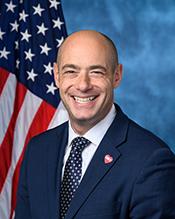
Greg Landsman
DDemocratOH-1 · Representative
60
/ 100
Average
Attendance99
Avg: 96
Independence8
Avg: 4
Bipartisan Tone18
Avg: 15
Ethics Record100
Avg: 99
Transparency64
Avg: 53
Accountability Score — composite of attendance, independence, bipartisan tone, ethics record & transparency.
Methodology28
Bills Sponsored
0
Enacted into Law
2
Passed a Chamber
25
In Committee
All Sponsored Bills
HR10570In Committee
No Secrets for Data Centers Act of 2026
HR10394In Committee
Protecting Approved Care Act
HR10367In Committee
Working Americans Affordability Tax Credit Act
HR10210In Committee
Doctors Not AI Act of 2026
HR6529Reported
Protecting Families from AI Data Center Energy Costs Act
This bill would likely limit or regulate how much electricity artificial intelligence data centers can use or how their energy costs are passed along to consumers and local communities. The goal appears to be protecting families from rising energy bills that could result from the massive power demands of AI operations. It would affect both the companies operating these data centers and the households in areas where they're built.
HR9629In Committee
Protecting Communities from Data Center Impacts Act of 2026
The government would be required to study how data centers affect the environment and public health, looking at issues like energy consumption, water usage, and air quality impacts. This assessment would help policymakers understand the costs of the growing number of data centers that power cloud computing, streaming services, and other internet-based businesses. The findings could inform future regulations affecting tech companies, communities near data centers, and anyone who uses online services.
HR9553In Committee
Child Care Small Business Insight and Improvement Act of 2026
The Small Business Administration would be required to study and report to Congress on for-profit child care businesses, examining their operations, challenges, and role in the child care market. This would help lawmakers understand how private child care companies function and what support or regulations might be needed to help working families access affordable care. The report would affect child care providers, parents seeking child care services, and policymakers considering child care policy.
HR9222In Committee
Drain the Swamp Act
This sweeping reform proposal would restrict elected officials and judges from trading stocks and participating in prediction markets, cut congressional pay during government shutdowns, impose term limits on members of Congress and Supreme Court justices, tighten ethics rules for judges, limit presidential pardon powers, eliminate statutes of limitations for presidential crimes, ban corporate political donations and gerrymandering, and prevent convicted felons from receiving government pensions. The bill would also overturn the Citizens United decision that allowed unlimited campaign spending and strengthen rules preventing politicians from profiting off their positions. It affects Congress members, the President, Vice President, Supreme Court justices, and the campaign finance system overall.
HJRES187In Committee
Providing for congressional disapproval under chapter 8 of title 5, United States Code, of the rule submitted by the Centers for Medicare & Medicaid Services of the Department of Health and Human Services relating to "Medicare Program; Implementation of Prior Authorization for Select Services for the Wasteful and Inappropriate Services Reduction (WISeR) Model".
This joint resolution prohibits the Centers for Medicare & Medicaid Services (CMS) from testing a new Medicare payment model in certain states that involves a prior authorization process and the use of enhanced technology by third-party contractors to determine whether certain claims should be paid. Specifically, the joint resolution nullifies a notice issued by the CMS on July 1, 2025, titled Medicare Program; Implementation of Prior Authorization for Select Services for the Wasteful and Inappropriate Services Reduction (WISeR) Model . (On May 12, 2026, the Government Accountability Office issued a letter of opinion stating that this notice constituted an agency rule and is therefore subject to the Congressional Review Act.) The CMS selected six states to participate in this model over a six-year period: New Jersey, Ohio, Oklahoma, Texas, Arizona, and Washington. Under the model, contracted companies must process prior authorization requests (i.e., requests for coverage determinations before a service is furnished) for certain services using enhanced technology (e.g., artificial intelligence). Contracted companies are paid based on the share of resulting savings. The CMS aims to test the model's ability to produce accurate results while streamlining the prior authorization process for Medicare claims. The model is based in part on similar processes used for Medicare Advantage claims. CMS began implementing the model on January 1, 2026. This joint resolution prohibits the CMS from continuing to do so.
HR8729In Committee
No-Cost Breast Examinations in Medicaid Act of 2026
The proposal would require state Medicaid programs to cover diagnostic breast exams and supplemental breast imaging tests (like ultrasounds or MRIs) at no cost to patients, eliminating copayments and deductibles for these services. This would affect low-income and disabled individuals who rely on Medicaid for health coverage, ensuring they can access these important screening and diagnostic tools without financial barriers.
HR8446In Committee
Family Farm Transition Act of 2026
The proposal would help family farmers pass their land and operations to the next generation by making it easier to transfer farms without triggering large tax bills that could force families to sell. It would primarily benefit farmers and their heirs by reducing the financial barriers to keeping farms in the family across generations.
HR8033In Committee
No Harm Data Centers Act
The bill would establish requirements for data centers to minimize their environmental impact, likely by setting energy efficiency standards or requiring companies to disclose their power consumption and cooling methods. Data center operators would need to comply with these standards or face potential penalties, affecting how large tech companies and other businesses that run data centers manage their facilities. The goal is to reduce the energy waste and environmental harm caused by the growing number of data centers that power cloud computing, streaming services, and other internet-based operations.
HRES1130In Committee
Recognizing the Bangladesh Genocide of 1971 and protection of religious minorities in Bangladesh.
This bill would officially recognize the 1971 mass killings in Bangladesh as a genocide and express concern about the treatment of religious minorities in that country today. The measure aims to raise awareness about historical atrocities while pressuring the Bangladesh government to better protect religious groups from discrimination and violence. It does not create new laws or direct U.S. military action, but rather serves as a statement of congressional position on these human rights issues.
HR7877In Committee
Shane DiGiovanna Act
I don't have enough information to write an accurate summary. The bill title "Shane DiGiovanna Act" is a proper name without descriptive language, and the subjects listed only indicate it relates to health policy generally. To provide a meaningful summary of what this bill would actually do, I would need access to the bill's text or more specific details about its provisions.
HR7876In Committee
Secret Service-Local Law Enforcement Partnership Act of 2026
This bill would establish formal partnerships between the Secret Service and local police departments to improve coordination on investigations and security matters. The law aims to make it easier for federal and local law enforcement to share information, resources, and training so they can work together more effectively on cases involving counterfeiting, fraud, and threats to protected individuals. Police departments and federal agents would benefit from clearer procedures for collaboration and communication.
HR7768In Committee
Tax Relief for Renters Act of 2026
This bill would allow renters to deduct a portion of their annual rent payments from their federal income taxes, similar to the mortgage interest deduction that homeowners currently receive. The tax break would reduce the amount of income that renters owe taxes on, potentially lowering their tax bills each year. The proposal aims to help renters afford housing costs and narrow the tax advantage that homeowners have over renters.
HRES1083In Committee
Honoring Mr. William DeHart Hubbard.
This resolution honors William DeHart Hubbard, a pioneering athlete in American sports history. The measure recognizes his achievements and contributions to athletics, likely through a formal congressional acknowledgment of his legacy and impact on sports.
HR4509In Committee
NOPAIN for Veterans Act
The bill would expand pain management and opioid addiction treatment options for veterans, likely by improving access to alternative therapies, mental health services, and medication-assisted treatment through the Department of Veterans Affairs. This would help veterans dealing with chronic pain from service-related injuries find relief without relying solely on prescription opioids, which carry risks of addiction and overdose. The measure aims to give veterans more choices for managing pain while reducing the harms associated with opioid dependence.
HR6753In Committee
Campus Housing Affordability Act
This bill would likely create programs or requirements to make student housing more affordable for college students, possibly through grants, loans, or regulations that limit rent increases near campuses. It could affect colleges, students, housing developers, and landlords in college towns by changing how student housing is funded or priced. The specific details would determine whether it helps students afford housing, encourages new dorm construction, or regulates private rental markets around universities.
HR6361In Committee
Ban AI Denials in Medicare Act
HR6147In Committee
Expanding Health Care Options for First Responders Act
Expanding Health Care Options for First Responders Act This bill establishes a Medicare buy-in option for certain qualifying first responders. Specifically, the bill allows first responders aged 50 to 64 to enroll in Medicare if they are retired or otherwise separated from service due to a disability. The Centers for Medicare & Medicaid Services (CMS) must determine enrollment periods and set premiums for the buy-in option established under the bill, in accordance with specified requirements. The CMS must also award grants to states and nonprofit organizations for outreach and enrollment activities relating to the buy-in option.
HR5962In Committee
To authorize the Department of Justice and the Department of State to provide law enforcement and intelligence technical assistance, training, capacity building, and advisory support to the Government of Ukraine to achieve the exchange of prisoners of war, the release of civilian detainees, and the return of forcibly transferred Ukrainian children, and for other purposes.
The federal government would be authorized to send law enforcement and intelligence experts to Ukraine to help their government negotiate the release of prisoners of war, free civilian detainees, and bring back Ukrainian children who were forcibly taken to other countries. This assistance would include training, technical support, and advisory help from the Justice Department and State Department. The goal is to strengthen Ukraine's capacity to handle these sensitive negotiations and recovery efforts during the ongoing conflict.
HR5403In Committee
Enhancing COPS Hiring Program Grants for Local Law Enforcement Act
This bill would increase federal grant funding available to local police departments through the COPS (Community Oriented Policing Services) program to help them hire and retain officers. The money would go directly to cities and counties to support their law enforcement agencies in expanding their police forces. Local governments and police departments would be the main beneficiaries of these expanded grants.
HR1709Passed House
Understanding Cybersecurity of Mobile Networks Act
Understanding Cybersecurity of Mobile Networks Act This bill requires the National Telecommunications and Information Administration to examine and report on the cybersecurity of mobile service networks and the vulnerability of these networks and mobile devices to cyberattacks and surveillance conducted by adversaries. The report must include, among other items, (1) an assessment of the degree to which mobile service providers have addressed certain cybersecurity vulnerabilities; (2) a discussion of the degree to which these providers have implemented cybersecurity best practices and risk assessment frameworks; and (3) an estimate of the prevalence and efficacy of encryption and authentication algorithms and techniques.
HR3977In Committee
Campus Housing Affordability for Foster Youth Act
This bill would help young people who grew up in foster care afford housing while attending college by providing financial assistance or support for campus housing. The legislation aims to reduce the burden on foster youth, who often lack family financial support and face higher rates of homelessness after leaving the foster care system, by making it easier for them to secure stable housing during their education.
HR2480Passed House
Securing Semiconductor Supply Chains Act of 2025
Securing Semiconductor Supply Chains Act of 2025 This bill requires the SelectUSA program to solicit comments from state economic development organizations regarding federal efforts to increase foreign direct investment in semiconductor-related manufacturing and production. SelectUSA must then report to Congress on such comments and the strategies that SelectUSA may employ to increase such investment and to secure the U.S. semiconductor supply chain. SelectUSA is a Department of Commerce program established to coordinate federal efforts to attract and retain business investment in the United States.
HR2859In Committee
Child Care Nutrition Enhancement Act of 2025
Child Care Nutrition Enhancement Act of 2025 This bill increases and modifies reimbursements for meals and snacks served under the Child and Adult Care Food Program (CACFP). CACFP is a Food and Nutrition Service program that provides federal reimbursements for meals and snacks provided to eligible children and adults who are enrolled at participating child care centers, day care homes (i.e., private homes that provide nonresidential child care services), and adult day care centers. Specifically, the bill eliminates the two-tiered system for CACFP reimbursement rates for day care homes and generally makes all day care homes eligible for the same reimbursement rates. Under current law, day care homes located in a low-income area or with a low-income provider receive higher reimbursement rates (i.e., Tier I rates). Day care homes that do not qualify for Tier I rates receive Tier II rates, which are lower. Further, the bill provides an additional 10-cent reimbursement for each eligible meal and snack served in the CACFP. The bill also allows the provider of a family or group day care home to serve reimbursable meals and snacks to their own children when serving meals and snacks to children in their care. Specifically, the bill eliminates the current requirement that the child of a day care home provider meet the program's income eligibility requirement in order for the day care provider to receive reimbursement for the meals and snacks served to their child.
HR2636In Committee
Making Insulin Affordable for All Children Act
This bill would cap the cost of insulin for children and young people, ensuring families don't have to pay more than a set amount out of pocket for this life-saving diabetes medication. The proposal aims to make insulin more affordable for families struggling with high prescription drug costs, which currently forces some people with diabetes to ration or skip doses. The bill is now being reviewed by three House committees to determine how best to implement these cost protections.