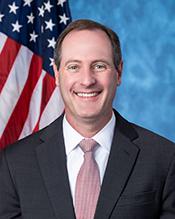
Tracey Mann
RRepublicanKS-1 · Representative
55
/ 100
Average
Attendance100
Avg: 96
Independence2
Avg: 4
Bipartisan Tone27
Avg: 15
Ethics Record100
Avg: 99
Transparency28
Avg: 53
Accountability Score — composite of attendance, independence, bipartisan tone, ethics record & transparency.
Methodology22
Bills Sponsored
0
Enacted into Law
1
Passed a Chamber
21
In Committee
All Sponsored Bills
HR10683In Committee
To authorize supplemental funding for the Federal Aviation Administration, and for other purposes.
HR2332In Committee
SHARE Act of 2026
The proposal would establish new rules for how federal agencies share information with each other and with Congress, aiming to improve government transparency and coordination. It affects federal employees, agency leaders, and lawmakers who need access to government data to do their jobs effectively. The measure passed its committee vote unanimously, indicating broad support for streamlining how information flows within the federal government.
HRES1564In Committee
Recognizing September 17, 2026, as National Teach Ag Day.
This resolution supports the designation of National Teach Ag Day and recognizes the important role of agricultural education and the National FFA Organization in developing the next generation of agricultural leaders.
HRES1455In Committee
Honoring and commending the 100th anniversary of the Golf Course Superintendents Association of America.
This resolution recognizes and celebrates the 100-year milestone of the Golf Course Superintendents Association of America, an organization that represents professionals who maintain golf courses across the country. The measure honors the association's contributions to the golf industry and the skilled work of its members in keeping courses playable and well-maintained. No new laws or regulations are created; this is simply a formal acknowledgment of the organization's achievement.
HR9225In Committee
To require the Administrator of the Federal Aviation Administration to conduct a study to assess whether certain aircraft certified under part 23 of title 14, Code of Federal Regulations, may be used in operations conducted under part 121 of such title, and for other purposes.
The FAA would be required to study whether smaller aircraft that are currently certified for limited use could safely operate as commercial passenger planes under the same rules as larger airlines. This research would help determine if these aircraft meet the safety and performance standards needed for regular commercial airline operations. The findings could potentially expand which types of planes airlines are allowed to use for passenger service.
HR9194In Committee
Build American Efficiency Act
The legislation would clarify how federal agencies should treat documentation and records created during certain quality control processes when determining whether products meet the "Buy American" requirements for federally funded infrastructure projects. This would help companies and government agencies better understand what paperwork counts as acceptable proof that materials were made in the United States, potentially reducing confusion and disputes over compliance with these purchasing rules.
HR8824In Committee
To repeal the jurisdiction conferred by section 3243 of title 18, United States Code, to the State of Kansas over offenses committed by or against Indians on Tribal lands in Kansas.
This bill would remove Kansas's authority to prosecute crimes committed by or against Native Americans on tribal lands within the state, returning that jurisdiction to tribal courts and federal authorities. Currently, Kansas has special legal power over these cases, but the bill would eliminate that arrangement, allowing tribes to handle their own legal matters on their lands. This change would primarily affect Native American tribes in Kansas, state prosecutors, and the tribal justice system.
HRES1194In Committee
Recognizing April 2026 as "Distracted Driving Awareness Month" and promoting efforts to help prevent tragic and preventable crashes, deaths, and injuries caused by distracted driving.
This resolution supports the recognition of Distracted Driving Awareness Month. The resolution also supports the efforts of the Department of Transportation, state and local governments, and state and local law enforcement to prevent and stop distracted driving.
HR8180In Committee
CFTC International Operational Improvements Act of 2026
This bill would give the Commodity Futures Trading Commission (CFTC), the federal agency that oversees futures and derivatives markets, more flexibility and authority to work with international regulators and operate across borders. The changes would likely make it easier for the CFTC to coordinate with other countries' financial regulators, share information, and enforce rules on global trading activities that affect U.S. markets and investors. Traders, financial firms, and companies that use futures contracts to manage risk would be affected by any resulting changes to how these markets are regulated internationally.
HR6460Passed House
Recreational Drone Empowerment Act
Recreational Drone Empowerment Act This bill expands the areas in which recreational unmanned aircraft systems (i.e., drones) are authorized to fly. The Federal Aviation Administration (FAA) has various classifications for airspace, including Class E airspace, which is controlled airspace that is comprised of multiple sectors (e.g., Classes E1 to E5). Class E airspace includes sectors that (1) generally begin where Class G airspace (i.e., uncontrolled airspace) ends, and (2) are associated with an airport surface area or a surface level extension to another class of airspace. Under current law, recreational drones may generally operate in certain circumstances from a fixed site, including within Class B, C, or D airspace. They may also operate within Class G airspace (1) up to 400 feet above ground level, without prior FAA authorization; and (2) over 400 feet above ground level with prior FAA authorization. The FAA has interpreted current law to allow recreational drone operations in Class E2 airspace designated for an airport and prohibit recreational drone operations in other Class E sectors. The bill specifies that the FAA may authorize recreational drones to operate at fixed site locations in Class E airspace that is above Class G airspace; or designated as an extension to a Class B, C, D, or E surface area.
HR8034In Committee
Protecting America’s Small Oil and Gas Producers and Rural Jobs Act
This bill would provide tax breaks and financial relief to small oil and gas companies and the rural communities that depend on them for jobs and tax revenue. The legislation aims to make it easier for smaller producers to compete with larger energy companies by reducing their tax burden or offering other tax incentives. It primarily affects small oil and gas businesses, their workers, and rural economies that rely on energy production.
HRES1073In Committee
Expressing support for the designation of February 21 through February 28, 2026, as "National FFA Week", recognizing the important role of the National Future Farmers of America (FFA) Organization in developing the next generation of globally conscious leaders who will change the world, and celebrating the 50th anniversary of the chartering of the State of Alaska as a State FFA Association.
This resolution supports the designation of National FFA (Future Farmers of America) Week. It also celebrates the 50th anniversary of the chartering of Alaska as a State FFA Association of the National FFA Organization.
HR7468In Committee
First-Time Home Buyer Empowerment Act
This bill would likely provide tax breaks or financial assistance to people buying their first home, such as tax credits, deductions, or down payment help. The goal is to make homeownership more affordable for first-time buyers who might otherwise struggle to save enough money for a down payment or cover closing costs. The bill is currently being reviewed by the House committee that handles tax policy.
HR6874In Committee
Roadway Safety Modernization Act of 2025
This bill would update federal rules and funding for road safety improvements, likely focusing on modernizing infrastructure to reduce accidents and fatalities on highways and local roads. It would affect states, cities, and transportation agencies that build and maintain roads, as well as drivers and pedestrians who use those roads daily. The changes could include new safety standards for road design, updated technology requirements, or increased federal funding for safety projects like better lighting, guardrails, or traffic management systems.
HR7261In Committee
Motor Carrier Safety Screening Modernization Act
Motor Carrier Safety Screening Modernization Act This bill expands and modifies a commercial vehicle operator safety screening program to allow the motor carrier industry to access an individual operator's crash and serious safety violation inspection history during employment. Under current law, this Federal Motor Carrier Safety Administration (FMCSA) program provides information for pre-employment screening. The bill also directs FMCSA to revise the appeals process for DataQs to require an appeal to be decided by a person other than the person that issued the violation. DataQs is the online system for motor carriers and commercial motor vehicle drivers to request and track a review of federal and state crash and inspection data that the requestor believes is incomplete or incorrect.
HR5198In Committee
Rural Health Clinic Location Modernization Act of 2025
This bill would update the rules for where rural health clinics can be located, likely allowing them to operate in areas that may have changed since current location restrictions were set. The change would help rural communities access healthcare services more flexibly by removing outdated geographic barriers that prevent clinics from opening in places that need them. Rural residents and healthcare providers in less populated areas would benefit from having more options for where medical clinics can be established.
HR5199In Committee
Modernizing Rural Physician Assistant and Nurse Practitioner Utilization Act of 2025
This bill would expand the ability of physician assistants and nurse practitioners to work independently in rural areas, allowing them to provide more medical care without requiring a supervising doctor on-site. The change would help address doctor shortages in rural communities by letting these trained healthcare professionals take on more responsibility for patient care. This would primarily affect rural patients seeking medical services and healthcare providers working in areas where doctors are scarce.
HR4601In Committee
Seasonal Agriculture CDL Modernization Act
The proposal would update rules for commercial driver's licenses (CDLs) to make it easier for seasonal farm workers to transport agricultural products during harvest times without needing the same extensive training and licensing requirements as year-round truck drivers. This would allow farmers and agricultural companies to move crops more flexibly during peak seasons while potentially reducing labor costs and transportation delays. The change primarily affects seasonal agricultural workers, farming operations, and rural transportation logistics.
HR2788In Committee
End DWI Act of 2025
The legislation would establish new federal standards and funding mechanisms to reduce drunk driving incidents across the country. It would likely affect state transportation departments, law enforcement agencies, and drivers by potentially requiring stricter penalties, enhanced enforcement programs, or improved detection technologies for impaired driving. The bill has been sent to a congressional subcommittee for review and discussion.
HRES206In Committee
Recognizing the importance of stepped-up basis under section 1014 of the Internal Revenue Code of 1986 in preserving family-owned farms and small businesses.
This resolution supports preserving the stepped-up basis of certain inherited assets (such as land, equipment, or buildings), opposes any efforts to impose new taxes on family farms or small businesses, and recognizes the importance of generational transfers of farm and family-owned businesses. As background, the basis for federal tax purposes of certain inherited assets is reset (or stepped up) from the original cost basis to the fair market value of the asset on the date of the previous owner’s death. Thus, any gain or loss on the subsequent sale of an inherited asset generally is calculated based on the asset’s stepped-up basis (and not the original cost basis).
HRES133In Committee
Expressing support for the designation of February 15 through February 22, 2025, as "National FFA Week", recognizing the important role of the National FFA Organization in developing the next generation of leaders who will change the world, and celebrating the 90th anniversary of New Farmers of America and the 75th anniversary of the Federal charter to Future Farmers of America.
This resolution supports the designation of National FFA (Future Farmers of America) Week. It also celebrates the 90th anniversary of New Farmers of America (NFA), which served Black vocational agriculture students in segregated public schools until NFA and FFA became one organization in 1965. The resolution also commemorates the 75th anniversary of the federal charter for the Future Farmers of America.
HR1131In Committee
Family Farm and Small Business Exemption Act
Family Farm and Small Business Exemption Act This bill restores an exemption for certain family farms and small businesses on the Free Application for Federal Student Aid (FAFSA) form. The bill applies to the net worth of (1) a family farm on which the family resides, or (2) a small business with not more than 100 full-time or full-time equivalent employees that is owned and controlled by the family. Prior to recent changes made to the FAFSA, the net worth of these family farms and small businesses were excluded as assets when calculating a student's financial need to determine federal student aid eligibility. Beginning with the 2024-2025 academic year, the net worth of these farms and businesses are treated as an asset and therefore included in the calculation. This bill restores the exemption to exclude such net worth from the calculation.