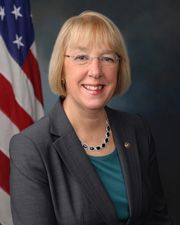
Patty Murray
DDemocratWA · Senator
62
/ 100
Average
Attendance94
Avg: 97
Independence11
Avg: 23
Bipartisan Tone11
Avg: 14
Ethics Record100
Avg: 100
Transparency97
Avg: 47
Accountability Score — composite of attendance, independence, bipartisan tone, ethics record & transparency.
Methodology39
Bills Sponsored
0
Enacted into Law
1
Passed a Chamber
31
In Committee
All Sponsored Bills
S1564Passed Senate
Floodplain Enhancement and Recovery Act
Floodplain Enhancement and Recovery Act This bill eases restrictions for ecosystem restoration projects in designated floodways that meet certain risk criteria. Under current National Flood Insurance Program requirements, such projects are generally prohibited in a designated floodway if the project would increase the area’s base flood elevation. The bill establishes conditions under which a community may permit an ecosystem restoration project within a designated floodway that would result in an increase in base flood elevations. Specifically, the project may be permitted if (1) a professional engineer determines that the cumulative effect of the increase will be not more than 1 foot; (2) no insurable structure or critical infrastructure is located in an impacted area; and (3) the community submits an analysis to the Federal Emergency Management Agency on the project’s effects after the project is complete. An ecosystem restoration project is defined by the bill as a project that manipulates the physical, chemical, or biological characteristics of a site with a goal of recovering, reclaiming, or improving the functions of an aquatic resource or floodplain.
S5546In Committee
Jeanette Acosta Invest in Women’s Health Act of 2026
S5494In Committee
Zeus 95 Memorial Act
S5539In Committee
Affordability is Access Act of 2026
S5247In Committee
Defense Community Infrastructure Program Tribal Eligibility Act of 2026
S5190In Committee
Restoring Justice for Workers Act
Workers would gain the right to take workplace disputes to court instead of being forced into private arbitration with their employers. Currently, many employment contracts require workers to settle disagreements about pay, discrimination, harassment, or wrongful termination through arbitration—a private process where an arbitrator makes a binding decision rather than a judge or jury. This bill would let employees choose whether to pursue their claims in the public court system, where proceedings are more transparent and they may have greater legal protections.
SJRES199In Committee
A joint resolution providing for congressional disapproval under chapter 8 of title 5, United States Code, of the rule submitted by the Department of Health and Human Services relating to "Restoring Flexibility in the Child Care and Development Fund (CCDF)".
Congress would reject a new rule from the Department of Health and Human Services that loosens requirements for how states manage child care assistance programs, which help low-income families pay for child care. The rule would give states more flexibility in how they spend federal child care funding and set their own standards, but Congress is considering blocking it to maintain stricter national requirements. This would affect child care providers, low-income families receiving assistance, and state governments that administer these programs.
S5146In Committee
Higher Education Access and Success for Homeless and Foster Youth Act of 2026
Young people who have experienced homelessness or been in foster care often struggle to complete the financial aid forms needed for college because they lack stable addresses, documents, or family support—this bill would simplify those requirements and remove barriers so these students can more easily access grants and loans. The changes would help colleges better identify and assist these vulnerable students, making it possible for more of them to afford higher education and complete their degrees.
S5132In Committee
Tribal Access to Nutrition Assistance Act of 2026
The proposal would change federal food assistance rules to let people on Indian reservations receive benefits from both the food stamp program (SNAP) and the federal food distribution program at the same time, instead of having to choose one or the other. Currently, people can only be enrolled in one program, so this change would give Native American families more flexibility in how they get food assistance. The bill is still in early stages and has been sent to the Senate Agriculture Committee for review.
S5082In Committee
Values in Arms Export Act of 2026
The federal government would strengthen its ability to track and verify how countries considered security concerns use weapons and military equipment that the U.S. sells or gives them, ensuring these items aren't misused or transferred to hostile groups. This would give the State Department and Defense Department better tools to monitor defense sales and military aid to make sure recipient countries use them as intended. The measure affects defense contractors, foreign governments that receive U.S. military equipment, and federal agencies responsible for overseeing international arms transfers.
S4879In Committee
Let Doctors Provide Reproductive Health Care Act
The bill would protect healthcare providers' ability to offer reproductive health services, including contraception and abortion care, by preventing states and the federal government from restricting or penalizing doctors and clinics that provide these services. It would affect patients seeking reproductive care, healthcare workers and medical facilities that provide these services, and states that have passed laws limiting access to reproductive health options. The measure is currently under review by the Senate Judiciary Committee.
S4919In Committee
Wage Theft Prevention and Wage Recovery Act
The legislation would strengthen protections against wage theft by making it easier for workers to recover unpaid wages and allowing the Department of Labor to pursue cases on their behalf. It would also provide federal grants to help states and organizations prevent wage violations like employers failing to pay minimum wage or overtime. The bill aims to help workers who have been cheated out of pay recover what they're owed and reduce these violations from happening in the first place.
S4817In Committee
CHILD Labor Act
The bill would increase penalties and enforcement actions against companies that violate child labor laws, making it harder for businesses to employ minors in dangerous or illegal working conditions. It would give federal labor inspectors stronger tools to investigate violations and protect young workers from exploitation in industries like agriculture, manufacturing, and retail. The changes would affect employers across the country and aim to ensure children can focus on school and safe activities rather than dangerous work.
S4635In Committee
SAFE for Survivors Act of 2026
The bill would help survivors of domestic violence, dating violence, sexual assault, and stalking become more economically independent and safe by providing resources and protections related to employment, housing, and financial security. It aims to address barriers these survivors face when trying to leave abusive situations and rebuild their lives, affecting both the survivors themselves and potentially employers and housing providers who would need to comply with new requirements. The legislation is currently under review by the Senate committee responsible for health, education, labor, and pension matters.
S4540In Committee
Reproductive Health Care Accessibility Act
The proposal would update federal health care rules to ensure that people with disabilities receive better reproductive health services, including family planning, pregnancy care, and related medical support. It aims to remove barriers that prevent disabled individuals from accessing the same reproductive health options available to others, affecting both patients seeking care and health care providers serving them.
S4490In Committee
Fair Trusts for Fiscal Responsibility Act
The proposal would create a new tax on the assets held in trusts, which are legal arrangements where someone manages money or property for another person's benefit. This would primarily affect wealthy individuals and families who use trusts to pass down assets to heirs, as they would owe taxes based on the value of trust holdings. The measure is currently under review by the Senate Finance Committee.
S4503In Committee
Advancing Menopause Care and Mid-Life Women’s Health Act
The legislation would improve healthcare services and support for women going through menopause and mid-life health changes by potentially expanding access to treatment options, improving provider training, and increasing research into menopause-related conditions. This would affect millions of women experiencing menopause symptoms and the healthcare providers who treat them. The bill is currently under review by the Senate committee responsible for health and education matters.
SRES691In Committee
A resolution supporting the designation of April 2026 as the "Month of the Military Child".
This resolution would officially recognize April 2026 as a month dedicated to honoring military children and raising awareness about their unique experiences and challenges. Military families, schools, and communities would be encouraged to celebrate and support the children of active-duty service members, veterans, and National Guard personnel during this designated month. The resolution is currently under review by the Armed Services Committee.
SJRES148In Committee
A joint resolution providing for congressional disapproval under chapter 8 of title 5, United States Code, of the rule submitted by the Bureau of Consumer Financial Protection relating to the withdrawal of the rule relating to "Bulletin 2022-01: Medical Debt Collection and Consumer Reporting Requirements in Connection with the No Surprises Act".
Congress is considering blocking a decision by the Consumer Financial Protection Bureau to withdraw its guidance on how medical debt collectors and credit reporting companies must follow rules about surprise medical bills. If approved, this would force the agency to keep its previous rules in place rather than allow it to reverse course on protecting consumers from unexpected medical debt collection practices.
S4261In Committee
Preventing Youth Homelessness Demonstration Act of 2026
This bill would fund pilot programs in different communities to test new ways of preventing young people from becoming homeless, such as providing emergency financial help, housing assistance, or support services to at-risk youth and their families. The demonstration projects would help identify which strategies work best before potentially expanding them nationwide, affecting homeless youth, their families, and local housing organizations that would run these programs.
S342In Committee
Purple Heart Veterans Education Act of 2025
Purple Heart Veterans Education Act of 2025 This bill authorizes certain Purple Heart recipients to elect to transfer to one or more eligible dependents (e.g., a spouse or child) unused portions of such recipients’ entitlement to Post-9/11 GI Bill educational assistance. This authority specifically applies to veterans who are awarded the Purple Heart for service in the Armed Forces occurring on or after September 11, 2001, and who have been discharged or released from active service. Under the bill, the total number of months of entitlement transferred by a Purple Heart recipient may not exceed 36 months. Additionally, the Purple Heart recipient may modify or revoke any unused portion of the transferred entitlement by submitting written notice. A transferred entitlement may not be treated as marital property or marital assets in divorce or other civil proceedings. The death of the Purple Heart recipient must not affect the use of the entitlement by the individual who receives the transferred entitlement. In the event of an overpayment of educational assistance, the Purple Heart recipient and the transferee of the entitlement must be held jointly and severally liable for the amount. The bill requires the VA and DOD to coordinate to facilitate the transfer of entitlements under the bill.
S4081In Committee
Fair Wages for Home Care Workers Act
This bill would establish new wage and labor protections for home care workers, who provide services like assistance with daily living and medical care to elderly and disabled people in their homes. The legislation aims to ensure these workers receive fair pay and benefits comparable to other care workers, addressing concerns that home care jobs often pay significantly less than similar positions in hospitals or care facilities. The bill would affect millions of home care workers and the families or government programs that employ them.
SRES610Introduced
A resolution congratulating the Seattle Seahawks for winning Super Bowl LX.
Congress passed a resolution officially congratulating the Seattle Seahawks football team for winning Super Bowl LX. This type of resolution is a ceremonial action that recognizes the team's achievement but has no practical effect on laws or policies. The resolution was approved unanimously by the Senate.
S3865In Committee
BE HEARD in the Workplace Act
This bill would give workers new legal protections to speak up about workplace problems, safety concerns, or illegal activities without fear of losing their jobs or facing retaliation from employers. It likely expands existing whistleblower protections or creates clearer rules about what kinds of employee complaints are protected by law. Workers in various industries would benefit from stronger safeguards when reporting issues to their employers or government agencies.
S1320Reported
Servicewomen and Veterans Menopause Research Act
Servicewomen and Veterans Menopause Research Act This bill requires the Department of Defense (DOD) to coordinate with the Department of Veterans Affairs (VA) to evaluate and report on research related to menopause, perimenopause, or mid-life women’s health among members and former members of the uniformed services (i.e., Army, Navy, Air Force, Marine Corps, Space Force, Coast Guard, the commissioned corps of the Public Health Service, and the commissioned corps of the National Oceanic and Atmospheric Administration). Such evaluation must also examine (1) any gaps in knowledge and research on menopause treatments and the relation of service in the uniformed services to perimenopause and menopause, (2) the availability and uptake of professional training resources for DOD- or VA-employed providers relating to mid-life women’s health, and (3) the availability of and uptake of treatments for women in the uniformed services or veterans who are experiencing perimenopause or menopause. The report must include a strategic plan that resolves the gaps in knowledge and research.
S1737In Committee
Wild Olympics Wilderness and Wild and Scenic Rivers Act
This bill would protect certain wilderness areas and rivers in the Olympic region of Washington state by designating them as federally protected lands where commercial development and resource extraction are prohibited. The protected areas would preserve wildlife habitat, recreation opportunities, and scenic landscapes for future generations while restricting logging, mining, and dam construction in these designated zones. The measure affects outdoor enthusiasts, conservation groups, timber companies, and local communities that depend on or use these public lands.
S2882Introduced
Continuing Appropriations and Extensions and Other Matters Act, 2026
Continuing Appropriations and Extensions and Other Matters Act, 2026 This bill provides continuing FY2026 appropriations for federal agencies, permanently extends the expanded premium tax credit for purchasing health insurance, provides additional funding for Medicaid and security for federal officials, and extends various expiring programs. Specifically, the bill provides continuing FY2026 appropriations to federal agencies through the earlier of October 31, 2025, or the enactment of the applicable appropriations act. It is known as a continuing resolution (CR) and prevents a government shutdown that would otherwise occur if the FY2026 appropriations bills have not been enacted when FY2026 begins on October 1, 2025. The CR funds most programs and activities at the FY2025 levels with several exceptions that provide funding flexibility and additional appropriations for various programs. For example, the CR provides additional funding for the Corporation for Public Broadcasting and security for federal officials. In addition, the CR permanently extends provisions that expanded the premium tax credit, which generally reduces premiums for health insurance purchased through a health insurance exchange; repeals health care provisions that were included in the One Big Beautiful Bill Act, including provisions that reduced Medicaid funding; authorizes the District of Columbia to spend local funds at the rates included in its FY2026 local budget; extends the availability of certain funds that are being withheld by the Office of Management and Budget (OMB); and limits the authority of OMB to withhold appropriations. Finally, the bill extends several expiring programs and authorities, including programs related to health care, veterans, homeland security, and agriculture.
S1433Reported
Northwest Straits Marine Conservation Initiative Reauthorization Act of 2025
Northwest Straits Marine Conservation Initiative Reauthorization Act of 2025 This bill revises and reauthorizes through FY2031 the Northwest Straits Marine Conservation Initiative and its Northwest Straits Advisory Commission. The initiative and the commission work to protect and restore marine waters, habitats, and species of the Northwest Straits region. The region stretches from Snohomish and Jefferson counties in Washington state to the Canadian border and includes the U.S. marine waters of the Strait of Juan de Fuca, the San Juan Islands, and the northern area of the Puget Sound. The bill establishes requirements regarding the commission's membership, goals, and duties. Among other duties, the commission must provide resources and technical support for marine resources committees, develop scientifically sound restoration and protection recommendations, and serve as a public forum for informal policy discussions about the marine ecosystem of the Northwest Straits region.
S2307In Committee
Sound Insulation Treatment Repair and Replacement Program Act
Sound Insulation Treatment Repair and Replacement Program Act This bill establishes a pilot program to allow airports to repair and replace sound insulation in residential buildings using funds provided under the Airport Improvement Program (AIP). Currently, airports may use AIP funds for one-time sound insulation projects for residential buildings. Under the bill, the Federal Aviation Administration must establish a pilot program to allow up to four airports to have a one-time waiver to use AIP funds for the repair and replacement of sound insulation in residential buildings if the airport previously received federal assistance or federally authorized airport assistance for the insulation. For a property to qualify under the waiver, additional requirements include that the insulation previously installed was done prior to 2002 and has resulted in structural deterioration; interior and exterior sound decibel levels for the residence meet certain criteria; current interior noise levels will be reduced by new insulation; and the airport and the property owner have exhausted funding available through warranties, insurance coverage, and legal remedies for the previously installed insulation.
S1736In Committee
Improving Training for School Food Service Workers Act of 2025
This bill would require the federal government to develop and fund training programs for school cafeteria workers to improve their skills in food preparation, nutrition, and food safety. The training would help school food service employees do their jobs better and potentially improve the quality and healthfulness of meals served to students across the country.
S1663In Committee
Therapeutic Fraud Prevention Act of 2025
The legislation would establish new federal rules to prevent fraudulent claims about therapeutic treatments and products, giving the government stronger tools to investigate and punish companies that make false health promises to consumers. It would affect manufacturers, sellers, and marketers of health products and treatments, as well as patients who rely on accurate information when making medical decisions. The bill aims to protect people from wasting money on fake cures and potentially dangerous products by cracking down on misleading advertising and unproven claims.
SRES191Introduced
A resolution supporting the designation of April 2025 as the "Month of the Military Child".
Congress is officially recognizing April 2025 as a month dedicated to honoring and celebrating the children of military service members. This symbolic designation aims to raise awareness about the unique challenges military families face, such as frequent moves, deployments, and separation from their parents. The resolution passed unanimously in the Senate without any changes.
S924Introduced
Further Additional Continuing Appropriations and Other Extensions Act, 2025
Further Additional Continuing Appropriations and Other Extensions Act, 2025 This bill provides continuing FY2025 appropriations for federal agencies through April 11, 2025. It also extends various expiring programs and authorities, including several public health programs. Specifically, the bill provides continuing FY2025 appropriations to federal agencies through the earlier of April 11, 2025, or the enactment of the applicable appropriations act. It is known as a continuing resolution (CR) and prevents a government shutdown that would otherwise occur if the FY2025 appropriations bills have not been enacted when the existing CR expires on March 14, 2025. The CR funds most programs and activities at the FY2024 levels with some exceptions that provide funding flexibility and additional appropriations for various programs. For example, the CR provides additional emergency funding for the Federal Emergency Management Agency's Disaster Relief Fund, permits the Navy to apportion funds at the rate necessary to fund the Columbia-class submarine program and cost increases for certain shipbuilding programs, and provides additional funding for the Office of Navajo and Hopi Relocation. In addition, the bill extends several expiring programs and authorities, including several public health, Medicare, and Medicaid authorities and programs; authorities related to the Commodity Futures Trading Commission whistleblower program; authorities for the Department of Homeland Security and the Department of Justice to take actions to mitigate a credible threat from an unmanned aircraft system; the special assessment on nonindigent persons or entities convicted of certain offenses involving sexual abuse or human trafficking; and the National Cybersecurity Protection System.
S916In Committee
Stop Shackling and Detaining Pregnant Women Act
S411In Committee
Flight 293 Remembrance Act
This bill would likely establish a memorial or commemoration for Flight 293, a military or national security-related incident, though the specific details would depend on the bill's full text. The measure appears designed to honor those affected by this event and ensure it is remembered as part of armed forces history. It would primarily affect military personnel, veterans, and their families through official recognition and remembrance activities.
SRES42In Committee
A resolution condemning the pardons for individuals who were found guilty of assaulting Capitol Police Officers.
This resolution disapproves of pardons for individuals who were found guilty of assaulting U.S. Capitol Police officers.
S3631In Committee
Clean Energy Works Act
Clean Energy Works Act - Amends the Energy Policy and Conservation Act to set forth provisions governing the allocation of funds for assisting states in the development, implementation, or modification of energy conservation plans. Requires a state that receives such assistance to use no less than a third of it to provide grants and loans: (1) for renewable energy development; (2) to energy technology companies; or (3) to promote energy efficiency. Sets forth state cost-sharing requirements. Authorizes appropriations for such assistance for FY2011-FY2016. Amends the America COMPETES Act to: (1) revise provisions concerning the Advanced Research Projects Agency-Energy (ARPA-E), including by creating additional duties of the Director of ARPA-E; and (2) increase and extend authorization for ARPA-E for FY2011-FY2016. Authorizes the Secretary of Labor to award on a competitive basis: (1) regional energy alliance skills grants to energy alliances; (2) regional industry energy efficiency grants to covered entities for educating and training incumbent workers in the skills necessary to increase energy efficiency in industries in existence on this Act's enactment; and (3) law carbon energy training grants to eligible entities to provide customized training services to businesses in identified industries, or to businesses in industries that directly support or supply identified industries. Amends the American Recovery and Reinvestment Act of 2009 to prohibit, as of October 1, 2010, provisions of such Act that are otherwise applicable to the use of the authority made available under the Federal Columbia River Transmission System Act from applying to borrowing authority available to the Bonneville Power Administration (BPA) to assist in financing the construction, acquisition, and replacement of the BPA transmission system and implementing the BPA Administrator's authority under the Pacific Northwest Electric Power Planning and Conservation Act.
S721Reported
Alpine Lakes Wilderness Additions and Pratt and Middle Fork Snoqualmie Rivers Protection Act
Alpine Lakes Wilderness Additions and Pratt and Middle Fork Snoqualmie Rivers Protection Act - Designates as wilderness and as a component of the National Wilderness Preservation System and considers as part of the Alpine Lakes Wilderness certain federal land in the Mount Baker-Snoqualmie National Forest in the state of Washington that is within the proposed Alpine Lakes Wilderness Additions Boundary. Makes any land or interests within the proposed boundary acquired by the United States part of the Wilderness. Amends the Wild and Scenic Rivers Act to designate the Middle Fork Snoqualmie and Pratt Rivers in the state of Washington as scenic and/or wild rivers.
S635In Committee
A bill to amend the Wild and Scenic Rivers Act to designate a segment of Illabot Creek in Skagit County, Washington, as a component of the National Wild and Scenic Rivers System.
Amends the Wild and Scenic Rivers Act to designate a specified segment of the Illabot Creek in Skagit County, Washington, as a component of the National Wild and Scenic Rivers System.