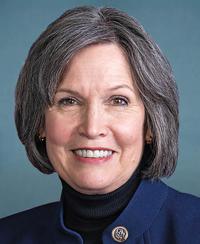
Betty McCollum
DDemocratMN-4 · Representative
59
/ 100
Average
Attendance99
Avg: 96
Independence1
Avg: 4
Bipartisan Tone18
Avg: 15
Ethics Record100
Avg: 99
Transparency72
Avg: 53
Accountability Score — composite of attendance, independence, bipartisan tone, ethics record & transparency.
Methodology12
Bills Sponsored
0
Enacted into Law
0
Passed a Chamber
12
In Committee
All Sponsored Bills
HR10576In Committee
Leech Lake Reservation Restoration Amendments Act of 2026
HR10395In Committee
Critical Materials Future Act of 2025
HRES1484In Committee
Recognizing the nonprofit sector and the contributions of nonprofit employees, and expressing support for August 17, 2026, to be designated as "National Nonprofit Day".
HRES1463In Committee
Expressing support for July to be designated as "Disability Pride Month".
The resolution calls for the federal government to officially recognize July as "Disability Pride Month" to celebrate and honor people with disabilities. This designation would raise awareness about the contributions and achievements of disabled individuals in American society and encourage communities to recognize disability pride throughout the month. The measure affects how the government acknowledges disability issues and could inspire schools, businesses, and organizations to hold events and activities celebrating people with disabilities.
HR8016In Committee
Forever Chemical Regulation and Accountability Act of 2026
Forever Chemical Regulation and Accountability Act of 2026 This bill phases out the release and nonessential use of perfluoroalkyl or polyfluoroalkyl substances (PFAS) and addresses PFAS research, remediation, regulation, and enforcement. The Environmental Protection Agency (EPA) must require each manufacturer and user of PFAS to submit annual reports that include specified information about the essential (e.g., critical for health or safety reasons) and nonessential uses of PFAS by such entities. Not later than 10 years after the enactment of this bill, manufacturers and users must fully phase out nonessential uses of PFAS. The bill also establishes specified deadlines to phase out the sale of certain products containing PFAS; requires federal agencies, to the maximum extent practicable, to eliminate the procurement of products known to contain PFAS; imposes a 10-year phaseout of the release of PFAS above a certain threshold of detection; provides enforcement authority to the EPA regarding violations of the requirements of the bill, including through civil and criminal penalties; allows citizen suits against manufacturers and users of PFAS and the EPA; and addresses actions under state law related to damages from exposure to hazardous substances, including with regard to statutes of repose. The bill exempts from a bankruptcy petition’s automatic stay any proceeding against a non-debtor entity (e.g., a proceeding to obtain property from a non-debtor) with respect to a PBT claim (a claim relating to persistent, bioaccumulative, and toxic chemicals) against the non-debtor entity, the debtor, or the estate.
HR7545In Committee
Defending the Human Rights of Palestinian Children and Families Living Under Israeli Military Occupation Act
This bill would direct the U.S. government to investigate and report on alleged human rights violations against Palestinian children and families in areas under Israeli military control, and would condition certain U.S. military aid to Israel on improvements in how Israeli forces treat Palestinian civilians. The legislation aims to hold both Israeli security forces and Palestinian armed groups accountable for abuses while pushing for better protection of children and families caught in the conflict.
HR5521In Committee
Peace Corps Volunteers Congressional Gold Medal Act of 2025
This bill would award the Congressional Gold Medal, one of the highest civilian honors, to Peace Corps volunteers in recognition of their service and contributions to international development and diplomacy. The medal honors volunteers who have worked abroad promoting education, health, infrastructure, and cultural exchange in developing countries. This is a ceremonial recognition of the Peace Corps' mission and the sacrifices volunteers make while serving communities worldwide.
HR5328In Committee
Indian Programs Advance Appropriations Act of 2025
Indian Programs Advance Appropriations Act of 2025 This bill authorizes advance appropriations for several covered appropriations accounts of (1) the Bureau of Indian Affairs and the Bureau of Indian Education within the Department of the Interior, and (2) the Indian Health Service within the Department of Health and Human Services. The advance appropriations provide new budget authority that first becomes available for the first fiscal year after the budget year. The covered accounts within the Bureau of Indian Affairs are (1) Operation of Indian Programs, (2) Contract Support Costs, (3) the Indian Guaranteed Loan Program, (4) Construction, and (5) Payments for Tribal Leases. The covered accounts within the Bureau of Indian Education are (1) Operation of Indian Education Programs, and (2) Education Construction. The covered accounts within the Indian Health Service are (1) Indian Health Services, (2) Contract Support Costs, (3) Payments for Tribal Leases, and (4) Indian Health Facilities. The bill also requires the President's budget and the supporting documents submitted to Congress to include detailed estimates related to the advance appropriations.
HRES613In Committee
Expressing support for July to be designated as "Disability Pride Month".
The resolution would officially recognize July as "Disability Pride Month" to celebrate the achievements and contributions of people with disabilities and raise awareness about disability rights. This symbolic designation would encourage communities, schools, and organizations to highlight the history and ongoing struggles of the disability community during that month. The measure affects all Americans by promoting greater inclusion and recognition of disabled individuals in society.
HR2977In Committee
MRRRI Act
HR2976In Committee
Cold-blooded Animal Research and Exhibition Act
The legislation would establish new standards and regulations for how cold-blooded animals like reptiles and amphibians are cared for, bred, and displayed in zoos, research facilities, and other public exhibitions. It would affect zoos, pet breeders, research institutions, and anyone else who keeps these animals, requiring them to meet specific housing, temperature, and care requirements. The bill aims to improve animal welfare while allowing legitimate research and educational programs to continue operating.
HR588In Committee
Boundary Waters Wilderness Protection and Pollution Prevention Act
Boundary Waters Wilderness Protection and Pollution Prevention Act This bill protects and preserves approximately 225,504 acres of federal land and waters in a specified area in the Rainy River Watershed of Superior National Forest in Minnesota from certain mining, such as sulfide-ore copper mining. (The area is upstream from the Boundary Waters Canoe Area Wilderness.) Specifically, the bill withdraws those acres from entry, appropriation, and disposal under the public land laws; location, entry, and patent under the mining laws; and operation of the mineral leasing, mineral materials, and geothermal leasing laws. However, the Forest Service is authorized to permit the removal of sand, granite, iron ore, and taconite from national forest system lands within such area if the removal is not detrimental to the water quality, air quality, and health of forest habitat within the Rainy River Watershed. Land or interest in land within such area that is acquired by the United States must be immediately withdrawn in accordance with this bill.