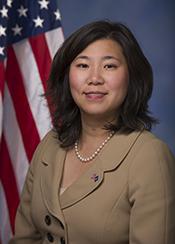
Grace Meng
DDemocratNY-6 · Representative
47
/ 100
Below Average
Attendance93
Avg: 96
Independence3
Avg: 4
Bipartisan Tone11
Avg: 15
Ethics Record100
Avg: 99
Transparency8
Avg: 53
Accountability Score — composite of attendance, independence, bipartisan tone, ethics record & transparency.
Methodology33
Bills Sponsored
0
Enacted into Law
0
Passed a Chamber
33
In Committee
All Sponsored Bills
HRES1582In Committee
Recognizing that the United States needs to support and strengthen mothers in the workforce by investing in the Mom Economy.
HRES1565In Committee
Expressing the sense of the House of Representatives that the United States Postal Service should issue a commemorative postage stamp honoring Lewis Howard Latimer, in recognition of his distinctive life, scientific achievements, and his civic contributions to technological advancement, to commemorate the 178th year anniversary of his birth and that the Citizens Stamp Advisory Committee should recommend to the Postmaster General that such a stamp be issued.
HR5645In Committee
Pray Safe Act of 2025
The bill would establish safety standards and emergency preparedness requirements for places of worship to help protect congregants during crises like fires, medical emergencies, or security threats. It likely requires or encourages religious buildings to have evacuation plans, trained personnel, and safety equipment similar to what other public buildings must maintain. The measure affects churches, synagogues, mosques, temples, and other religious organizations across the country.
HR10129In Committee
Stamps for Staying Connected Act of 2026
HR10057In Committee
Early Childhood Educator Professional Improvement Act of 2026
HR9413In Committee
Military Family Limb Loss Support Act
The Department of Defense would establish a new program to provide support and resources for military families dealing with limb loss or limb differences in their children or family members. This program would help connect affected families with medical care, prosthetics, rehabilitation services, and other assistance they need. The goal is to ensure military families have access to comprehensive support services to help them manage these conditions.
HR9359In Committee
Ending Stolen SNAP Benefits Act of 2026
This bill would allow people who receive food assistance benefits to get their money back if it's stolen through identity theft or card skimming (when criminals illegally copy card information). Currently, households that lose their benefits this way may have difficulty getting them replaced, so this change would make it easier for low-income families to recover stolen food assistance funds.
HRES1362In Committee
Honoring the life, military service, and congressional legacy of the Honorable Charles Bernard Rangel, and his enduring contributions to the alliance between the United States and the Republic of Korea.
This resolution honors former Congressman Charles Bernard Rangel's military service, his decades representing New York in Congress, and his work strengthening the relationship between the United States and South Korea. The measure recognizes Rangel's contributions to veterans' affairs and his role in supporting Korean-American communities and U.S.-Korea diplomatic ties throughout his career.
HR9066In Committee
Community-Based Approaches to Prevent and Address Hate Crimes Act of 2026
The Attorney General would be authorized to create a grant program to help prevent hate crimes, likely providing funding to law enforcement agencies, community organizations, and other groups working to reduce violence motivated by bias against protected characteristics like race, religion, or sexual orientation. This would affect local police departments, nonprofits, and communities seeking resources to combat hate-motivated violence through prevention, training, and community engagement efforts.
HRES1323In Committee
Recognizing the impact the stigmatization of menstruation has on the lives of women, girls, and people who menstruate, and expressing support for the designation of the month of May as "National Menstrual Health Awareness Month".
This resolution asks Congress to officially recognize May as "National Menstrual Health Awareness Month" to help reduce the shame and stigma surrounding menstruation that affects women, girls, and people who menstruate. The measure acknowledges how menstrual stigma can impact education, health, and quality of life, and calls for greater awareness and open discussion about menstrual health. The resolution has been sent to two House committees for review but does not create any new laws or programs.
HRES1243In Committee
Recognizing the significance of Asian American, Native Hawaiian, and Pacific Islander Heritage Month as an important time to celebrate the significant contributions of Asian Americans, Native Hawaiians, and Pacific Islanders to the history of the United States.
This resolution recognizes the significance of Asian American, Native Hawaiian, and Pacific Islander Heritage Month as an important time to celebrate the significant contributions of Asian Americans, Native Hawaiians, and Pacific Islanders to the history of the United States.
HR8582In Committee
Protecting Human Rights and Public Health in Foreign Assistance Act
The proposal would cancel certain government rules and regulations that govern how the United States provides aid and assistance to other countries. This would affect how federal agencies distribute foreign aid money and what requirements they must follow when doing so, potentially changing which countries receive assistance and under what conditions.
HR8381In Committee
Safe Check-Ins for Immigrants Act
This bill would allow immigrants waiting for a decision on whether they'll be deported to attend some of their required court appearances by video instead of having to show up in person every time. The change would make the immigration court process more flexible for people awaiting removal decisions while still ensuring they participate in their hearings.
HRES1116In Committee
Commemorating the 5-year remembrance of the March 16, 2021, shootings in the Atlanta, Georgia, region and denouncing continuing anti-Asian hate, including the resurgence of xenophobic and anti-immigrant rhetoric.
This resolution honors the memory of the eight people killed in the March 2021 shootings at spas in the Atlanta area and condemns anti-Asian hate crimes and discrimination. It expresses support for addressing xenophobic and anti-immigrant rhetoric that has contributed to violence and discrimination against Asian Americans and immigrants. The measure is primarily symbolic, intended to raise awareness about hate crimes targeting Asian communities.
HR1803In Committee
Fair Access to Co-ops for Veterans Act of 2025
Fair Access to Co-ops for Veterans Act of 2025 This bill revives and makes permanent the authority of the Department of Veterans Affairs (VA) home loan guarantee program to guarantee loans for a veteran’s purchase of stock or membership in a cooperative housing corporation (i.e., co-op) for the purpose of entitling the veteran to occupy a single family residential unit. For purposes of the administration of such loans, the bill establishes a fee rate of the usual fee plus 3.25% of the total amount of the loan, treats such cooperative housing units as residential property for purposes of imposing restrictions and liabilities, and guarantees up to 25% of the amount of the loan for loans exceeding $144,000. Additionally, the bill requires the VA to advertise the availability of loan guarantees for cooperative housing unit loans, including by issuing guidance and notifying eligible veterans.
HRES1061In Committee
Recognizing the cultural and historical significance of Lunar New Year in 2026.
This resolution would officially recognize Lunar New Year as a significant cultural and historical observance in the United States in 2026, acknowledging its importance to millions of Americans who celebrate this holiday. The measure is largely symbolic and does not create new laws or government programs, but rather expresses Congress's support for honoring this major celebration observed by Asian American communities and others around the world.
HR7439In Committee
Uniform Standards for Federal Law Enforcement Act of 2026
This bill would establish consistent training, equipment, and conduct standards that all federal law enforcement agencies must follow, rather than allowing each agency to set its own rules. The changes would affect federal agents working for agencies like the FBI, DEA, and Secret Service, aiming to ensure they operate under the same basic guidelines regardless of which agency employs them. The goal is likely to improve coordination between agencies and create more uniform accountability across federal law enforcement.
HR7223In Committee
Language Access for All Act of 2026
This bill would require federal agencies to provide documents, services, and assistance in multiple languages to help people who don't speak English fluently access government programs and benefits. It would affect immigrants, non-English speakers, and anyone seeking federal services by ensuring language barriers don't prevent them from understanding their rights or getting help they need. The bill aims to make government more accessible and fair across different communities.
HR6212In Committee
Good Samaritan Menstrual Products Act
The proposal would protect people who donate or distribute menstrual products from legal liability, similar to existing protections for food donations. This means individuals and organizations could safely give away unused menstrual products to people in need without fear of being sued or facing other legal consequences. The change would help address period poverty by encouraging more donations of these essential health products to communities and individuals who cannot afford them.
HR5151In Committee
Quiet Communities Act of 2025
HR5027In Committee
Ban Harmful Food Dyes Act
This bill would prohibit food manufacturers from using certain artificial dyes in products sold in the United States, similar to restrictions already in place in some European countries. The measure aims to address health concerns that some researchers have linked to these food colorings, particularly regarding effects on children's behavior and development. Food companies would need to reformulate products or find alternative coloring methods to comply with the new rules.
HR4343In Committee
United States-Greece Security Cooperation Reporting Act
The bill would require the U.S. government to regularly report to Congress on military and security cooperation between the United States and Greece, including details about defense agreements, military aid, and joint operations. These reports would help lawmakers stay informed about the scope and nature of the security relationship between the two countries. The measure affects defense officials, diplomats, and members of Congress who oversee foreign policy and military spending.
HR3644In Committee
Menstrual Equity For All Act of 2025
Menstrual Equity For All Act of 2025 This bill expands access to menstrual products (e.g., tampons) in certain locations and for particular groups, such as in schools and for low-income individuals, through federal programs and requirements. It also prohibits state or local sales taxes for these products. The bill expands access to menstrual products through federal programs by requiring Medicaid to cover such products, establishing grants within the Temporary Assistance for Needy Families (TANF) program to provide benefits to ensure access to such products, authorizing the Emergency Food and Shelter Program to provide menstrual products to homeless individuals, and increasing Social Services Block Grant funding to provide such products to low-income individuals. Also, the bill sets out requirements to make free menstrual products available in federal and state correctional facilities (including Department of Homeland Security detention facilities) and restrooms in federal buildings that are open to the public. Further, the bill (1) establishes grants to provide free menstrual products to students at institutions of higher education, and (2) permits elementary and secondary schools to use certain grant funds to provide menstrual products to students. In addition, the bill requires employers with at least 100 employees to provide free menstrual products for employees. Finally, the bill prohibits states and local governments from taxing retail sales of menstrual products.
HR3551In Committee
Teaching Asian American, Native Hawaiian, and Pacific Islander History Act
HRES400In Committee
Recognizing the significance of Asian American, Native Hawaiian, and Pacific Islander Heritage Month as an important time to celebrate the significant contributions of Asian Americans, Native Hawaiians, and Pacific Islanders to the history of the United States.
This resolution recognizes the significance of Asian American, Native Hawaiian, and Pacific Islander Heritage Month as an important time to celebrate the significant contributions of Asian Americans, Native Hawaiians, and Pacific Islanders to the history of the United States.
HRES372In Committee
Recognizing the impact the stigmatization of menstruation has on the lives of women, girls, and people who menstruate, and expressing support for the designation of the month of May as "National Menstrual Health Awareness Month".
This resolution supports the designation of National Menstrual Health Awareness Month to educate people about menstrual health and eliminate period stigma.
HR3117In Committee
Fairness for Victims of SNAP Skimming Act of 2025
Fairness for Victims of SNAP Skimming Act of 2025 This bill requires the Supplemental Nutrition Assistance Program (SNAP) to provide for the replacement of the full amount of a household's stolen benefits. Specifically, using funds provided by the Department of Agriculture, a state agency must provide a household with replacement SNAP benefits equal to the amount of benefits stolen through card skimming, card cloning, or similar fraudulent methods. This requirement applies if the state agency determines that the benefits were stolen and meets certain requirements. Under current law, a state agency may only replace SNAP benefits that were stolen between the period beginning on October 1, 2022, and ending on December 20, 2024. Further, the replacement amount is limited to the lesser of the amount of (1) the benefits stolen, or (2) two months of the household's monthly allotment immediately prior to the date on which the benefits were stolen. Thus, this bill permanently extends the provision and provides for the replacement of the full amount of the benefits stolen.
HR2512In Committee
Hot Foods Act of 2025
Hot Foods Act of 2025 This bill expands the Supplemental Nutrition Assistance Program (SNAP) to permit the use of SNAP benefits to purchase hot foods or hot food products ready for immediate consumption.
HRES149In Committee
Supporting the goals and ideals of International Mother Language Day in bringing attention to the importance of preserving linguistic and cultural heritage through education.
HRES87In Committee
Commemorating the 80th anniversary of the liberation of the Auschwitz extermination camp in Nazi-occupied Poland and International Holocaust Remembrance Day.
This resolution calls on the people of the United States to remember the innocent victims murdered at Auschwitz, the Jews killed during the Holocaust, and all the victims of the Nazi reign of terror. The resolution also (1) calls on the people of the United States to continue working to end all genocide and persecution, and (2) recommits to combating all forms of anti-Semitism.
HRES75In Committee
Recognizing the cultural and historical significance of Lunar New Year in 2025.
This resolution recognizes the cultural and historical significance of the Lunar New Year. The resolution expresses, in observance of this Lunar New Year, the Year of the Snake, the deepest respect of the House of Representatives for Asian Americans and all individuals throughout the world who celebrate this significant occasion. The resolution wishes Asian Americans and all individuals who observe this holiday a happy and prosperous new year.
HR794In Committee
Lunar New Year Day Act
Lunar New Year Day Act This bill establishes Lunar New Year Day as a federal holiday.
HRES66In Committee
Affirming the role of the United States in improving access to quality, inclusive public education and improving learning outcomes for children and adolescents, particularly for girls, around the world.
This resolution commends the role of the U.S. government in improving access to quality, inclusive education, and improved learning outcomes for the poorest and most marginalized children and adolescents around the world. The resolution calls on the Department of State and the U.S. Agency for International Development to use all diplomatic, humanitarian, and developmental means to promote access to such quality education.