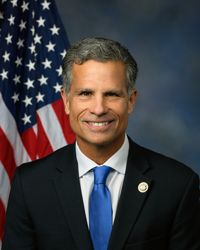
Daniel Meuser
RRepublicanPA-9 · Representative
52
/ 100
Average
Attendance95
Avg: 96
Independence2
Avg: 4
Bipartisan Tone11
Avg: 15
Ethics Record100
Avg: 99
Transparency40
Avg: 53
Accountability Score — composite of attendance, independence, bipartisan tone, ethics record & transparency.
Methodology20
Bills Sponsored
1
Enacted into Law
5
Passed a Chamber
12
In Committee
Bills That Became Law
All Sponsored Bills
HR10168In Committee
Veterans Housing Opportunity Act
HR7401Passed House
Small Business Lending Fraud Prevention Act
Small Business Lending Fraud Prevention Act This bill requires Small Business Administration (SBA) employees who participate in the origination, review, or approval of SBA loans to certify in writing prior to such participation that the employee does not have any conflict of interest with respect to the loan, will disclose any such conflict of interest arising after the certification is made, and understands the requirements with respect to conflicts of interest applicable SBA employees. Under current law, federal employees must disclose financial conflicts of interest with respect to a particular matter and recuse themselves from such matter (with limited exceptions upon authorization from the employee's agency designee). The SBA must issue regulations implementing the requirements of this bill.
HR2066Enacted
Investing in All of America Act of 2025
Investing in All of America Act of 2025 This bill modifies the limit on the amount of financing available to a Small Business Investment Company (SBIC) from the Small Business Administration (SBA). It also expands the definition of private capital with respect to SBICs. Specifically, the bill reduces the maximum outstanding financing available to an SBIC from 300% to 200% of the SBIC's private capital. The bill increases from $350 million to $475 million the maximum financing available to two or more commonly controlled SBICs that make quarterly or semiannual interest payments. The bill also expands the amounts that may be excluded from the calculation of the financing limit to include the amounts an SBIC invests in (1) rural areas, (2) certain technology categories, or (3) small manufacturers. The bill revises the cap on such excluded amounts to the lesser of $125 million or the aggregate of 50% of the private capital of the SBIC. Additionally, the bill expands what is considered the private capital of an SBIC to include funds obtained from the business revenue of additional government-sponsored corporations and funds invested by the trust or endowment of a college or university.
HR8489In Committee
HUD Payment Integrity and Accountability Act of 2026
The federal government would be required to study how much money is being lost to fraud, errors, and improper payments in housing assistance programs that help low-income people afford rent. This assessment would examine both project-based assistance (where aid goes to specific apartment buildings) and tenant-based assistance (where aid follows individual renters), helping identify where money is being wasted or misused. The findings could lead to better oversight and stronger controls to protect taxpayer dollars in these housing programs.
HR8162In Committee
Regulatory Review Improvement Act of 2026
This bill would change how federal agencies review and update their existing regulations, likely making it easier for agencies to reconsider or eliminate rules that are outdated or burdensome. The changes would affect businesses of all sizes, workers, and consumers by potentially reducing regulatory requirements across industries. Small businesses and the judiciary committees are particularly focused on this legislation because of how it could impact compliance costs and legal processes.
HR8114In Committee
Endless Mountains National Heritage Area Act
This bill would establish a new National Heritage Area in Pennsylvania's Endless Mountains region, allowing the federal government to work with local communities to preserve the area's natural landscapes, cultural heritage, and historical sites. The designation would help coordinate tourism, conservation efforts, and economic development in the region while giving residents and local organizations a say in how the land is managed. Visitors, outdoor enthusiasts, and people living in the area would benefit from improved access to recreational opportunities and protected natural resources.
HR8088In Committee
Growing Deposit Insurance for the Future Act
This bill would increase the amount of money the federal government guarantees to protect in individual bank accounts if a bank fails, likely raising the current $250,000 limit per account holder. The change would give depositors greater peace of mind that their savings are safe, though it could also increase costs for the insurance fund that backs these guarantees. Banks and their customers would be the primary groups affected by any increase in deposit protection.
HR7127Reported
Restoring the Secondary Trading Market Act
Restoring the Secondary Trading Market Act This bill prohibits states from banning, limiting, or imposing conditions upon off-exchange secondary trading of securities. This prohibition applies if the issuer of those securities provides public information on the issuer's financial status in accordance with federal regulations.
HR7837In Committee
Most Favored Patient Act of 2026
The bill would allow patients to access the same discounted drug prices that pharmaceutical companies negotiate with government health programs like Medicare, rather than paying higher prices available to the general public. This would apply to prescription medications covered by private insurance and other health plans, potentially reducing out-of-pocket costs for millions of Americans. The proposal aims to level the playing field so that individual patients benefit from bulk-purchasing discounts similar to what large government programs receive.
HR7548In Committee
SCAM Act
The SCAM Act aims to protect consumers from fraudulent schemes and deceptive business practices in commerce by establishing stronger penalties and enforcement mechanisms against scammers. The bill would likely give federal agencies more tools to investigate and prosecute people who use misleading tactics to steal money or personal information from the public. This would affect both individual consumers who fall victim to scams and the companies responsible for perpetrating them.
HR4460Reported
SAFE Guidance Act
The legislation would require federal financial regulators to provide clear written guidance to banks and financial companies before enforcing new rules, giving these institutions time to understand and prepare for compliance. This affects banks, credit unions, and other financial firms that need to know what regulators expect of them, potentially reducing confusion and unintended violations of financial regulations.
HR3645In Committee
ACCESS Act of 2025
Amendment for Crowdfunding Capital Enhancement and Small-business Support Act of 2025 or the ACCESS Act of 2025 This bill expands the exemption from certain disclosures applicable to crowdfunding issuers with specified target offering amounts. (Crowdfunding is used to raise capital through a large number of individuals investing potentially small amounts of money.) Under current law, crowdfunding issuers that have target offering amounts of $100,000 or less are not required to make available financial statements reviewed by an independent public accountant. The bill increases that amount to $250,000 and allows the Securities and Exchange Commission to increase this amount to no more than $400,000 upon recommendation of the Office of the Advocate for Small Business Capital Formation and the Office of the Investor Advocate.
HR1804Passed House
7(a) Loan Agent Oversight Act
7(a) Loan Agent Oversight Act This bill requires the Small Business Administration (SBA) to submit an annual report containing specified information related to 7(a) loan agents. These agents provide fee-based referral and loan application services related to the SBA's 7(a) Program. Under the 7(a) Program, the SBA provides loans and loan guarantees to small business borrowers who cannot obtain credit elsewhere on reasonable terms and conditions. The required report must include (1) the number and type of agents assisting applicants for 7(a) loans, (2) the number of fraudulent loans made for which an applicant used the services of a 7(a) agent, (3) the purchase rate of loans for which an applicant used the services of a 7(a) agent, and (4) the number and aggregate dollar value of referral fees paid to 7(a) agents.
HRES364Passed House
Calling upon local communities to support organizations that provide resources and aid Gold Shield Families in their time of need.
This resolution encourages local communities throughout the United States to support nonprofit organizations that provide resources to Gold Shield Families during their time of need. Gold Shield Families consist of the families of fallen police officers, firefighters, emergency medical technicians, correction officers, emergency dispatch officers, and emergency service providers.
HR2513In Committee
CFPB–IG Reform Act of 2025
This bill would change how the Consumer Financial Protection Bureau's internal watchdog operates, likely affecting the agency's ability to investigate wrongdoing and oversee its own operations. The changes would go to Congress's oversight committees for review, suggesting the bill aims to either strengthen the inspector general's independence or adjust their powers and responsibilities within the agency that regulates banks, credit card companies, and other financial institutions.
HRES213Passed House
Electing Members to certain standing committees of the House of Representatives.
The House of Representatives voted to fill open positions on several of its standing committees, which are the permanent groups that handle specific areas like taxes, defense, healthcare, and other policy matters. These committees are where most legislative work happens before bills go to the full House for a vote. The motion to reconsider was set aside, meaning the committee assignments are now final.
HR1533In Committee
PIIA Reform Act
PIIA Reform Act This bill establishes a federal Overpayment Czar position, requires federal agencies to identify certain programs and activities as susceptible to improper payments (i.e., payments that should not have been made or were made in an incorrect amount), and imposes financial penalties on agencies for noncompliance with requirements related to reducing improper payments. The bill establishes the position of Director of Improper Payment Mitigation, to be known as the Overpayment Czar, within the Office of Management and Budget (OMB). The duties of the Overpayment Czar include assisting federal agencies in preventing improper payments and fraud. Under the bill, federal agencies must additionally identify as susceptible to significant improper payments any program or activity that is in the first four years of operation and has or is expected to have outlays exceeding $100 million in any of the first three fiscal years of operation unless, based upon a review of the program or activity, the agency makes a determination to the contrary. The bill requires a reduction in certain appropriations accounts for agencies that do not comply with various requirements related to reducing improper payments (such as publishing improper payments estimates and programmatic corrective action plans). States receiving funding for certain programs, such as Medicaid and unemployment compensation, must use payment integrity tools approved by OMB to reduce overpayments. Each annual governmentwide five-year financial management plan produced by OMB must include a plan to decrease improper payments throughout executive agencies.
HR1264In Committee
USA Batteries Act
USA Batteries Act This bill eliminates the Superfund chemical excise tax imposed on lead oxide ($8.28 per ton), antimony ($8.90 per ton), and sulfuric acid ($0.52 per ton). Under current law, an excise tax is imposed through December 31, 2031, on taxable chemicals and taxable chemical substances that are (1) manufactured or produced in the United States, or (2) imported into the United States. The excise tax rate varies between $0.44 per ton to $9.74 per ton, depending on the chemical and certain other variables. (There are 42 listed taxable chemicals, including lead oxide, antimony, and sulfuric acid.) Further, under current law, amounts collected from the excise tax on taxable chemicals are deposited into the Superfund, which finances the remediation of certain environmentally contaminated sites.
HR692Passed House
China Exchange Rate Transparency Act of 2025
China Exchange Rate Transparency Act of 2023 This bill requires the U.S. Executive Director at the International Monetary Fund (IMF) to use the voice and vote of the United States to advocate for increased exchange rate transparency from China. Some areas of focus for this advocacy are (1) Chinese exchange rate arrangements, including any indirect foreign exchange market intervention through Chinese financial institutions or state-owned enterprises; (2) enhanced multilateral and bilateral surveillance by the IMF; and (3) stronger consideration of China's performance as a responsible stakeholder in the international monetary system when evaluating quota and voting shares at the IMF. The requirements of the bill expire seven years and 30 days after the date of the bill's enactment or earlier if China meets certain conditions regarding its exchange rate policies.
HRES76In Committee
Recognizing Gold Shield Families and affirming that their sacrifices and difficulties should not be forgotten.
This resolution recognizes and honors Gold Shield Families for their sacrifices and support of their loved ones in service to our nation. Gold Shield Families consist of the families of fallen police officers, firefighters, emergency medical technicians (EMTs), correction officers, emergency dispatch officers, and emergency service providers.