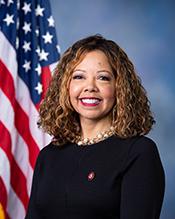
Lucy McBath
DDemocratGA-6 · Representative
62
/ 100
Average
Attendance95
Avg: 96
Independence3
Avg: 4
Bipartisan Tone23
Avg: 15
Ethics Record100
Avg: 99
Transparency88
Avg: 53
Accountability Score — composite of attendance, independence, bipartisan tone, ethics record & transparency.
Methodology21
Bills Sponsored
0
Enacted into Law
0
Passed a Chamber
21
In Committee
All Sponsored Bills
HR10631In Committee
Smaller Class Sizes for Students and Educators Act of 2026
Smaller Class Sizes for Students and Educators Act of 2026 This bill directs the Department of Education to award grants for local educational agencies to reduce class sizes in the early elementary grades (grades K-3) in targeted public elementary schools by recruiting, hiring, and supporting qualified teachers.
HRES1580In Committee
Supporting the designation of the week of September 21 through September 25, 2026, as "National Hazing Awareness Week".
HRES1551In Committee
Honoring the life and legacy of the late Constance Benjamin Clery.
HRES1550In Committee
Expressing support for designation of the week of September 13 through 19, 2026, as "National Adult Education and Family Literacy Week".
HR10281In Committee
FEMA for Safe Recovery Act
HR10031In Committee
READ Act
The bill would increase federal funding and support for reading instruction programs in schools, with a focus on teaching methods backed by scientific research about how people learn to read. It would require states to use grant money for teacher training, classroom materials, and literacy programs that follow evidence-based approaches, while also funding research to improve reading outcomes for all students. The legislation aims to help schools better identify and support students who struggle with reading, particularly in early grades.
HR9754In Committee
Health Claim Denial Transparency Act
Health insurance companies would be required to include detailed information about denied claims in their yearly reports to workers, making it easier for employees to see how often their coverage is being rejected and for what reasons. This transparency requirement would help workers understand patterns in claim denials and potentially identify unfair practices by their health plans. The change affects employers who offer group health insurance and the workers covered under those plans.
HR8937In Committee
Early Childhood Workforce Advancement Act of 2026
The federal government would provide competitive grants to partnerships of schools, colleges, and organizations to create or expand training programs that prepare students for careers in early childhood education and childcare. These programs would teach students the skills needed to work with young children in preschools, daycare centers, and similar settings. The initiative aims to address workforce shortages in the early childhood education field by making it easier for people to get trained for these jobs.
HR8304In Committee
CREATES Act
The bill would direct the Labor Department to create a grant program that gives money to states to build or upgrade digital systems for storing and managing professional credentials and certifications. This would help workers, employers, and educational institutions more easily track, verify, and share information about skills certifications, licenses, and other qualifications that workers have earned. The goal is to make it simpler for people to prove their qualifications when applying for jobs or moving between states.
HR8055In Committee
Extending WIC for New Moms Act
Extending WIC for New Moms Act This bill amends the Special Supplemental Nutrition Program for Women, Infants, and Children (WIC) to extend the eligibility periods for breastfeeding and postpartum women. Specifically, a state program may elect to certify a breastfeeding woman for up to 24 months (currently 1 year) postpartum. The bill also expands the eligibility period for postpartum women to up to 24 months after termination of pregnancy (currently 6 months). The Department of Agriculture must submit a report to Congress evaluating the effect of these changes to the program on (1) maternal and infant health outcomes, (2) breastfeeding rates, and (3) qualitative evaluations of family experiences under WIC.
HR7599In Committee
Federal Extreme Risk Protection Order Act of 2026
Federal Extreme Risk Protection Order Act of 2026 This bill authorizes and establishes procedures for federal courts to issue federal extreme risk protection orders. Additionally, the bill establishes grants to support the implementation of extreme risk protection order laws at the state and local levels, extends federal firearms restrictions to individuals who are subject to extreme risk protection orders, and expands related data collection. Extreme risk protection order laws, or red flag laws, generally allow certain individuals (e.g., law enforcement officers or family members) to petition a court for a temporary order that prohibits an at-risk individual from purchasing and possessing firearms. Among its provisions, the bill authorizes a family or household member, or a law enforcement officer, to petition for a federal extreme risk protection order with respect to an individual who poses a risk to themselves or others; directs the Department of Justice to establish a grant program to help states, local governments, Indian tribes, and other entities implement extreme risk protection order laws; extends federal restrictions on the receipt, possession, shipment, and transportation of firearms and ammunition to individuals who are subject to extreme risk protection orders; and requires the Federal Bureau of Investigation to compile records from federal, tribal, and state courts and other agencies that identify individuals who are subject to extreme risk protection orders.
HR7333In Committee
Family Violence Prevention and Services Improvement Act of 2026
This bill would expand and improve federal programs that help families experiencing domestic violence, likely including funding for shelters, counseling services, and support for victims. It aims to strengthen how these services are delivered and coordinated across states to better protect people fleeing abusive situations. The bill is currently being reviewed by two congressional committees to determine which parts fall under their areas of responsibility.
HRES760In Committee
Supporting the designation of the week of September 22 through September 26, 2025, as "National Hazing Awareness Week".
HR5476In Committee
Preparing And Retaining All (PARA) Educators Act
This bill aims to help schools recruit and keep teachers by improving teacher pay, benefits, and working conditions. It would likely provide funding or incentives to make teaching careers more attractive and help reduce teacher shortages that many schools currently face. The legislation would affect teachers, school districts, and students who depend on having stable, qualified educators in their classrooms.
HR4701In Committee
Charting My Path for Future Success Act
The proposal would help students explore different career paths and make informed decisions about their education by requiring schools to provide better information about job opportunities, training programs, and earning potential in various fields. Students and their families would gain access to clearer guidance about which educational choices lead to specific careers, helping them plan their futures more effectively. The bill aims to connect classroom learning with real-world job prospects so young people can choose education paths that match their interests and goals.
HR4602In Committee
Countering Threats and Attacks on Our Judges Act
Countering Threats and Attacks on Our Judges Act This bill allows funds awarded by the State Justice Institute to be used to establish, implement, and operate a judicial threat and intelligence resource center. The State Justice Institute is a private, nonprofit corporation established by federal law to support and improve the administration of justice in state courts.
HR3115In Committee
Assault Weapons Ban of 2025
Assault Weapons Ban of 2025 This bill makes it a crime to knowingly import, sell, manufacture, transfer, or possess a semiautomatic assault weapon (SAW) or large capacity ammunition feeding device (LCAFD). The prohibition does not apply to a firearm that is (1) manually operated by bolt, pump, lever, or slide action, except for certain shotguns; (2) permanently inoperable; (3) an antique; (4) only capable of firing rimfire ammunition; or (5) a rifle or shotgun specifically identified by make and model. The bill also exempts from the prohibition the following, with respect to a SAW or LCAFD: importation, sale, manufacture, transfer, or possession related to certain law enforcement efforts, or authorized tests or experiments; importation, sale, transfer, or possession related to securing nuclear materials; and possession by a retired law enforcement officer. The bill permits continued possession, sale, or transfer of a grandfathered SAW, which must be securely stored. A licensed gun dealer must conduct a background check prior to the sale or transfer of a grandfathered SAW between private parties. The bill permits continued possession of, but prohibits sale or transfer of, a grandfathered LCAFD. Newly manufactured LCAFDs must display serial number identification. Newly manufactured SAWs and LCAFDs must display the date of manufacture. The bill also allows a state or local government to use Edward Byrne Memorial Justice Assistance Grant Program funds to compensate individuals who surrender a SAW or LCAFD under a buy-back program.
HR3114In Committee
Clean Slate Act of 2025
Clean Slate Act of 2025 This bill establishes a framework for sealing records related to certain federal criminal offenses. Courts must automatically seal records related to (1) a conviction for simple possession of a controlled substance or for any nonviolent offense involving marijuana, or (2) an arrest for an offense that does not result in a conviction. Additionally, an individual who meets certain criteria may petition to seal records related to a conviction for other nonviolent offenses.
HR2790In Committee
GOSAFE Act
Gas-Operated Semi-Automatic Firearms Exclusion Act or the GOSAFE Act This bill establishes a framework to regulate gas-operated semiautomatic firearms and large capacity ammunition feeding devices under federal firearms laws. First, the bill generally prohibits the import, sale, manufacture, transfer, receipt, or possession of a firearm that is or is modified to operate as a prohibited gas-operated semiautomatic firearm; a combination of parts that modify or can be assembled into a prohibited gas-operated semiautomatic firearm, or that produce an unlawful gas-operated semiautomatic cycling action; a device or combination of parts designed to materially increase the rate of fire of a semiautomatic firearm; or a firearm that is modified to materially increase the rate of fire. Second, the bill generally prohibits (1) the import, sale, manufacture, transfer, or receipt of a large capacity ammunition feeding device; or (2) the possession of a large capacity ammunition feeding device manufactured after the date of enactment. A violation is subject to criminal penalties—a fine, a prison term of up to 12 months, or both, for each violation. In addition, an individual who possesses a prohibited gas-operated semiautomatic firearm during a federal felony offense is subject to additional penalties—a fine, a mandatory minimum prison term of two years, or both. Finally, the bill allows a state or local government to use Edward Byrne Memorial Justice Assistance Grant Program funds to compensate individuals who surrender gas-operated semiautomatic firearms and large capacity ammunition feeding devices under a buy-back program.
HR2789In Committee
Adult Education WORKS Act
This bill would likely expand or reform adult education and job training programs to help workers gain new skills and find better employment opportunities. The legislation probably focuses on making it easier for adults who didn't finish traditional schooling or need to retrain for new jobs to access education and workforce development services. It would affect working adults, employers looking for skilled workers, and community colleges or training organizations that provide these programs.
HR1132In Committee
To amend the Workforce Innovation and Opportunity Act to direct the Secretary of Labor to award grants to community colleges for high-quality workforce development programs.
The federal government would give money to community colleges to create and improve job training programs that prepare students for careers in high-demand fields. These grants would help community colleges offer better equipment, instructor training, and curriculum so graduates are ready for actual jobs employers need filled. Workers and job seekers would benefit from more accessible, affordable training options in their communities, while employers would gain access to a better-trained workforce.