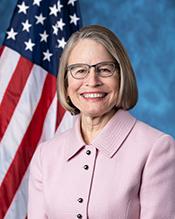
Mariannette Miller-Meeks
RRepublicanIA-1 · Representative
54
/ 100
Average
Attendance96
Avg: 96
Independence3
Avg: 4
Bipartisan Tone17
Avg: 15
Ethics Record100
Avg: 99
Transparency41
Avg: 53
Accountability Score — composite of attendance, independence, bipartisan tone, ethics record & transparency.
Methodology42
Bills Sponsored
0
Enacted into Law
8
Passed a Chamber
32
In Committee
All Sponsored Bills
HR1721Passed House
Critical Infrastructure Manufacturing Feasibility Act
Critical Infrastructure Manufacturing Feasibility Act This bill requires the Department of Commerce to study and report on products that are in high demand across the critical infrastructure sectors. Critical infrastructure sectors are those whose assets, systems, and networks are vital to national security, the economy, public health or safety, or any combination of those matters. The study must (1) identify the products in high demand across those sectors that are being imported due to manufacturing, material, or supply chain constraints; and (2) analyze the costs, benefits, and feasibility of manufacturing those products in the United States.
HR10632In Committee
Medicaid Whistleblower Protection Act
HR10450In Committee
REVEAL Act
HR10170In Committee
Memory Chip Competitiveness Assessment Act of 2026
Memory Chip Competitiveness Assessment Act of 2026 This bill requires the Department of Commerce to study and report on the advanced memory technology marketplace. Under the bill, advanced memory technology means semiconductor memory products manufactured using leading-edge process technologies and primarily designed for high-performance, high-bandwidth, or energy-efficient computing applications. The study must assess the advanced memory technology supply chain, the impact of market trends on the cost of end products, and mechanisms to increase supply (without acquiring products from North Korea, China, Russia, or Iran). Commerce must provide an opportunity for public comment on the report before finalizing it.
HR9615Passed House
BRACE Act
Battery Recycling for America’s Competitive Economy Act or the BRACE Act This bill modifies the regulation of lithium-ion batteries under the Resource Conservation and Recovery Act in order to facilitate the recycling of lithium-ion batteries and the recovery of critical minerals. Specifically, the bill directs certain facilities that store lithium-ion batteries prior to recycling them to follow regulations for large quantity handlers of universal waste instead of following the more stringent hazardous waste regulations that currently apply, thereby allowing these facilities to store lithium-ion batteries without needing a special permit.
HR4707Passed House
To designate the facility of the United States Postal Service located at 1019 Avenue H in Fort Madison, Iowa, as the "Martin L. Graber Post Office".
This bill designates the facility of the United States Postal Service located at 1019 Avenue H in Fort Madison, Iowa, as the "Martin L. Graber Post Office".
HRES1537In Committee
Supporting the designation of the week of September 14 through September 18, 2026, as "National Clean Energy Week".
This resolution expresses support for the designation of National Clean Energy Week.
HR1722Passed House
Billion Dollar Boondoggle Act
Billion Dollar Boondoggle Act This bill requires the Office of Management and Budget (OMB) to collect information from federal agencies and report to Congress regarding projects that are behind schedule or have expenditures that have exceeded the original cost estimate. Specifically, the bill requires OMB to issue guidance directing federal agencies to annually submit specified information to OMB regarding certain federally funded projects that (1) are more than five years behind schedule, or (2) have expenditures that are at least $1 billion more than the original cost estimate for the project. Among other information, the agencies must submit to OMB a description of each project; an explanation of any change to the original scope of the project; the original and current expected dates for the completion of the project; the original and current cost estimates adjusted for inflation; an explanation for any delays in completing the project or increases in the cost; and the amount of and rationale for any award, incentive fee, or other type of bonus awarded for the project. The bill also requires OMB to submit an annual report to Congress containing the information submitted by the agencies and post the report on the OMB website. The report must be submitted in unclassified form, but may include a classified annex.
HR9390In Committee
Prices on the Wall Act of 2026
Healthcare facilities would be required to display their prices for services and procedures on their walls so patients can see costs before receiving care. This would help patients understand what they'll be charged and allow them to compare prices between different facilities. The requirement would apply to hospitals, clinics, and other healthcare providers covered under federal health law.
HR9757In Committee
Conversational AI Services Act
The legislation would create rules and standards for companies that develop and use conversational AI systems like chatbots, requiring them to meet certain safety and transparency requirements. These rules would apply to AI companies and businesses using the technology, potentially affecting how they design and deploy these systems to protect users from harmful outputs and ensure companies are honest about how the AI works. The bill has been sent to the House Committee on Energy and Commerce for review and discussion.
HR9682In Committee
Cure Hepatitis C Act of 2026
Cure Hepatitis C Act of 2026 This bill establishes programs and requirements to provide free medications to treat hepatitis C in certain high-risk or vulnerable populations. It also establishes grants and other resources to support testing and treatment for hepatitis C. The bill provides funding for FY2027 to implement these provisions. The Department of Health and Human Services (HHS) must enter into a five-year purchasing contract with manufacturers of drugs that treat hepatitis C so that eligible individuals may receive the drugs without cost-sharing. Eligible individuals are those diagnosed with hepatitis C who are (1) enrolled in Medicaid or the Children’s Health Insurance Program (CHIP), (2) confined to federal, state, or local correctional facilities (or were released and began treatment there), (3) uninsured, or (4) receiving health care through the Indian Health Service. State Medicaid and CHIP programs and state and local correctional facilities may opt into the program; participation is mandatory for federal correctional facilities and the Indian Health Service. HHS must award grants to certain entities, including states, public health organizations, and correctional facilities, to support the coordination and provision of screening, treatment, and supportive services for the affected populations. The bill also allows Medicare beneficiaries to receive hepatitis C drugs without cost-sharing from 2028-2032.
HR7266Passed House
Rural and Municipal Utility Cybersecurity Act
Rural and Municipal Utility Cybersecurity Act This bill reauthorizes through FY2030 a program that provides cybersecurity-related assistance and funding to rural electric cooperatives and municipal or small, investor-owned electric utilities. The bill also revises methods of awarding support and expands protections for information shared under the program. This program, known as the Rural and Municipal Advanced Cybersecurity Grant and Technical Assistance Program, is administered by the Department of Energy (DOE). Current law requires DOE to provide technical assistance and funding under the program on a competitive basis; under the bill, assistance and funding may be provided on a competitive or noncompetitive basis. Current law also requires DOE to prioritize providing technical assistance and funding to certain entities, including entities that own defense critical electric infrastructure . The bill specifies that DOE must also prioritize entities that operate such infrastructure. (Defense critical electric infrastructure is electric infrastructure that (1) is located in the contiguous United States, and (2) serves a designated critical defense facility but is not owned or operated by the owner or operator of the critical facility.) Finally, the bill expands an existing protection against disclosure to cover all information shared under the program by or with the federal government or a state, tribal, or local government. This provision protects against disclosure under the Freedom of Information Act and other state, tribal, or local disclosure laws.
HR9476In Committee
To direct the Secretary of Veterans Affairs to coordinate with the Secretary of Health and Human Services in administering the Veterans Community Care Program, and for other purposes.
The Department of Veterans Affairs would work more closely with the Department of Health and Human Services to run the Veterans Community Care Program, which helps veterans access medical treatment outside the VA system. This coordination could improve how veterans receive care from private doctors and hospitals while potentially reducing costs and wait times. The bill affects veterans seeking healthcare services and the federal agencies responsible for managing their benefits.
HRES1332In Committee
Supporting the designation of February 1, as "Blue Star Mother's Day".
The proposal would officially recognize February 1st as "Blue Star Mother's Day" to honor mothers of active-duty military service members. This designation would acknowledge the sacrifices and contributions of military mothers across the country through a national observance day. The measure has been referred to the House Armed Services Committee for consideration.
HR9033In Committee
Timely Agreements Act
The proposal would allow the Department of Veterans Affairs to more easily share medical equipment, supplies, and staff expertise with state-run veterans homes, helping these facilities provide better care to veterans. This could mean veterans in state homes get faster access to VA specialists and equipment without having to travel to VA hospitals. The change affects both VA facilities and state veterans homes across the country that serve retired military members.
HR2145Reported
Recycling Infrastructure and Accessibility Act of 2025
This bill would improve recycling programs across the country by funding new recycling facilities and equipment, making it easier for people in underserved communities to access recycling services. The legislation aims to help states and local governments expand their recycling infrastructure while also setting standards to ensure recycling programs work more effectively and reduce waste going to landfills. Residents, municipalities, and waste management companies would all be affected by these changes to how recycling is organized and funded nationwide.
HR6580In Committee
VA National Formulary Act of 2025
This bill would give the Department of Veterans Affairs more control over which medications veterans can access by establishing a national formulary—essentially a preferred list of drugs that the VA would cover. The change could reduce costs for the VA and potentially speed up medication approvals for veterans, though it might limit some veterans' access to certain drugs their doctors recommend. Veterans and their healthcare providers would be most affected by how the VA's drug coverage decisions are made under this new system.
HR3726Passed House
Fisher House Availability Act of 2026
Fisher House Availability Act of 2026 This bill expands eligibility for temporary lodging at a Fisher House to additional individuals receiving medical care or treatment at a Department of Veteran Affairs (VA) or non-VA facility or those accompanying individuals receiving such treatment. (Fisher Houses are where the VA furnishes no-cost lodging to veterans and other eligible individuals when receiving treatment or accompanying an individual receiving treatment.) Specifically, the bill authorizes the VA to provide lodging at a Fisher House on a space-available basis to members of the uniformed services performing active duty (i.e., covered beneficiaries) who must travel a significant distance to receive care or services; family members and others accompanying such covered beneficiaries to receive care or services; veterans, members of a veteran's family, and others who must travel a significant distance for a member of a veteran's family to receive care or services; and covered beneficiaries, members of a covered beneficiary’s family, and others who must travel a significant distance for a member of a beneficiary’s family to receive care or services. Finally, the bill extends the limitation on pension amounts for certain hospitalized or institutionalized veterans through July 31, 2033.
HR8622In Committee
Medicare Physician Data-driven Performance Payment System Act of 2026
The proposal would replace Medicare's current system for paying doctors based on quality metrics with a new approach that uses data to determine physician payments, potentially rewarding doctors who demonstrate better patient outcomes and efficiency. This change would affect how Medicare compensates the roughly one million doctors who treat Medicare patients, potentially shifting financial incentives in how medical care is delivered. The bill is currently under review by two congressional committees that handle healthcare and budget matters.
HR8583In Committee
Lowering Input Costs for American Farmers Act
The proposal would prevent the government from placing tariffs or taxes on imported phosphate fertilizers, which are commonly used by farmers to grow crops. This would keep fertilizer prices lower for American farmers and agricultural companies that rely on these imports. The bill is currently being reviewed by the House Committee on Ways and Means.
HR8115In Committee
Precision Brain Health Research Act of 2026
Precision Brain Health Research Act of 2026 This bill expands the Scott Hannon Initiative for Precision Mental Health, a program at the Department of Veterans Affairs (VA). Specifically, the bill expands the scope of the initiative by requiring the identification and validation of brain and mental health biomarkers among veterans for repetitive low-level blast exposure, dementia, and other such brain conditions. Currently, the initiative addresses several other conditions such as depression and post-traumatic stress disorder. The VA must work with the Department of Defense to establish a data-sharing partnership under the initiative. The bill requires the VA to conduct various research studies about repetitive low-level blast exposure under the initiative. The VA must seek to enter into a contract with the National Academies of Sciences, Engineering, and Medicine to work in tandem with the initiative on validation of brain and mental health biomarkers among veterans and report on the findings at least once every two years. The VA must assess all in progress and planned translational research studies under the initiative and report to Congress on the assessment. Additionally, the VA must report to Congress on the initiative at least once every two years and include recommendations for immediate administrative and legislative action to improve the initiative. The bill authorizes the initiative through FY2030.
HR8057In Committee
To amend title 38, United States Code, to modify the rate of pay for care or services provided under the Community Care Program of the Department of Veterans Affairs based on the location at which such care or services were provided, and for other purposes.
The bill would adjust how much the Department of Veterans Affairs pays for medical care and services it purchases from private doctors and hospitals through its Community Care Program, with payment rates varying depending on where the care is provided. This change would allow the VA to pay different amounts in different geographic areas, potentially reflecting local cost differences and market conditions. Veterans using community care providers would be affected by these payment adjustments, which could influence which providers participate in the program and how quickly veterans can access care.
HR7141In Committee
Affordable Housing Guarantee Act
This bill would guarantee affordable housing options for military members and their families, likely by creating programs or funding to help service members access or afford homes near military bases. The measure aims to address housing costs that can strain military families' budgets and make it harder for the armed forces to recruit and retain personnel. It is currently moving through the House or Senate committee process for further review.
HR7550In Committee
Permanent Tax Relief for Seniors Act
This bill would make permanent certain tax breaks for people over 65, likely including provisions that reduce their tax burden or protect retirement income from taxation. The changes would affect millions of seniors and retirees across the country by potentially lowering the taxes they owe on pensions, Social Security, or other retirement savings. The specific tax benefits would need to be detailed in the bill's language, but the goal appears to be providing long-term financial relief for older Americans.
HR1588Reported
Facilitating DIGITAL Applications Act
Facilitating the Deployment of Infrastructure with Greater Internet Transactions And Legacy Applications Act or the Facilitating DIGITAL Applications Act This bill requires the National Telecommunications and Information Administration (NTIA) to periodically report on the development of online portals for the acceptance, processing, and disposal of applications for communications use authorizations. Communications use authorizations are requests for easements, rights-of-way, leases, licenses, or other authorizations to locate or modify a transmitting device, support structure, or other communications facility on public lands or National Forest System land. Specifically, the NTIA must report to Congress about (1) whether the Department of the Interior and the Forest Service have each established a portal, and (2) any barriers to establishing the portals. The NTIA must submit the first report within 90 days of the enactment of the bill and additional reports every 60 days thereafter until the portals are established. Additionally, Interior and the Forest Service must notify the NTIA within three business days of establishing their respective portals.
HR7112In Committee
Veterans’ Bill of Rights Act of 2026
The bill would establish a formal set of rights and protections for military veterans, likely covering areas such as access to healthcare, benefits, education, and fair treatment by government agencies. Veterans and their families would gain clearer guarantees about what services they can expect and how complaints or disputes should be handled. The specific protections would be determined as the bill moves through the Veterans' Affairs and Armed Services committees.
HR6703Passed House
Lower Health Care Premiums for All Americans Act
This bill aims to reduce health insurance premiums that Americans pay for coverage by making changes to how health care costs are managed and regulated. The specific mechanisms would likely involve measures to increase competition among insurers, reduce administrative costs, or adjust how insurance companies set prices. The bill has passed the House and is now being considered by the Senate.
HRES716In Committee
Supporting the designation of the week of September 15 through September 19, 2025, as "National Clean Energy Week".
This resolution expresses support for the designation of National Clean Energy Week.
HR4895In Committee
Afghan Adjustment Act
The legislation would allow certain Afghan nationals who worked with the U.S. military or government during the war in Afghanistan to obtain permanent residency and eventually become U.S. citizens, without having to return to Afghanistan first or go through the standard visa process. This would primarily benefit Afghan interpreters, security personnel, and other employees who helped American forces and now face safety risks in their home country. The bill aims to provide a faster path to legal status for these individuals and their families who were evacuated to the United States.
HR4764In Committee
Biochar Research Network Act of 2025
Biochar Research Network Act of 2025 This bill directs the Agricultural Research Service (ARS) to establish a biochar research network of not more than 20 research sites or facilities to test the impact of biochar across various soil types, application methods, and climates to learn more about its potential to benefit agriculture, forestry, and the environment. Eligible entities for the research network include (1) state agriculture and forestry experiment stations; and (2) research facilities of the ARS, the Forest Service, and the Departments of Energy, Commerce, and the Interior. Biochar is created by heating biomass (e.g., wood, grass, and manure) in a low-oxygen environment and can be applied to soil to sequester carbon and improve soil health.
HR4518In Committee
Cooper Davis and Devin Norring Act
Cooper Davis and Devin Norring Act This bill requires electronic communication service providers and remote computing service providers to report knowledge of offenses involving the creation, manufacture, distribution, or dispensing of counterfeit controlled substances (including counterfeit prescription drugs), fentanyl, methamphetamine, or prescription pain medications or stimulants to the Drug Enforcement Administration. Providers are subject to criminal and civil penalties for failing to comply with these requirements.
HR1969Passed House
No Wrong Door for Veterans Act
No Wrong Door for Veterans Act This bill reauthorizes through FY2028 and modifies the Staff Sergeant Parker Gordon Fox Suicide Prevention Grant Program of the Department of Veterans Affairs (VA), which awards grants to eligible entities to provide or coordinate suicide prevention services for veterans and members of the Armed Forces and their families. Among other elements, the bill adjusts the maximum amount for grants awarded under the program and provides for additional funding per individual who receives suicide prevention services provided or coordinated by a grantee; requires the VA to provide briefings about the grant program at least once a year to certain personnel at each VA medical center located within 100 miles from the primary location of a grantee; requires baseline mental health screenings for risk provided as suicide prevention services under the program to use a protocol selected by the VA; and modifies eligibility requirements for entities seeking grants, including by authorizing applications from health care providers. In subsequent applications, grantees who have previously received funds under the program must include evidence that previously awarded funds served a significant number of veterans. The bill requires grantees to notify (1) eligible individuals that they may receive emergent suicide care furnished or paid for by the VA, and (2) the VA if eligible individuals request emergent suicide care.
HR2873In Committee
To continue Executive Order 14220 in effect indefinitely.
This bill provides statutory authority for Executive Order 14220 and any action taken or regulation issued by any agency pursuant to the order. This executive order, issued by President Donald J. Trump on February 25, 2025, directed the Department of Commerce to investigate the effects of copper imports on national security under Section 232 of the Trade Expansion Act of 1962. Section 232 authorizes the President to take action (e.g., impose tariffs) if Commerce determines that imports of a good threaten U.S. national security.
HR1970In Committee
Providing Veterans Essential Medications Act
This bill would ensure that veterans have access to essential medications through the Department of Veterans Affairs, likely by expanding coverage or removing barriers to prescription drugs that veterans need for their health conditions. The legislation aims to make it easier for former military members to get the medicines their doctors prescribe without facing delays or denials from the VA system.
HR1971In Committee
Veterans SPORT Act
Veterans Supporting Prosthetics Opportunities and Recreational Therapy Act or the Veterans SPORT Act This bill includes adaptive prostheses and terminal devices for sports and other recreational activities within the definition of medical services under the laws administered by the Department of Veterans Affairs (VA). Under the bill, these artificial limbs must be furnished as medical services to eligible veterans.
HR2305In Committee
Corrections Officer Blake Schwarz Suicide Prevention Act of 2025
The legislation would establish new mental health support programs and suicide prevention initiatives specifically for corrections officers working in federal prisons. It aims to address the high suicide rates among correctional staff by requiring training, peer support systems, and improved access to mental health services. The measure would affect federal Bureau of Prisons employees and potentially influence how other law enforcement agencies approach officer mental health and wellness.
HR2005In Committee
DMEPOS Relief Act of 2025
DMEPOS Relief Act of 2025 This bill extends until December 31, 2025, a higher payment rate (known as the 75/25 blended rate) for durable medical equipment in nonrural or noncontiguous areas under Medicare.
HR1896In Committee
Renewable Fuel for Ocean-Going Vessels Act
This bill would require or encourage ocean-going ships to use renewable fuels instead of traditional petroleum-based fuels, aiming to reduce pollution from international shipping. The change would affect shipping companies and cargo transporters that operate large vessels, potentially increasing their fuel costs but lowering their environmental impact. The goal is to make the shipping industry cleaner and help the U.S. meet climate and air quality goals.
HR1883In Committee
Disclosing Foreign Influence in Lobbying Act
The legislation would require lobbyists and organizations that receive funding from foreign governments or entities to publicly disclose these financial connections when they lobby Congress or federal agencies. This transparency measure would help lawmakers and the public understand when foreign interests are trying to influence U.S. policy decisions. The requirement would apply to lobbying firms, think tanks, and advocacy groups that accept foreign money and engage in lobbying activities.
HR1397In Committee
Increasing Access to Dental Insurance Act
Increasing Access to Dental Insurance Act This bill permits individuals to enroll in a dental benefits plan on a health insurance exchange without also enrolling in a qualified health plan.
HR1227In Committee
Alternatives to PAIN Act
Alternatives to Prevent Addiction In the Nation Act or the Alternatives to PAIN Act This bill reduces cost-sharing and prohibits the imposition of certain utilization requirements under the Medicare prescription drug benefit for certain non-opioid pain management drugs. Specifically, the bill requires such drugs to be covered without a deductible and to be placed on the lowest cost-sharing tier (if any). The bill also prohibits the imposition of prior authorization requirements (i.e., requiring prior approval from a plan) or step therapy requirements (i.e., requiring the use of alternative drugs before a drug is covered under a plan) with respect to such drugs.
HR1019In Committee
Medicaid Program Improvement Act
Medicaid Program Improvement Act This bill provides statutory authority for the requirement that state Medicaid programs and the Children's Health Insurance Program (CHIP) have a process in place to obtain updated addresses for enrollees. It also requires contracted managed care plans to report addresses that have been directly verified by enrollees to states.