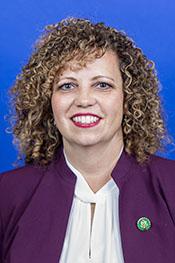
Celeste Maloy
RRepublicanUT-2 · Representative
55
/ 100
Average
Attendance99
Avg: 96
Independence4
Avg: 4
Bipartisan Tone29
Avg: 15
Ethics Record100
Avg: 99
Transparency21
Avg: 53
Accountability Score — composite of attendance, independence, bipartisan tone, ethics record & transparency.
Methodology16
Bills Sponsored
1
Enacted into Law
2
Passed a Chamber
12
In Committee
All Sponsored Bills
HR9965In Committee
AI Threat Output and Monitoring Incident Containment Act
The federal government would create a new program to use artificial intelligence technology to help evaluate and improve nuclear weapons and security systems. This program, run through the Department of Energy's nuclear security division, would help scientists and engineers better understand nuclear threats and strengthen the nation's nuclear defenses. The initiative affects nuclear weapons laboratories, energy department employees, and national security operations.
HR301Reported
GEO Act
Geothermal Energy Opportunity Act or the GEO Act This bill expands the Geothermal Steam Act of 1970 to establish a deadline for the Department of the Interior to process applications related to geothermal leases. Specifically, Interior must process each application for a geothermal drilling permit or other authorization under a valid existing geothermal lease within 60 days after completing all requirements under applicable federal laws and regulations (including the National Environmental Policy Act of 1969, the Endangered Species Act of 1973, and the National Historic Preservation Act) unless a U.S. federal court vacates or provides injunctive relief for the underlying lease.
HR6802In Committee
CLEAR Act of 2025
The CLEAR Act would likely address management and use of federal public lands, possibly by streamlining permitting processes, clarifying rules for resource extraction or recreation, or adjusting how the government handles land conservation and development. The bill would affect ranchers, miners, outdoor enthusiasts, environmental groups, and federal land agencies like the Forest Service and Bureau of Land Management. Without seeing the full text, the specific changes remain unclear, but the focus on public lands suggests it aims to either increase access to natural resources or reform how federal lands are currently managed.
HR8204In Committee
Western Refined Fuel Reserve Act of 2026
This bill would establish a strategic fuel reserve in the western United States to store refined gasoline and diesel, similar to the existing Strategic Petroleum Reserve, helping ensure the region has adequate fuel supplies during emergencies or supply disruptions. The reserve would benefit consumers and businesses across the West by reducing the risk of fuel shortages and price spikes caused by natural disasters, refinery problems, or other crises.
HRES1144In Committee
Supporting recognition of 2026 as the "International Year of Rangelands and Pastoralists".
This resolution supports recognizing the International Year of Rangelands and Pastoralists. It also encourages federal agencies, universities, and organizations across the country to promote education, research, and outreach related to rangeland management.
HR8113In Committee
To direct the Secretary of the Interior to carry out a feasibility study on a selective water withdrawal system at Glen Canyon Dam, and for other purposes.
The federal government would study whether a special system could be installed at Glen Canyon Dam to allow water managers to withdraw water from different depths of the reservoir, potentially improving water quality and environmental conditions downstream. This feasibility study would help determine if such a system is technically possible and cost-effective before any actual construction takes place. The study would affect water users, environmental groups, and communities that depend on the Colorado River system.
HR3073Passed House
Shivwits Band of Paiutes Jurisdictional Clarity Act
Shivwits Band of Paiutes Jurisdictional Clarity Act This bill confers legal jurisdiction to the State of Utah over certain civil cases involving the Shivwits Band of Paiutes. It also allows the tribe to lease its land held in trust. The tribe is located in southwestern Utah. Specifically, the bill confers jurisdiction to the State of Utah over any civil cause of action (1) to which the Shivwits Band of Paiutes is a party, and (2) that arises on or within Indian lands. Under the bill, Indian lands are lands of the tribe that are (1) held in trust for the benefit of the tribe, or (2) subject to restrictions by the United States against alienation (i.e., sale or transfer). Additionally, the bill specifies that any cause of action arising from any contract or agreement (including a lease) to which the tribe is party or that affects or arises on these Indian lands shall be deemed a civil cause of action. Therefore, this bill allows the tribe and third parties to resolve contract disputes in state court. The bill also authorizes the tribe to lease its land held in trust for a term of up to 99 years.
HJRES151In Committee
Providing for congressional disapproval under chapter 8 of title 5, United States Code, of the rule submitted by the Bureau of Land Management relating to "Grand Staircase-Escalante National Monument Record of Decision and Approved Resource Management Plan".
Congress is considering blocking a federal rule that would implement a management plan for the Grand Staircase-Escalante National Monument, which is located in Utah and managed by the Bureau of Land Management. If approved, this would overturn the agency's decision about how the monument's land and resources should be used and protected. The vote would allow lawmakers to reject the plan without the president's signature being required.
HR7739In Committee
Rural Emergency Response Support Act
This bill would likely create or expand support programs to help rural areas recruit and retain emergency responders like firefighters, paramedics, and police officers, who often struggle to find adequate staffing in less populated regions. It may include funding, training assistance, or employment incentives to make these jobs more attractive in rural communities. The legislation would primarily affect rural workers, emergency service agencies, and local governments in sparsely populated areas.
HR4285Passed House
STARS Act
Semiquincentennial Tourism and Access to Recreation Sites Act or the STARS Act This bill directs the Department of the Interior and the Forest Service to designate September 17, 2026, as an entrance-fee free date in honor of the 250th anniversary of the United States of America. On that date, Interior must waive (1) the entrance fees for all visitors of National Park Service sites; and (2) the standard amenity recreation fees for all visitors to each site managed by the Bureau of Land Management, the U.S. Fish and Wildlife Service, or the Bureau of Reclamation. The Forest Service must waive the standard amenity recreation fees on that date for all visitors to sites it manages.
HR6459In Committee
To designate the facility of the United States Postal Service located at 35 South Main Street in Glendale, Utah, as the "Deputy Sheriff Brian Harris Post Office".
This bill designates the facility of the United States Postal Service located at 35 South Main Street in Glendale, Utah, as the "Deputy Sheriff Brian Harris Post Office".
HR302In Committee
Water Rights Protection Act
Water Rights Protection Act of 2025 This bill limits the transfer of water rights from water users to the Department of the Interior or the Department of Agriculture (USDA). First, the bill prohibits Interior and USDA from conditioning the issuance or renewal of land use or occupancy agreements (e.g., permits and leases) on the transfer of any water right to the United States. Next, it prohibits Interior and USDA from requiring water users, including Indian tribes, to acquire water rights in the name of the United States as a condition of the issuance or renewal of a land use or occupancy agreement. Finally, it prohibits Interior and USDA from conditioning or withholding the issuance or renewal of land use or occupancy agreements on (1) limiting the date, time, quantity, location of diversion or pumping, or place of use of a state water right beyond any applicable limitations under state water law; or (2) modifying the terms and conditions of groundwater withdrawal, guidance and reporting procedures, or conservation and source protection measures established by a state. Interior and USDA must also ensure that federal action imposes no greater restriction or regulatory requirement than under applicable state water law. Further, Interior and USDA must not take actions that adversely affect state authority in permitting water usage or in adjudicating water rights.
HR5091In Committee
To amend section 5545 of title 5, United States Code, to provide hazard pay for carrying out prescribed burns, and for other purposes.
Federal employees who conduct prescribed burns—controlled fires used to reduce wildfire risk and manage forests—would receive extra hazard pay for this dangerous work. The bill recognizes that these workers face significant risks from smoke, flames, and unpredictable fire behavior, similar to other hazardous duties that already qualify for additional compensation. This would apply to employees across federal agencies involved in land management and fire prevention.
HR3777In Committee
Public Land Search and Rescue Act
The bill would establish federal standards and funding for search and rescue operations on public lands managed by agencies like the Forest Service and Bureau of Land Management. It likely aims to improve coordination between federal agencies and local rescue teams, ensure consistent training and equipment, and provide resources to help locate and assist lost or injured people in remote areas. This would affect outdoor enthusiasts, hikers, and the volunteer and professional rescue personnel who respond to emergencies on public lands.
HJRES60Enacted
Providing for congressional disapproval under chapter 8 of title 5, United States Code, of the rule submitted by the National Park Service relating to "Glen Canyon National Recreation Area: Motor Vehicles".
This joint resolution allows off-road vehicles to be used in certain areas of the Glen Canyon National Recreation Area, which is in northern Arizona and southeastern Utah and contains Lake Powell. Specifically, the joint resolution nullifies the rule issued by the National Park Service (NPS) titled Glen Canyon National Recreation Area; Motor Vehicles and published on January 13, 2025. Under the rule, the NPS limited the use of off-road vehicles, such as off-highway vehicles and all-terrain vehicles, in certain areas. For instance, the rule prohibited the use of off-road vehicles on an 8-mile segment of the Poison Spring Loop located on Route 633 proceeding north to Route 730 in the Orange Cliffs Special Management Unit. The rule also eliminated the authority of the NPS to open the upper portion of the Flint Trail in that unit to off-road vehicles. Additionally, the rule limited off-road vehicle use from certain roads to the shoreline of the lake.
HR300In Committee
Daylight Act
Daylight Act This bill allows states to observe daylight saving time year-round. (States may already choose to observe standard time year-round.)