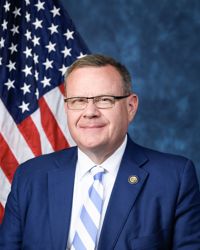
Tim Moore
RRepublicanNC-14 · Representative
53
/ 100
Average
Attendance100
Avg: 96
Independence2
Avg: 4
Bipartisan Tone9
Avg: 15
Ethics Record100
Avg: 99
Transparency40
Avg: 53
Accountability Score — composite of attendance, independence, bipartisan tone, ethics record & transparency.
Methodology18
Bills Sponsored
0
Enacted into Law
3
Passed a Chamber
15
In Committee
All Sponsored Bills
HR10580In Committee
LABEL Act
HR10130In Committee
Army Quantum Readiness Act
HRES1482In Committee
Recognizing 100 years of American Legion Baseball and the American Legion World Series, and honoring the city of Shelby, North Carolina, for serving as the permanent home of the American Legion World Series.
HR9992In Committee
HUD Disaster Information Improvement Act
The federal government would create a formal agreement requiring the Housing and Urban Development Department, Federal Emergency Management Agency, and Small Business Administration to share information and data about disaster relief with each other. This would help these agencies coordinate better when responding to disasters and distributing aid to affected homeowners, renters, and small business owners. The goal is to reduce confusion and gaps in assistance by ensuring the agencies know what help each one is providing to disaster victims.
HR9683In Committee
FEMA Caseworker Accountability Act
The federal government's top auditor would be required to study why FEMA loses so many of its case management workers and report back to Congress with findings and recommendations. This would help lawmakers understand the reasons behind high turnover rates at the agency responsible for disaster response and recovery, which could affect how quickly and effectively FEMA helps people after emergencies.
HRES1395In Committee
Support for the designation of the week of June 29 through July 4, 2026, as "National Tire Safety Week" in the United States, and supporting the goals and ideals of National Tire Safety Week to educate American motorists about the importance of proper tire care and maintenance.
This resolution supports the designation of National Tire Safety Week. The resolution also encourages people to educate themselves and others on the importance of regularly inspecting and maintaining a vehicle's tires.
HR4238Passed House
DLARA
Disaster Loan Accountability and Reform Act or the DLARA This bill modifies the Small Business Administration (SBA) disaster loan program to require additional oversight and reports regarding the program. First, the bill requires the SBA to report monthly on the operation of the disaster loan program. (Currently, the SBA must report only during the applicable period for a major disaster.) The report must estimate the date on which available funding for such loans will reach 10% of the most recent appropriation and the date on which the funds will be depleted. If a report is not submitted by the required date, no funds may be appropriated for official travel by the SBA Administrator until the report is submitted. Second, the President's annual budget must include separate statements regarding the appropriations request for SBA disaster loans and COVID-19 Economic Injury Disaster Loans (EIDL), including explanations for any difference between the amount requested and the 10-year average cost for such loans. Third, the SBA must notify Congress when the balance of amounts available for disaster loans is less than 10% of the 10-year average annual cost provided in the most recent presidential budget. Finally, the bill requires additional oversight of the disaster loan program, including Government Accountability Office reports on the disbursement of disaster loans and the cost of specified SBA rules that modified the loan program; and an SBA report on its actions to improve forecasting, data quality, and budget assumptions for the cost of disaster loans.
HR9197In Committee
Advancing Research in Nuclear Fuel Recycling Act
The federal government would be required to research new ways to recycle and reuse spent nuclear fuel from power plants instead of storing it permanently. This study would examine what technologies and methods could recover valuable materials from used nuclear fuel, potentially reducing waste and creating new resources. The research would help inform future decisions about how the U.S. handles nuclear waste and could affect energy companies, nuclear power plants, and communities near storage sites.
HR8856In Committee
Stop Gang Violence Act
The federal government would prioritize giving crime-fighting grants to local police departments and sheriffs' offices that share information about gang affiliations with the FBI. This means cities and counties that report gang-related data would have a better chance of receiving federal funding to support law enforcement activities. The change aims to encourage information-sharing between local police and federal authorities to help combat gang violence.
HR4478Passed House
TRUST Act of 2025
Tailored Regulatory Updates for Supervisory Testing Act of 2025 or the TRUST Act of 2025 This bill permits additional small insured depository institutions that are considered well-capitalized and well-managed (per their most recent examination) to qualify for less frequent examinations conducted by federal financial regulators. Specifically, the bill raises the maximum asset level that qualifies an institution for less frequent examinations from less than $3 billion to less than $6 billion.
HR8182In Committee
Banning Perpetrators of Religious Persecution Act of 2026
This bill would prevent people from entering or staying in the United States if they have committed or been involved in religious persecution in their home countries. The law would target individuals who have targeted, harmed, or discriminated against people based on their religious beliefs, potentially affecting immigration decisions for asylum seekers, visa applicants, and others seeking entry to the U.S. It aims to protect religious freedom by denying entry to those with a history of persecuting others for their faith.
HR7402In Committee
Unlocking Homeownership Act
This bill would likely make changes to tax rules to help more people afford to buy homes, possibly by adjusting deductions, credits, or other tax benefits related to homeownership. The specific changes would affect both individual homebuyers trying to purchase their first property and potentially existing homeowners, while also impacting federal tax revenue. The bill is currently under review by the House committee responsible for tax policy.
HRES984In Committee
Supporting the recognition of January 9, 2026, as "National Law Enforcement Appreciation Day".
The bill would officially designate January 9, 2026, as a national day to recognize and appreciate law enforcement officers for their service and contributions to public safety. This is a symbolic measure that honors police, sheriffs, and other law enforcement personnel across the country, though it does not create any new programs or funding. The designation encourages Americans to acknowledge the work of these officers on that specific date.
HR6805In Committee
Next Generation Nuclear Deployment Act
HR5738In Committee
No Budget, No Pay Act
No Budget, No Pay Act This bill prohibits Members of Congress from being paid in a fiscal year until both chambers approve the budget resolution and pass all regular appropriations bills for that fiscal year. Retroactive pay is prohibited for such a period. This bill takes effect on September 29, 2027.
HR4765In Committee
Securing our Border Act
Securing our Border Act This bill addresses issues concerning border security and immigration, including by transferring unobligated funds from the Internal Revenue Service to certain border-related projects. Specifically, the bill transfers certain unobligated funds previously appropriated for tax enforcement activities (e.g., collecting owed taxes and conducting criminal investigations) to fund (1) nonintrusive inspection systems along the northern border and southwest border of the United States, and (2) the construction of a border wall system along the southwest border. The bill also authorizes the U.S. Customs and Border Protection to pay recruitment, retention, and relocation bonuses, subject to various requirements and limitations. For example, a relocation bonus may not exceed 15% of the agent's annual basic bay and must be conditioned on the agent agreeing to serve for at least three years at the new duty station. The bill also modifies the treatment of non-U.S. nationals ( aliens under federal law) arriving by land from a country next to the United States. Specifically, if such an individual is not clearly entitled to admission into the United States, the Department of Justice must (1) return the individual to that neighboring country or a safe third country while removal proceedings are pending, or (2) detain the individual while the individual's asylum application is under consideration. (Current law authorizes DOJ to return the individual to the neighboring country but does not require such action or detention.)
HRES565In Committee
Expressing support for the designation of the week of June 30 through July 4, 2025, as "National Tire Safety Week" in the United States, and supporting the goals and ideals of "National Tire Safety Week" to educate American motorists about the importance of proper tire care and maintenance.
This resolution supports the designation of National Tire Safety Week. The resolution also encourages people to educate themselves and others on the importance of regularly inspecting and maintaining a vehicle's tires.
HR2240Passed House
Improving Law Enforcement Officer Safety and Wellness Through Data Act
Improving Law Enforcement Officer Safety and Wellness Through Data Act of 2025 This bill requires the Department of Justice to report on (1) targeted attacks on law enforcement officers, (2) the feasibility of incorporating such attacks into existing crime reporting systems, and (3) the mental health resources that are available to law enforcement officers.