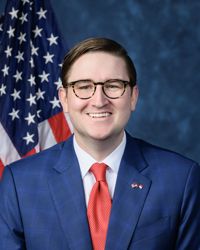
Addison P. McDowell
RRepublicanNC-6 · Representative
55
/ 100
Average
Attendance99
Avg: 96
Independence3
Avg: 4
Bipartisan Tone25
Avg: 15
Ethics Record100
Avg: 99
Transparency31
Avg: 53
Accountability Score — composite of attendance, independence, bipartisan tone, ethics record & transparency.
Methodology15
Bills Sponsored
0
Enacted into Law
1
Passed a Chamber
13
In Committee
All Sponsored Bills
HRES1581In Committee
Supporting the goals and ideals of Red Ribbon Week during the period of October 23 through October 31, 2026.
HR10502In Committee
To direct the Director of National Intelligence to submit to Congress a report on the use of artificial intelligence systems to acquire, analyze, query, disseminate, or otherwise access information under section 702 of the Foreign Intelligence Surveillance Act of 1978.
HR6152Reported
Foreign Robocall Elimination Act
This bill would give the Federal Communications Commission stronger tools to block and investigate robocalls coming from outside the United States, aiming to reduce the flood of spam and scam calls that target American phone users. The measure would likely require phone companies to implement better filtering technology and give regulators more authority to penalize carriers that fail to stop foreign robocalls from reaching customers. Consumers and phone service providers would be the main groups affected by these new protections and requirements.
HR7625In Committee
MTS CYBER Act of 2026
The bill would strengthen cybersecurity protections for mass transit systems like buses, trains, and subways by requiring them to implement security standards and report cyberattacks to federal authorities. It aims to prevent hackers from disrupting transportation networks that millions of Americans rely on daily, protecting both passenger safety and critical infrastructure from digital threats.
HRES1496In Committee
Commemorating the fifth anniversary of the evacuation of Afghanistan, the Gulf war era, and honoring Gulf war era veterans.
HR7184In Committee
PRESS Act
The PRESS Act would protect journalists and news organizations from being forced to reveal their sources or hand over unpublished materials during criminal investigations and legal proceedings. The law would establish a federal "shield" that allows reporters to keep confidential sources secret unless the government can prove the information is essential to a case and cannot be obtained any other way. This would affect news organizations, law enforcement agencies, and anyone involved in legal cases where journalists might be subpoenaed for their reporting.
HR9521In Committee
Broadband Infrastructure Extension Act
The legislation would extend the deadline for spending federal funds that were allocated for broadband infrastructure projects, allowing states and communities more time to use the money for expanding internet access. This affects local governments and broadband providers who received grants or funding to build or improve internet networks in underserved areas. By pushing back the spending deadline, the bill gives these organizations additional time to complete their projects before the funds expire.
HRES1387In Committee
Congratulating the Carolina Hurricanes for winning the 2026 Stanley Cup Final.
This is a ceremonial resolution expressing congratulations to the Carolina Hurricanes hockey team for winning the 2026 Stanley Cup championship. The measure has no practical effect on laws or policies, but serves as an official recognition of the team's achievement by Congress. It is currently under review by the House Committee on Oversight and Government Reform.
HR9065In Committee
Pregnancy Loss Mental Health Research Act of 2026
The legislation would fund research into mental health problems that women experience after losing a pregnancy, and would establish services to help these women get treatment and support. It aims to better understand conditions like depression and anxiety that can follow miscarriage, stillbirth, or other pregnancy losses, and to make sure affected women have access to care. The bill has been sent to the House Committee on Energy and Commerce for review.
HRES1111In Committee
Recognizing the 245th anniversary of the Battle of Guilford Courthouse and encouraging all United States citizens to visit the Guilford Courthouse National Military Park in Guilford County, North Carolina.
This resolution honors the 245th anniversary of the Battle of Guilford Courthouse, a significant Revolutionary War battle fought in North Carolina, and encourages Americans to visit the Guilford Courthouse National Military Park to learn about this historical event. The measure is largely symbolic and does not create new laws or funding, but rather recognizes the historical importance of the battle and promotes tourism to the national park in Guilford County.
HR6876In Committee
Protecting Children from Foreign Mutilation Act
This bill would make it illegal to take children out of the United States for the purpose of subjecting them to female genital mutilation, and would also prohibit knowingly transporting minors across state lines for this purpose. The legislation aims to protect children from this harmful practice by establishing federal criminal penalties for parents, guardians, or others who facilitate such procedures. It affects families, immigration enforcement, and child protection agencies.
HR6364In Committee
Kidd’s Stuttering Act
This bill would likely establish new federal programs or funding to support stuttering research, treatment, and awareness in the United States. It could affect speech-language pathologists, people who stutter, healthcare providers, and potentially schools that serve students with speech disorders. The bill is currently under review by the House Committee on Energy and Commerce to determine whether it should move forward for a vote.
HR2351Passed House
To direct the Commandant of the Coast Guard to update the policy of the Coast Guard regarding the use of medication to treat drug overdose, and for other purposes.
This bill requires the Coast Guard to provide access to naloxone (a medication to reverse opioid overdoses) at its facilities, track distribution of the medication, and monitor the illegal use of of controlled substances. The bill directs the Coast Guard to update its policy regarding the use of medication to treat drug overdoses to require naloxone or a similar medication to be made available to members on all Coast Guard installations and in each operational environment. Further, the Coast Guard must participate in the Department of Defense (DOD) tracking system for naloxone distribution and the illegal use of fentanyl and other controlled substances. (The National Defense Authorization Act for Fiscal Year 2024 directed DOD to establish the tracking system.) The bill requires the Coast Guard to finalize a memorandum of understanding with DOD to facilitate Coast Guard access to the tracking system. The bill also specifies that laws that prohibit manufacturing or distributing controlled substances on vessels apply when controlled substances are intentionally or knowingly placed or caused to be placed on board a vessel (e.g., without the crew's knowledge or on board an unmanned vessel). Further, the bill requires the Coast Guard to brief Congress within two years after the bill's enactment about the use of opioids and overdose medication at Coast Guard facilities by members and personnel. The briefing must describe the Coast Guard's progress in implementing its updated policy, the prevalence and incidence of the illegal use of controlled substances, and its processes to mitigate substance abuse.
HR3725In Committee
Preventing the Abuse of Immigration Parole Act
Preventing the Abuse of Immigration Parole Act This bill places limits on the authority of the Department of Homeland Security (DHS) to parole individuals into the United States. Currently, DHS is allowed to parole non-U.S. nationals ( aliens under federal law) temporarily into the United States on public benefit or urgent humanitarian grounds. Under the bill, the total number of parolees allowed annually is capped at 3,000. Additionally, parole may not be granted to nationals of China, Russia, Iran, North Korea, Cuba, or Syria without a waiver from the Department of State. The bill also eliminates DHS’s authority to parole refugees into the United States on separate public interest grounds.
HR2065In Committee
Unmasking Hamas Act of 2025
Unmasking Hamas Act of 2025 This bill establishes a new offense and strengthens the penalty for certain existing offenses involving prohibited conduct while wearing a disguise. Specifically, it establishes a new criminal civil rights violation for wearing a disguise while interfering with another person's exercise of a protected right or privilege. A violator is subject to criminal penalties—a fine, a prison term of up to 15 years, or both. Additionally, the bill establishes an enhanced penalty—a mandatory two-year prison term—for a person who wears a disguise during an offense involving the willful and malicious destruction of a building or property.