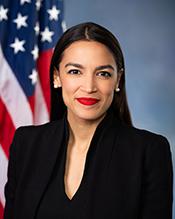
Alexandria Ocasio-Cortez
DDemocratNY-14 · Representative
52
/ 100
Average
Attendance97
Avg: 96
Independence4
Avg: 4
Bipartisan Tone16
Avg: 15
Ethics Record100
Avg: 99
Transparency22
Avg: 53
Accountability Score — composite of attendance, independence, bipartisan tone, ethics record & transparency.
Methodology12
Bills Sponsored
0
Enacted into Law
0
Passed a Chamber
11
In Committee
All Sponsored Bills
HR10692In Committee
Restoring Essential Plan Coverage Act
HR10691In Committee
Ban Flock Act
HR10585In Committee
Civilian Climate Corps for Jobs and Justice Act
HR10063In Committee
Green New Deal for Public Housing Act
HR9395In Committee
Transparency in Medicare Advantage Steering Act
The proposal would require Medicare Advantage insurance organizations to report detailed information about the agents and brokers who sell their plans, including data on compensation, complaints, and disciplinary actions. This increased transparency would help Medicare officials and consumers better understand who is selling these plans and whether there are any problems with how they operate. The change affects insurance companies offering Medicare Advantage coverage, the brokers and agents who sell these plans, and the millions of seniors enrolled in them.
HR9442In Committee
Artificial Intelligence Data Center Moratorium Act
The proposal would pause the construction and operation of large artificial intelligence data centers in the United States for a set period, affecting tech companies and AI developers who need these facilities to train and run AI systems. The pause would give Congress and regulators time to study the potential impacts of AI data centers on electricity grids, national security, and the environment before allowing new ones to be built. This would slow down AI development and deployment in the U.S. while the government figures out what rules should govern these massive computing facilities.
HR398Reported
Geothermal Cost-Recovery Authority Act of 2025
Geothermal Cost-Recovery Authority Act of 2025 This bill expands the Geothermal Steam Act of 1970 to give the Department of the Interior the authority to collect certain fees from applicants for, or holders of, geothermal leases through September 30, 2032. Specifically, Interior may direct those applicants or leaseholders to reimburse the United States for costs from (1) processing applications for geothermal leases on federal land, such as applications for geothermal drilling permits; and (2) inspecting and monitoring geothermal exploration and development activities, including reclamation activities. Interior may reduce the amount of the fee if it determines that (1) the full reimbursement would impose an economic hardship on the applicant, or (2) a less than full reimbursement is necessary to promote the greatest use of geothermal resources. Interior may use those fees only to the extent that they are provided in advance in appropriations acts for (1) processing applications for geothermal leases, and (2) inspecting and monitoring related exploration and development activities. Within five years of the bill's enactment, Interior must submit to Congress a report that includes an assessment of how the fees affect Interior's geothermal leasing program and any recommendations for updates to the fees and the program.
HR7917In Committee
Fair Wages for Home Care Workers Act
This bill would require home care workers—people who provide in-home assistance to elderly and disabled individuals—to receive minimum wage and overtime pay protections similar to other workers. Currently, many home care workers are classified as independent contractors or domestic workers and fall outside standard labor protections, often earning very low wages for physically demanding work. The legislation aims to improve pay and working conditions for this workforce, which would likely increase costs for families and government programs that pay for home care services.
HR5333In Committee
9/11 Immigrant Worker Freedom Act
This legislation would allow certain immigrants who worked at or near the World Trade Center, Pentagon, or other sites affected by the September 11 attacks to obtain legal status and work authorization in the United States. The bill recognizes the contributions of these workers—many of whom were undocumented at the time—who helped with rescue and recovery efforts following the terrorist attacks. Eligible immigrants would gain a pathway to remain and work legally in the country without fear of deportation.
HR3562In Committee
DEFIANCE Act of 2025
Disrupt Explicit Forged Images And Non-Consensual Edits Act of 2025 or the DEFIANCE Act of 2025 This bill expands civil remedies for the nonconsensual disclosure of intimate images (i.e., nonconsensual pornography). The bill also establishes a new federal civil action for nonconsensual conduct involving intimate digital forgeries (i.e., deepfakes). The term intimate digital forgery means any intimate visual depiction of an identifiable individual created using software, machine learning, artificial intelligence, or other computer-generated or technological means that looks authentic. With respect to the nonconsensual disclosure of intimate images, current law allows an identifiable individual to recover civil remedies, including litigation costs, damages, and injunctive relief. This bill increases the available damages by allowing the individual to recover punitive damages and by including, as part of actual damages, profits of the defendant that are attributable to the conduct at issue. The bill also allows an identifiable individual who is the subject of an intimate digital forgery to file a federal civil action against anyone who knowingly discloses, produces or possesses with intent to disclose, or solicits and receives the intimate digital forgery without the individual's consent. Under the bill, the identifiable individual may recover the same expanded civil remedies that are available for the nonconsensual disclosure of intimate images. Finally, the bill establishes a 10-year statute of limitations for filing civil actions involving nonconsensual intimate digital forgeries or nonconsensual disclosure of intimate images. The statute begins to run when the individual discovers the violation or turns 18, whichever is later.
HR1944In Committee
10 Percent Credit Card Interest Rate Cap Act
10 Percent Credit Card Interest Rate Cap Act This bill temporarily caps credit card interest rates at 10%. Creditors that knowingly violate this bill forfeit the entire interest of the debt. The bill also provides a private right of action for debtors to recover interest, finance charges, or fees. The action must be brought within two years of the violation. In addition, violations of this bill are subject to civil liability under the Truth in Lending Act, which is enforced by the Consumer Financial Protection Bureau and the Federal Trade Commission. These changes sunset on January 1, 2031.
HR360In Committee
Oyster Reef Recovery Act of 2025
Oyster Reef Recovery Act of 2025 This bill directs the National Oceanic and Atmospheric Administration (NOAA) to establish a grant program to support the conservation of oyster reefs. Under the bill, NOAA must award grants and provide technical assistance to qualified entities to support the conservation, restoration, enhancement, or management of oyster reefs. (An oyster reef is a large colonial aggregation of living oysters and shells, rocks, or other items that have grown together and provide a habitat for other marine animals and plants.) Grants must be used for research, planning, construction, assessments, management, building capacity, monitoring, collaborating and sharing information, or workforce training with respect to the conservation, restoration, enhancement, or management of oyster reefs. Grant applicants must demonstrate that proposed projects will not reasonably interfere with commercial or recreational fishing or other water-related uses of the relevant area. Entities qualified to apply for grants are units of federal, state, local, or tribal government; nongovernmental institutions; nonprofit organizations; institutions of higher education; shellfish growers; shellfish harvesters; private individuals; and private entities.