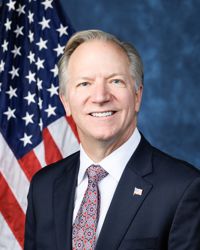
Robert F. Onder, Jr.
RRepublicanMO-3 · Representative
52
/ 100
Average
Attendance97
Avg: 96
Independence6
Avg: 4
Bipartisan Tone5
Avg: 15
Ethics Record100
Avg: 99
Transparency34
Avg: 53
Accountability Score — composite of attendance, independence, bipartisan tone, ethics record & transparency.
Methodology17
Bills Sponsored
0
Enacted into Law
3
Passed a Chamber
14
In Committee
All Sponsored Bills
HR1945Passed House
America's National Churchill Museum National Historic Landmark Act
America's National Churchill Museum National Historic Landmark Act This bill designates the America’s National Churchill Museum, including the Winston Churchill Memorial, located at Westminster College in Fulton, Missouri, as the America’s National Churchill Museum National Historic Landmark. (Former British Prime Minister Winston Churchill gave a speech titled The Sinews of Peace , also widely known as the Iron Curtain Speech, at the college in 1946.) The bill permits the Department of the Interior to enter into cooperative agreements with public and private entities for the purposes of protecting historic resources at the landmark and providing educational and interpretive facilities for the public. Interior may provide technical and financial assistance to partner entities. The bill also directs Interior to conduct a special resource study to evaluate the national significance of the landmark and to determine the suitability and feasibility of designating it as a unit of the National Park System. The study must consider alternatives to that designation for the preservation, protection, and interpretation of the landmark, and must include cost estimates associated with identified alternatives.
HR9228In Committee
Health DATA Act of 2026
The proposal would allow people who manage retirement and health benefit plans to access information about health insurance claims without knowing which specific employees the claims belong to. This change would let plan administrators better understand healthcare costs and trends affecting their workers while protecting individual privacy. The measure affects companies and organizations that sponsor employee health and retirement benefits.
HR4523Passed House
To make technical amendments to title 49, United States Code, as necessary to improve the Code.
This bill makes technical amendments to Title 49 (Transportation) of the U.S. Code , including amendments related to the Railroad Rehabilitation and Improvement Financing program.
HR9606In Committee
Less Bureaucracy, Better Child Care for Student Parents Act
Less Bureaucracy, Better Child Care for Student Parents Act This bill transfers specified functions relating to child care access for eligible low-income parents in postsecondary education from the Department of Education (ED) to the Department of Health and Human Services (HHS). Specifically, the bill transfers to HHS all the functions and authorities exercised by ED before the bill's effective date related to the Child Care Access Means Parents in School (CCAMPIS) program. (The CCAMPIS program awards grants to support the participation of eligible low-income parents in postsecondary education through the provision of campus-based child care services. On November 18, 2025, ED announced an interagency agreement with HHS for HHS to manage competitions, provide technical assistance, and integrate ED's program with HHS's existing programs, while ED must maintain its statutory responsibilities and program oversight.) Additionally, the bill transfers to HHS all personnel and appropriations related to the functions that are transferred under this bill. The bill outlines the authority of the Office of Management and Budget (OMB) related to the functions that are transferred under this bill, including that OMB must ensure that this bill does not create a net increase in full-time equivalent employees at HHS or ED. Further, OMB must certify compliance with the bill to specified congressional committees. The transfer of these functions does not affect any suits, proceedings, or applications for benefits, services, licenses, permits, certificates, or financial assistance that are pending on the date of this bill's effective date.
HR7651In Committee
Chloe Cole Act of 2026
Without access to the specific bill text, this legislation appears to address health policy matters and has been referred to the Judiciary Committee, suggesting it may involve legal or regulatory aspects of healthcare. The bill's referral to Judiciary rather than a health-focused committee indicates it likely deals with healthcare law, liability, or regulatory frameworks rather than direct medical programs. To provide an accurate summary of what this bill would actually do and who it affects, the specific legislative language would need to be reviewed.
HR9636In Committee
Improving CTU Act of 2026
Labor unions would be required to include the results of financial audits in their regular financial reports to members, making union finances more transparent and easier for workers to review. This change would apply to all labor organizations covered under federal labor law and aims to give union members better visibility into how their dues are being spent. The requirement would help ensure that union leadership is accountable for managing member funds responsibly.
HR7722In Committee
Child Care Integrity Monitoring Act of 2026
This bill would establish new oversight and monitoring systems for child care programs and providers to ensure they meet safety and quality standards. It would likely require child care facilities to undergo regular inspections, background checks, and compliance reviews to protect children and give parents better information about the care their kids receive. The bill would affect child care centers, family day care providers, and families seeking affordable, safe child care options.
HR7554In Committee
CARBON Act
The CARBON Act addresses environmental protection policies, likely aiming to reduce carbon emissions or regulate carbon-related activities that affect air quality and climate. Based on its referral to the House Committee on Energy and Commerce, the bill probably involves rules for power plants, transportation, or other major sources of greenhouse gases. The specific impact on businesses, consumers, and workers would depend on the bill's detailed provisions once it moves through committee review.
HR2571In Committee
Self-Insurance Protection Act
The legislation would establish new rules for companies that self-insure their employees' health benefits rather than buying insurance from an insurance company. It would require these self-insured plans to meet certain standards for protecting workers' medical information and ensuring they can access their benefits fairly. The changes would affect both large employers that self-insure and the workers who rely on these company-run health plans.
HR6222In Committee
ROTOR Act
Rotorcraft Operations Transparency and Oversight Reform Act or the ROTOR Act This bill addresses aviation safety by increasing requirements for aircraft tracking and communication using Automatic Dependent Surveillance-Broadcast (ADS-B) technology and expanding oversight. As background, ADS-B for broadcasting (Out) and receiving (In) transmits information (e.g., location and weather information) between aircraft and air traffic control. Under the bill, aircraft must generally operate with ADS-B In equipment to provide the aircraft with location information of other aircraft and traffic advisories. Current law does not require this equipment. Current Federal Aviation Administration (FAA) regulations allow aircraft performing a sensitive government mission to be excepted from requirements for using ADS-B Out equipment. This bill limits which flights may be considered sensitive government missions (e.g., not training flights) and requires additional reporting for the exception. The Government Accountability Office must review the use of the ADS-B Out exception and the Office of Inspector General (OIG) of the Department of Transportation (DOT) must annually audit FAA oversight of operations that use the exception. Further, the bill repeals a 2018 law that prohibits DOT from requiring certain military aircraft to install or use ADS-B equipment. The bill also requires the OIG of the Army to audit the Army’s coordination with the FAA, the FAA to establish an office to coordinate airspace usage of military aircraft and review the safety of flight operations and routes around airports, and the FAA to enter into memoranda of understanding with military agencies for safety information sharing.
HR6156In Committee
Endorsement Transparency Act
The proposal would require labor unions to disclose to their members how they spend money on political endorsements and campaign activities, similar to how they already report other financial spending. Union members would gain access to detailed information about which candidates and causes their dues support, allowing them to make more informed decisions about their membership. The measure affects unions and their members by increasing transparency around political spending decisions made on behalf of workers.
HR5483In Committee
Chloe Cole Act
Without access to the specific bill text, this appears to be health-related legislation that has been referred to the House committee responsible for healthcare policy. Based on the name and health subject matter, the bill likely addresses a specific health issue or medical concern, though the exact provisions would need to be reviewed in the full bill text to provide accurate details about who it affects and what changes it would make.
HR3424Passed House
SPACE Act of 2025
Shared Property Agency Collaboration and Engagement Act of 2025 or the SPACE Act of 2025 This bill directs the General Services Administration (GSA) to collaborate with federal agencies regarding the use of shared-space arrangements in federally leased buildings. The GSA must (1) collaborate with tenants of federally leased space to better identify concerns around shared-space arrangements; (2) develop criteria that would facilitate the expanded use of space sharing; (3) identify how special-use space can be used to improve space sharing; and (4) establish measurable objectives, in consultation with tenants, to quantify the success of shared-space arrangements among federal agencies. GSA must brief Congress on implementation of the bill within six months after the bill's enactment.
HR4715In Committee
MEGA Act of 2025
The proposal would establish or expand federal support for arts, culture, and religious organizations and institutions across the country. It aims to promote economic development in communities through cultural programs and initiatives while potentially providing funding or tax benefits for arts and cultural projects. The measure would affect artists, cultural organizations, religious institutions, and communities seeking to develop their cultural and economic resources.
HR4146In Committee
PAPA Act of 2025
Pilot and Aircraft Privacy Act or the PAPA Act of 2025 This bill limits how Automatic Dependent Surveillance-Broadcast (ADS-B) data may be used by the Federal Aviation Administration (FAA) and other government agencies. The bill also establishes disclosure requirements for certain user fees imposed on general aviation aircraft at public-use airports and limits the purposes for which the fees may be used. As background, ADS-B transmits information (e.g., location and weather information) between aircraft and air traffic control. The bill prohibits a person or government agency from using ADS-B data to identify an aircraft in order to impose a charge on the aircraft owner or operator. The bill also specifies that air traffic controllers may only use ADS-B data to assist in tracking aircraft and improving air traffic safety and efficiency, or for other purposes determined appropriate by the Department of Transportation after notice and public comment. Further, the bill prohibits any federal, state, local, territorial, or tribal official from initiating an investigation (excluding a criminal investigation) of a person based exclusively on ADS-B data. Under current law, this prohibition only applies to the FAA. In addition, owners and operators of public-use airports must publicly disclose financial information about certain expenses and cost estimates for airside safety projects (e.g., runway or taxiway safety improvements) prior to charging landing or takeoff fees for general aviation aircraft (e.g., aircraft used for personal, recreational, or flight training purposes). Further, any revenue from these fees may only be used for airside safety projects.
HR2572In Committee
Worker Enfranchisement Act
This bill would likely expand workers' rights and protections in the workplace, though the specific details depend on the bill's full text. Based on its name and referral to the education and workforce committee, it probably addresses issues like voting rights for workers in union elections, workplace representation, or other forms of worker participation in decisions affecting their jobs. The changes would affect millions of American employees across various industries.
HR2075In Committee
Protecting Life and Integrity in Research Act of 2025
This bill would restrict federal funding for certain types of medical research, likely including studies involving fetal tissue or human embryos, based on what supporters view as ethical concerns about protecting human life. The restrictions would affect universities, hospitals, and research institutions that receive federal grants, potentially limiting the types of studies they can conduct with government money. Researchers and medical institutions seeking federal funding would need to comply with new rules about which research projects are eligible for support.