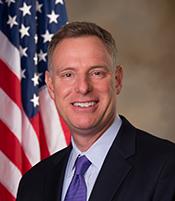
Scott H. Peters
DDemocratCA-50 · Representative
51
/ 100
Average
Attendance98
Avg: 96
Independence4
Avg: 4
Bipartisan Tone12
Avg: 15
Ethics Record100
Avg: 99
Transparency22
Avg: 53
Accountability Score — composite of attendance, independence, bipartisan tone, ethics record & transparency.
Methodology33
Bills Sponsored
0
Enacted into Law
2
Passed a Chamber
31
In Committee
All Sponsored Bills
HR10591In Committee
Safer Choice Program Authorization Act of 2026
HR10302In Committee
Certainty in Litigation for Electric Asset Reliability (CLEAR) Act of 2026
HR10215In Committee
Workforce Mobility Act of 2026
HR9929In Committee
To designate the facility of the United States Postal Service located at 4640 Cass Street in San Diego, California, as the "Mary Wilding Memorial Post Office Building".
This bill designates the facility of the United States Postal Service located at 4640 Cass Street in San Diego, California, as the "Mary Wilding Memorial Post Office Building".
HR9870In Committee
Affordable Housing Incentives Act
Property owners who sell land or buildings to be converted into affordable housing would be able to avoid paying taxes on the profits they make from the sale. This tax break would apply to real estate transactions where the buyer intends to use the property for affordable housing purposes, potentially encouraging more property owners to sell to affordable housing developers. The change would affect real estate investors, property owners, and affordable housing organizations.
HR9760In Committee
National Coordination on Adaptation and Resilience for Security Act of 2026
The federal government would be required to develop a comprehensive national resilience strategy to help the country prepare for and recover from major threats and disruptions. This strategy would guide how different government agencies, businesses, and communities work together to strengthen America's ability to withstand crises like natural disasters, cyberattacks, pandemics, or other emergencies. The plan would affect federal agencies, state and local governments, and potentially private companies involved in critical infrastructure and emergency response.
HR9599In Committee
SECURE 340B Act
The proposal would make changes to the 340B drug discount program, which allows certain hospitals, clinics, and other healthcare providers to buy prescription drugs at significantly reduced prices from manufacturers. These discounts help healthcare facilities serve low-income and uninsured patients while potentially reducing their overall drug costs. The bill aims to strengthen how this program operates, though the specific changes would be determined as it moves through the relevant congressional committees.
HR9564In Committee
Military Housing Innovation Act
The federal government would be required to study how "point-access block design" — a construction method that limits entry and exit points to military buildings — could be used in future military construction projects. This research would help the Department of Defense understand whether this design approach could improve security, reduce costs, or offer other benefits for military facilities. The study would be conducted by the Comptroller General, the government's chief auditor, and results would be reported back to Congress.
HRES1396In Committee
Expressing support for the designation of the month of June 2026 as "National Post-Traumatic Stress Awareness Month" and June 27, 2026, as "National Post-Traumatic Stress Awareness Day".
This resolution supports the designation of National Post-Traumatic Stress Awareness Month and National Post-Traumatic Stress Awareness Day. The resolution supports (1) the education of members of the Armed Forces, veterans, their families, and the public about post-traumatic stress; and (2) efforts by the Department of Veterans Affairs and the Department of Defense to foster cultural change around the issue of post-traumatic stress. The resolution also encourages the leadership of the Armed Forces to support treatment of members of the Armed Forces who suffer from post-traumatic stress.
HRES1265In Committee
Expressing support for the designation of the week of May 3, 2026, through May 9, 2026, as "Tardive Dyskinesia Awareness Week".
This resolution designates the week of May 3-9, 2026, as "Tardive Dyskinesia Awareness Week" to increase public understanding of this serious movement disorder that can develop as a side effect of certain psychiatric medications. The designation aims to draw attention to the condition, which causes involuntary repetitive movements, and to encourage awareness among patients, healthcare providers, and the general public about its risks and management.
HR8308In Committee
CERTAIN Act
This bill would set up new rules for how the federal government ends permits and approvals (called "authorizations") for projects, makes sure reviews of these permits are completed on time and coordinated across agencies, and allows people to challenge government decisions about permits in court. The bill affects companies and individuals seeking federal permits for activities like construction, energy development, and transportation projects, as well as the federal agencies that issue these permits. The specific details of what changes would be made aren't clear from the title alone, but the bill is designed to make the permit process more predictable and accountable.
HR7844In Committee
To provide the Secretary of Homeland Security with the authority to transfer funds between accounts under the Department of Homeland Security during a lapse in appropriations, and for other purposes.
During a government shutdown when Congress hasn't approved a budget, this bill would let the Secretary of Homeland Security move money between different DHS accounts to keep essential operations running instead of having all activities freeze. This would allow the agency to maintain critical functions like border security and immigration enforcement without waiting for Congress to pass a new budget. The bill affects how the Department of Homeland Security manages its finances during budget gaps.
HR7845In Committee
DROUGHT Act of 2026
The bill addresses water resource management and drought-related issues, likely proposing new federal programs or funding to help states and communities deal with water shortages and improve water infrastructure. The legislation would probably affect farmers, cities, water utilities, and residents in drought-prone regions by providing tools, money, or policies to better manage and conserve water supplies during dry periods.
HR7472In Committee
To amend title 38, United States Code, to repeal a certain limitation on the receipt of assistance under both the Department of Veterans Affairs Veteran Readiness and Employment program and Department of Veterans Affairs educational assistance programs.
Veterans currently cannot receive benefits from both the VA's job training program and the VA's education assistance programs at the same time, forcing them to choose between getting help finding work or paying for school. This bill would remove that restriction, allowing veterans to use both programs simultaneously to pursue education while also getting career counseling and job placement support. The change would give veterans more flexibility in how they use their earned benefits to transition to civilian employment.
HR7118In Committee
Genomic Answers for Children’s Health Act of 2026
This bill would expand access to genetic testing and genomic analysis for children to help doctors diagnose rare diseases and genetic disorders earlier and more accurately. It likely aims to improve how pediatric patients receive genetic counseling and treatment by making these advanced tests more available through healthcare providers. The legislation would affect children with suspected genetic conditions, their families, and healthcare systems that provide diagnostic services.
HR6670In Committee
Temporary Family Visitation Act
The legislation would allow certain family members of U.S. citizens and permanent residents to visit the country temporarily without going through the standard visa application process, making it easier for people to see relatives abroad for short periods. This would primarily affect immigrants and their families who currently face lengthy waits and complex paperwork to visit loved ones in the United States. The bill is currently being reviewed by the House Judiciary Committee to determine whether it should move forward.
HR5973In Committee
Stop Excessive Force in Immigration Act of 2025
This bill would establish new rules and oversight to limit the use of physical force by immigration enforcement officers when detaining or apprehending people. It would likely require training, documentation, and accountability measures for immigration agents, and could create penalties for excessive force incidents that harm immigrants or detainees. The bill affects immigration enforcement agencies, detained immigrants, and their families.
HR5755In Committee
No Budget, No Pay Act
No Budget, No Pay Act This bill prohibits Members of Congress from being paid in a fiscal year until both chambers approve the budget resolution and pass all regular appropriations bills for that fiscal year. Retroactive pay is prohibited for such a period.
HR5601In Committee
Faith in Housing Act of 2025
HR5600In Committee
SPEED and Reliability Act of 2025
This bill aims to improve how quickly and reliably the nation's electrical grid operates, likely by streamlining the process for building new power lines and energy infrastructure while reducing regulatory delays. The changes would affect energy companies, utilities, and consumers by potentially lowering costs and speeding up the transition to new energy sources, though the specific measures would depend on the bill's final language.
HR5443In Committee
Fair Housing Improvement Act of 2025
This bill would strengthen fair housing laws to better protect people from discrimination when buying, renting, or obtaining housing loans based on race, color, religion, sex, national origin, disability, or family status. It likely includes measures to improve enforcement of existing fair housing rules, increase penalties for violations, and expand protections for additional groups facing housing discrimination. The changes would affect homebuyers, renters, landlords, real estate agents, and lenders across the country.
HR4576In Committee
Build More Housing Near Transit Act of 2025
This bill would encourage developers to build more apartment buildings and housing near public transportation hubs like bus and train stations by offering federal incentives or streamlined approval processes. The goal is to make it easier and more affordable for people to live closer to transit options, reducing car dependency and traffic while giving communities more housing options. It would primarily affect housing developers, local governments, and people looking for affordable places to live in urban and suburban areas.
HRES542In Committee
Expressing support for the designation of the month of June 2025 as "National Post-Traumatic Stress Awareness Month" and June 27, 2025, as "National Post-Traumatic Stress Awareness Day".
This resolution supports the designation of National Post-Traumatic Stress Awareness Month and National Post-Traumatic Stress Awareness Day. The resolution supports (1) the education of members of the Armed Forces, veterans, their families, and the public about post-traumatic stress; and (2) efforts by the Department of Veterans Affairs and the Department of Defense to foster cultural change around the issue of post-traumatic stress. The resolution also encourages the leadership of the Armed Forces to support treatment of members of the Armed Forces who suffer from post-traumatic stress.
HR1948Passed House
To authorize the International Boundary and Water Commission to accept funds for activities relating to wastewater treatment and flood control works, and for other purposes.
This bill authorizes the U.S. Section of the International Boundary and Water Commission, United States and Mexico (USIBWC) to accept funds to study, design, construct, operate, or maintain wastewater treatment works, water conservation projects, or flood control works, and related structures. The USIBWC is a federal government agency and the U.S. component of the International Boundary and Water Commission, which applies the boundary and water treaties of the United States and Mexico and settles differences that may arise in their application. The USIBWC may not provide credit towards the nonfederal share of project costs, or reimbursement, to nonfederal entities in an amount that exceeds $5 million in any fiscal year. Further, the USIBWC may not accept funds from any nonfederal entity that (1) is domiciled in, headquartered in, or organized under the laws of a foreign country of concern (e.g., China, North Korea, Russia, or Iran); or (2) has in place any agreement with a foreign country of concern. Any funds accepted by the USIBWC must be deposited into the account titled International Boundary and Water Commission, United States and Mexico .
HR3564In Committee
The Nuclear First-Strike Security Act of 2025
This bill would likely establish new policies or restrictions around when the United States can use nuclear weapons as a first strike rather than in response to an attack, affecting how the military and president make decisions about nuclear weapons use. The legislation would impact military strategy, international relations with other nuclear-armed countries, and potentially limit or clarify the circumstances under which nuclear weapons could be deployed. Congress is currently reviewing the proposal to determine whether it falls under foreign policy or military authority.
HR1578Passed House
Veterans Claims Education Act of 2025
Veterans Claims Education Act of 2025 This bill requires the Department of Veterans Affairs (VA) to, upon receipt of an initial claim for benefits from a claimant that is not represented by an accredited person (i.e., a veterans service organization, attorney, or agent recognized by the VA), provide (1) notice that an accredited person may assist the claimant, (2) notice that a veterans service organization may represent the claimant for free, (3) information regarding a search tool to find an accredited person to assist in the filing of claims, and (4) information on how and where to report a person who is not accredited and charged a fee to assist with a claim. In its web portal, the VA must provide a warning regarding fees an agent or attorney may charge for assistance in filing benefits claims. (Under current law, fees are generally prohibited for filing an initial claim.)
HR3304In Committee
Providing Child Care for Police Officers Act of 2025
The bill would help police officers afford child care by providing federal funding or support for child care services specifically for law enforcement families. This could make it easier for police officers to work full shifts without worrying about finding or paying for reliable child care, which is particularly important for officers who work irregular hours including nights and weekends. The measure aims to support both police families and law enforcement agencies by reducing barriers that might prevent officers from staying in the profession.
HRES396In Committee
Expressing support for the designation of the week of May 4, 2025, through May 10, 2025, as "Tardive Dyskinesia Awareness Week".
This resolution supports the designation of Tardive Dyskinesia Awareness Week. Tardive dyskinesia is a movement disorder characterized by involuntary and uncontrolled movements of muscles in the face, torso, and extremities.
HR2956In Committee
DISASTER Act of 2025
Disclosing Aid Spent to Ensure Relief Act of 2025 or the DISASTER Act of 2025 This bill requires the Office of Management and Budget to submit an annual report to Congress on all disaster-related assistance provided by the federal government. The report must include all federal obligations related to disaster response, recovery, mitigation efforts, and administrative costs associated with these activities for specified agencies and programs.
HR2309In Committee
Medicare and Medicaid Fraud Prevention Act
Medicare and Medicaid Fraud Prevention Act This bill provides statutory authority for the requirement that state Medicaid programs check, as part of the provider enrollment and reenrollment process, whether providers are deceased through the Social Security Administration's Death Master File. The bill requires states to continue to check this database on at least a quarterly basis after providers are enrolled.
HR1390In Committee
Ocean Pollution Reduction Act II
Ocean Pollution Reduction Act II This bill provides an alternative permitting process for the Point Loma Wastewater Treatment Plant located in San Diego, California, to comply with the requirements of the National Pollutant Discharge Elimination System (NPDES) permit program. Currently, the plant operates with a temporary variance (or waiver) from certain NPDES treatment standards under the Clean Water Act (CWA). The City of San Diego has applied for a new variance for the plant. If the variance is not granted, then the city must obtain a new NPDES permit and fully comply with the treatment standards. The bill allows the Environmental Protection Agency (EPA) to issue an NPDES permit that requires the plant to comply with certain conditions. Thus, it eliminates the need for the city to apply for another variance so long as it obtains the conditional NPDES permit and the plant: maintains its current deep ocean outfall pipe; complies with specified annual and monthly limits for total suspended solids (e.g., sewage); removes at least 80% of total suspended solids from the discharge on a monthly average and 58% of biochemical oxygen demand on an annual average; attains all other effluent limitations of secondary treatment; complies with CWA pretreatment requirements and other requirements applicable to NPDES permits; provides to the EPA 10 consecutive years of compliance data and analysis; and demonstrates that it will produce at least 83 million gallons per day on an annual average of water safe for human consumption by December 31, 2039.
HR1092In Committee
Responsible Budgeting Act
HR566In Committee
Cleaner Air Spaces Act of 2025
Cleaner Air Spaces Act of 2025 This bill requires the Environmental Protection Agency to provide grants to air pollution control agencies, including at least one tribal agency with jurisdiction over air quality, to implement cleaner air space programs (i.e., programs to provide clean air to the public during wildland fire smoke events). Generally, such programs must be located in areas at risk of exposure to wildland fire smoke and must help provide educational materials, clean air centers (i.e., one or more clean air rooms in a publicly accessible building), and air filtration systems to certain households. Clean air rooms are rooms designed to keep levels of harmful air pollutants as low as possible during wildland fire smoke events. Under the bill, air pollution control agencies must partner with at least one community-based organization in implementing such programs.