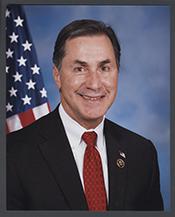
Gary J. Palmer
RRepublicanAL-6 · Representative
54
/ 100
Average
Attendance99
Avg: 96
Independence3
Avg: 4
Bipartisan Tone10
Avg: 15
Ethics Record100
Avg: 99
Transparency42
Avg: 53
Accountability Score — composite of attendance, independence, bipartisan tone, ethics record & transparency.
Methodology11
Bills Sponsored
1
Enacted into Law
2
Passed a Chamber
5
In Committee
All Sponsored Bills
HR9617Passed House
CHARM Act
Coordinating and Harnessing America’s Recovery of Minerals Act or the CHARM Act This bill requires the Environmental Protection Agency (EPA) to establish and carry out a national strategy for recovering critical minerals from discarded materials. Critical minerals are defined as any mineral, element, substance, or material designated as critical by the U.S. Geological Survey because it is essential to U.S. economic or national security, has a vulnerable supply chain, and serves an essential function in manufacturing a product. The EPA must report to Congress every two years on its actions, plans, and recommendations relating to the national strategy.
HJRES211In Committee
Providing congressional disapproval under chapter 8 of title 5, United States Code, of the rule submitted by the Environmental Protection Agency relating to "California State Motor Vehicle Pollution Control Standards; Notice of Decision Granting a Waiver of Clean Air Act Preemption for California's 2009 and Subsequent Model Year Greenhouse Gas Emission Standards for New Motor Vehicles".
HR8467Passed House
ZOMBIE Act
Zeroing Out Monetary Benefits Improperly Expended Act or the ZOMBIE Act This bill focuses requirements governing the assessment, tracking, and reporting of improper payments made by federal agencies on improper payments that result in financial loss to the government. The bill defines financial loss to the government as any payment (or part of a payment) in excess of the correct amount that results in a financial loss to the government, but excludes any payment (or part of a payment) that is made to the correct recipient for the correct amount but fails to meet administrative procedures (other than those required to verify the validity of the payment). The bill requires agencies to assess programs and activities every three years for the risk of improper payments resulting in financial loss to the government. The bill also generally modifies other reporting requirements to focus on such improper payments, including by expanding reporting requirements to include information about actions taken by agencies to prevent such payments (e.g., use of the Do Not Pay system) and to implement certain best practices. The bill also requires an estimate of such improper payments in agencies’ annual budget justification, requires the Department of the Treasury to develop risk assessment guidance, and allows up to 75% of funds that are recovered through audits to be directed back to the original program or activity (currently, up to 25% of such funds may be directed back to the original program or activity).
HR6373Reported
Air Permitting Improvements to Protect National Security Act of 2025
This bill would streamline the air pollution permitting process for projects deemed important to national security, allowing the federal government to approve certain industrial facilities and infrastructure more quickly while still maintaining environmental protections. The changes would primarily affect companies building defense-related manufacturing plants, energy infrastructure, and other facilities that officials consider critical to national security, potentially reducing the time and regulatory requirements for these projects compared to standard environmental reviews.
HR2076Reported
Lulu’s Law
Lulu’s Law This bill requires the Federal Communications Commission to issue an order explicitly permitting the transmission of wireless emergency alerts to mobile phones in the event of a shark attack. (Under current regulations, authorized government authorities are permitted to send wireless emergency alerts regarding public safety emergencies, including severe weather, missing children, and other threats to life or property.)
HR7934In Committee
Settlement Agreement Information Database Act of 2026
This bill would create a public database where people can search for settlement agreements that the federal government has made with individuals or organizations, making these deals more transparent and accessible to the public. Currently, many government settlements are scattered across different agencies or kept private, so this database would centralize that information in one searchable place. The bill affects federal agencies, taxpayers who want to know how government money is being spent, and anyone interested in government accountability.
HR1731Reported
Standard FEES Act
Standard Fees to Expedite Evaluation and Streamlining Act or the Standard FEES Act This bill requires the General Services Administration (GSA) to establish, and federal agencies to adopt, a uniform schedule of fees for applications to place, modify, or maintain communications facilities in, over, or on federally owned buildings and property. The fees established by the GSA must be competitively neutral with respect to other application fees for similar uses of federal buildings and property and based on the direct and actual costs of processing such applications. The GSA may establish exceptions to the fee schedule to be granted by agencies on a case-by-case basis, provided the exceptions are competitively neutral with respect to the categories of individuals or entities granted exceptions and meet certain other requirements. Agencies may only use fees collected to cover the costs of processing applications, and only to the extent that the funds are provided in advance in appropriations acts.
HR6102In Committee
Citizen Ballot Protection Act
HR4609In Committee
To extend the authority to carry out the Defense Production Act of 1950.
This bill would extend the federal government's power to use the Defense Production Act, a law that lets the president direct private companies to prioritize making goods needed for national defense or emergencies. The extension would keep this authority active beyond its current expiration date, allowing the government to require factories and businesses to produce critical supplies like military equipment, medical devices, or other essential materials during crises. This affects manufacturers and businesses that could be called upon to shift their production to meet urgent national needs.
HJRES20Enacted
Providing for congressional disapproval under chapter 8 of title 5, United States Code, of the rule submitted by the Department of Energy relating to "Energy Conservation Program: Energy Conservation Standards for Consumer Gas-fired Instantaneous Water Heaters".
This joint resolution nullifies the rule titled Energy Conservation Program: Energy Conservation Standards for Consumer Gas-fired Instantaneous Water Heaters and submitted by the Department of Energy (DOE) on December 26, 2024. Under the rule, DOE adopted amended energy conservation standards for gas-fired instantaneous water heaters to achieve the maximum improvement in energy efficiency that DOE determined was technologically feasible and economically justified.
HR1628In Committee
761st Tank Battalion Congressional Gold Medal Act
761st Tank Battalion Congressional Gold Medal Act This bill provides for the award of a Congressional Gold Medal to the 761st Tank Battalion in recognition of their role in the success of Allied forces in Europe during World War II and for the example they set as the first Black soldiers to go to war as part of an American armored unit. Following the award of the gold medal, the gold medal shall be given to the National Museum of African American History and Culture where it shall be available for display and research.