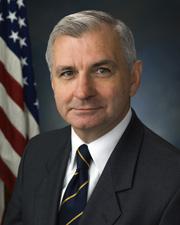
Jack Reed
DDemocratRI · Senator
60
/ 100
Average
Attendance99
Avg: 97
Independence18
Avg: 23
Bipartisan Tone18
Avg: 14
Ethics Record100
Avg: 100
Transparency51
Avg: 47
Accountability Score — composite of attendance, independence, bipartisan tone, ethics record & transparency.
Methodology33
Bills Sponsored
0
Enacted into Law
1
Passed a Chamber
24
In Committee
All Sponsored Bills
SRES926Introduced
A resolution designating September 2026 as "National Literacy Month".
S5549In Committee
Quality Educator Partnership Act
SRES863In Committee
A resolution expressing support for designation of the week of September 13 through 19, 2026, as "National Adult Education and Family Literacy Week".
S5320In Committee
Insider Trading Prohibition Act
S5264In Committee
Bus Operator Safety and Security Act
SJRES203In Committee
A joint resolution providing for congressional disapproval under chapter 8 of title 5, United States Code, of the rule submitted by the Office of the Comptroller of the Currency relating to "Preemption Determination: State Interest-on-Escrow Laws".
Congress would reject a banking regulation that allows national banks to ignore state laws requiring them to pay interest on customer escrow accounts (money held temporarily for things like property taxes or insurance). The rule, created by the Office of the Comptroller of the Currency, would let federal banking rules override stricter state protections for customers' money. This would affect bank customers in states with interest-on-escrow laws, potentially costing them money they would otherwise earn on funds held in escrow.
S4110Reported
EMPOWER for Health Act
Educating Medical Professionals and Optimizing Workforce Efficiency and Readiness for Health Act or the EMPOWER for Health Act This bill reauthorizes through FY2031 and revises a range of programs that provide funding and other resources to support recruiting, training, and retaining individuals to work or teach in the health professions. These programs are administered by the Health Resources and Services Administration (HRSA). For instance, the bill revises an educational loan repayment program for certain pediatric health specialists that agree to practice in areas with shortages of such specialists. The bill (1) requires direct clinical care to comprise at least half of the required service hours, (2) broadens the eligible specialties to include any pediatric mental or behavioral health discipline HRSA determines appropriate, and (3) specifically authorizes focusing care on children enrolled in Medicaid. Also, the bill specifically authorizes grants to entities such as states and health professions schools for supporting the nursing workforce by providing analysis, technical assistance, and best practices for alleviating nursing workforce shortages. Finally, the bill expands grants for recruiting youth into public health careers to include outreach to middle school students (current law only includes outreach to high school students).
S5018In Committee
Disaster Relief Fairness Act of 2026
This bill would approve federal disaster relief funding for areas that have experienced major disasters and requested federal assistance. The money would help communities recover from events like hurricanes, floods, earthquakes, or other emergencies by supporting rebuilding efforts, emergency response, and aid to affected residents and businesses. The specific disasters covered would be determined through the formal approval process in Congress.
S4109Reported
Stem Cell Therapeutic and Research Reauthorization Act of 2026
Stem Cell Therapeutic and Research Reauthorization Act of 2026 This bill reauthorizes through FY2031 and revises programs that help patients receive transplants of bone marrow or umbilical cord blood from biologically unrelated donors. These programs are administered by the Health Resources and Services Administration (HRSA). The bill reauthorizes the C.W. Bill Young Cell Transplantation Program. This program supports transplantation of bone marrow and cord blood by increasing the quantities of donations, providing processes for matching and distributing donated materials to patients, and providing related information and research. The bill also expands periodic reviews of the state of stem cell science to specifically include a review of the use of high-quality cord blood units and other emergent technologies to develop new therapies for potential inclusion in the program. Also, the bill reauthorizes and revises the National Cord Blood Inventory program, through which HRSA contracts with qualified cord blood banks to collect and maintain a supply of high-quality units for transplantation through the C.W. Bill Young Cell Transplantation Program. The bill amends the inventory program by (1) changing the inventory goal from 150,000 units to a sufficient supply as determined by HRSA, (2) requiring HRSA to manage the size and composition of the inventory to maximize clinical utility and efficiency, and (3) defining high quality cord blood unit to mean a unit meeting current industry standards and the requirements of the Food and Drug Administration.
S4611In Committee
Job Corps Shipbuilding-Defense Industrial Base Pipeline Act of 2026
The proposal would connect the Job Corps job training program more closely with industries that support military and defense manufacturing, helping prepare workers for careers in defense-related fields. This could affect young people and low-income adults who participate in Job Corps training, as well as defense contractors looking to fill skilled positions in manufacturing and related sectors.
SJRES134In Committee
A joint resolution providing for congressional disapproval under chapter 8 of title 5, United States Code, of the rule submitted by the Bureau of Consumer Financial Protection relating to the withdrawal of the rule relating to "Truth in Lending (Regulation Z); Use of Digital User Accounts to Access Buy Now, Pay Later Loans".
Congress is considering blocking a decision by the Consumer Financial Protection Bureau to withdraw a rule that would have required "buy now, pay later" companies to disclose loan terms clearly to borrowers through digital accounts. If approved, this resolution would force the agency to keep the disclosure rule in place, ensuring consumers get transparent information about the costs and terms when they use services that let them split purchases into installments. The resolution targets a specific regulatory action rather than creating new law, and would primarily affect buy now, pay later lenders and their customers.
SJRES132In Committee
A joint resolution providing for congressional disapproval under chapter 8 of title 5, United States Code, of the rule submitted by the Bureau of Consumer Financial Protection relating to the withdrawal of the rule relating to "Examinations for Risks to Active-Duty Servicemembers and Their Covered Dependents".
Congress is attempting to block a decision by the Consumer Financial Protection Bureau to withdraw a rule that required banks and financial companies to examine their practices for risks to active-duty military members and their families. If approved, this resolution would force the agency to keep the rule in place, ensuring that financial institutions continue checking whether their products and services might harm servicemembers. The measure is currently under review by the Senate Banking Committee.
SRES694Introduced
A resolution designating April 2026 as "Financial Literacy Month".
This resolution designates April 2026 as Financial Literacy Month.
S4350In Committee
Southeast New England Program Authorization Act of 2026
The bill would create a new Southeast New England Program under federal water pollution laws to address water quality issues in that region. The program would likely establish standards, funding, or coordinated efforts to reduce pollution in rivers, coastal areas, and other waterways affecting communities and businesses in southeastern New England. This would impact residents, fishing industries, and local governments in states like Connecticut, Rhode Island, and Massachusetts that depend on clean water resources.
S4068In Committee
ACTION for National Service Act
This bill would create or expand national service programs that allow Americans to serve their country through civilian or military work in exchange for benefits like education funding or student loan forgiveness. The legislation aims to increase civic engagement and national service participation among young people and other Americans while providing them with financial support for education or other needs. It would affect young adults, veterans, and potentially employers who might participate in or benefit from these service programs.
S3907In Committee
Foreign Stablecoin Transparency Act
This bill would require foreign cryptocurrency companies that issue stablecoins—digital currencies designed to maintain a fixed value—to disclose information to U.S. regulators and meet certain transparency standards before operating in American markets. The measure aims to give federal banking regulators better visibility into foreign stablecoin operations to protect consumers and prevent financial risks. It would primarily affect cryptocurrency companies, financial institutions, and investors who use or trade these digital assets.
S3793In Committee
Predatory Lending Elimination Act
This bill would establish stricter rules to prevent lenders from offering loans with unfair terms that trap borrowers in cycles of debt, such as extremely high interest rates or hidden fees. The legislation would likely affect payday lenders, title loan companies, and other financial institutions that currently operate with minimal restrictions, while protecting consumers—especially lower-income individuals—from predatory lending practices. The bill is currently under review by the Senate Banking Committee.
S3777In Committee
Rebuild America’s Schools Act of 2026
Rebuild America's Schools Act of 2026 This bill provides support for long-term improvements to public elementary and secondary school facilities. First, the bill sets forth allocations to states and establishes a need-based grant program for local educational agencies (LEAs) to improve school facilities. Further, the bill specifies allowable uses of grant funds, including carrying out major repairs, improving indoor air quality, and making facilities accessible to individuals with disabilities. Additionally, the bill requires LEAs that receive funds for new construction, modernization, or renovation projects to comply with hazard-resistance building codes and performance criteria under the WaterSense program of the Environmental Protection Agency. Further, the bill requires such LEAs to adopt certain green practices (environmental standards) and requires the use of iron, steel, and manufactured products that are made in the United States (Buy America). The bill restores school infrastructure tax credit bonds. The bill also sets forth reporting requirements, including annual reports on grant program projects and a report by the Government Accountability Office that requires a study of the geographic distribution of projects, the impact of selected projects on student and staff health and safety, and the accessibility of projects to high-needs schools. The bill also establishes the Office of School Infrastructure and Sustainability within the Department of Education. Next, the bill extends through FY2031 the Impact Aid Construction program. Finally, the bill establishes a grant program to assist LEAs with repairing or replacing concrete foundations affected by pyrrhotite (an iron sulfide material linked to crumbling foundations).
S3754In Committee
Affordable Housing and Homeownership Protection Act of 2026
This bill would likely modify tax rules to make homeownership more affordable and protect people from losing their homes, though the specific changes aren't yet detailed in the legislative record. The measure could involve tax credits, deductions, or other financial incentives aimed at helping lower and middle-income families buy homes or keep the ones they have. It's currently being reviewed by the Senate Finance Committee to determine what tax changes would be most effective.
S3753In Committee
Preserving Homes and Communities Act of 2026
This bill likely aims to protect homeowners and neighborhoods from financial practices that could lead to foreclosures or property loss, possibly by regulating how banks handle mortgages or preventing rapid property acquisitions that destabilize communities. The measure would affect homeowners, banks, and potentially investors who buy residential properties, with the goal of keeping people in their homes and maintaining stable neighborhoods. The Banking Committee will review the specific details of what protections or restrictions the bill would actually put in place.
S3561In Committee
Buy Now, Pay Later Protection Act of 2025
This bill would establish new federal rules for "buy now, pay later" services—companies that let shoppers split purchases into installments without using a credit card—to ensure they follow consumer protection standards similar to traditional credit products. The legislation would likely require these companies to disclose fees and interest rates clearly, limit unfair practices, and give consumers rights like the ability to dispute charges, affecting both the companies offering these services and the millions of Americans using them to make purchases.
S3365In Committee
Right to Read Act of 2025
Right to Read Act of 2025 This bill expands access to school libraries and literacy skills support for elementary and secondary school students. It also outlines certain constitutional rights and liability protections related to school libraries. Specifically, the bill reauthorizes through FY2030 (1) the Comprehensive Literacy State Development Program, which provides grants to ensure high-quality instruction and effective strategies in reading and writing for children through 12th grade; and (2) the Innovative Approaches to Literacy Program, which provides grants to support the development of literacy skills in low-income communities. Additionally, the bill allows Supporting Effective Instruction State Grants to be used to assist local educational agencies (LEAs) and schools in recruiting, hiring, and retaining state-certified school librarians. Further, the bill authorizes states and LEAs to use Student Support and Academic Enrichment grants for programs and activities that promote the development of digital literacy and information literacy skills. The Department of Education (ED) must direct the National Center for Education Statistics to biennially collect data on school libraries. ED must require an assurance from each state and LEA receiving certain funds confirming that it will (1) protect the First Amendment rights of students in school libraries, and (2) provide equal protection in the conduct of school libraries in compliance with the requirements of the Fourteenth Amendment and nondiscrimination laws. The bill also provides liability protection to teachers, school librarians, school leaders, paraprofessionals, and other staff for actions that conform with state or local policies regarding the right to read.
SRES361Introduced
A resolution designating August 16, 2025, "National Airborne Day".
This resolution designates August 16, 2025, as National Airborne Day.
S2338In Committee
Strengthening Local Food Security Act of 2025
This bill aims to boost local food production and availability by supporting farmers markets, community gardens, and regional food systems rather than relying solely on large-scale national distribution. It likely provides funding or incentives to help communities grow and distribute their own food, which could benefit small farmers, low-income neighborhoods with limited grocery access, and people wanting fresher local produce. The measure is currently under review by the Senate Agriculture Committee.
SRES303Introduced
A resolution expressing support for the designation of May 17, 2025, as "DIPG Pediatric Brain Cancer Awareness Day" to raise awareness of, and encourage research on, diffuse intrinsic pontine glioma tumors and pediatric cancers in general.
This resolution expresses support for the designation of May 17, 2025, as DIPG Pediatric Brain Cancer Awareness Day. DIPG refers to diffuse intrinsic pontine glioma, a terminal childhood brain cancer.
S1467Passed Senate
Homebuyers Privacy Protection Act
Homebuyers Privacy Protection Act This bill limits the circumstances in which credit reporting agencies may provide consumer credit reports to third parties in connection with residential mortgage transactions. Specifically, the bill prohibits a credit reporting agency from providing a consumer's credit report to a third party in connection with a residential mortgage transaction unless the transaction consists of a firm offer of credit or insurance and (1) the third party provides documentation certifying that it has the consumer's consent; or (2) the third party has originated a mortgage on behalf of the consumer, is a current mortgage loan servicer to the consumer, or has a current specified banking relationship with the consumer. These provisions take effect 180 days after the bill's enactment.
SRES193Introduced
A resolution designating April 2025 as "Financial Literacy Month".
This resolution designates April 2025 as Financial Literacy Month.
S1342In Committee
Weatherization Assistance Program Improvements Act of 2025
This bill would improve the federal Weatherization Assistance Program, which helps low-income households reduce energy costs by upgrading their homes with better insulation, windows, and heating systems. The changes likely aim to make the program more efficient, expand its reach to more families, or update its standards to reflect modern energy-saving technology. Homeowners and renters with limited incomes would be the primary beneficiaries, while also reducing overall energy consumption nationwide.
S1152In Committee
Rhode Island Fishermen's Fairness Act of 2025
This legislation would establish new protections and fair treatment standards for commercial fishermen in Rhode Island, likely addressing issues like fishing rights, catch limits, and access to fishing grounds. The bill aims to ensure that local fishermen have equitable opportunities to make a living from their trade while competing with larger fishing operations. It has been sent to the Senate Commerce Committee for review and discussion.
S970In Committee
Helping More Families Save Act
S964In Committee
Property Improvement and Manufactured Housing Loan Modernization Act of 2025
S965In Committee
A bill to strengthen the United States Interagency Council on Homelessness.
This bill permanently reauthorizes the United States Interagency Council on Homelessness, an independent federal agency within the executive branch that coordinates the federal response to prevent and end homelessness.
S1672Reported
National Oilheat Research Alliance Reauthorization Act of 2009
(This measure has not been amended since it was introduced. The summary of that version is repeated here.) National Oilheat Research Alliance Reauthorization Act of 2009 - Amends the National Oilheat Research Alliance Act of 2000 to extend the national oilheat research alliance program until February 6, 2011.