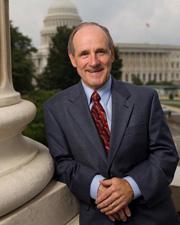
James E. Risch
RRepublicanID · Senator
60
/ 100
Average
Attendance97
Avg: 97
Independence23
Avg: 23
Bipartisan Tone3
Avg: 14
Ethics Record100
Avg: 100
Transparency70
Avg: 47
Accountability Score — composite of attendance, independence, bipartisan tone, ethics record & transparency.
Methodology53
Bills Sponsored
0
Enacted into Law
0
Passed a Chamber
40
In Committee
All Sponsored Bills
S5374In Committee
A bill to facilitate the conveyance of certain land in Bonners Ferry, Idaho, platted under section 2387 of the Revised Statutes, and for other purposes.
S1254In Committee
A bill to amend the Aquifer Recharge Flexibility Act to clarify a provision relating to conveyances for aquifer recharge purposes.
This bill makes a technical clarification to existing water law regarding how water can be transferred or moved for the purpose of refilling underground water supplies. The change would affect water agencies, farmers, and other organizations that manage water resources in areas where aquifer recharge is important for maintaining water supplies. The bill is still in early stages and has been sent to a Senate committee for review.
S5484In Committee
Affordable HOMES Act of 2026
S1257Reported
A bill to amend the Infrastructure Investment and Jobs Act to authorize the use of funds for certain additional Carey Act projects, and for other purposes.
This bill would allow money from the major infrastructure law to be used for additional water projects under the Carey Act, a century-old program that helps states develop irrigation and water systems on federal land. The change would expand which water development projects can receive federal funding, potentially benefiting farmers, ranchers, and communities that rely on irrigation infrastructure in western states.
S2753Reported
Urban Canal Modernization Act
This bill would update and improve aging canal systems in urban areas to make them more efficient at delivering water and managing flood risks. The changes would likely involve repairs, modernization of infrastructure, and possibly new technology to help cities better manage their water resources. Cities and water districts that rely on these canals would be the main beneficiaries of the improvements.
S5254In Committee
Civil Nuclear Export Act of 2026
Civil Nuclear Export Act of 2026 This bill provides the Export-Import Bank with certain authorities to finance civil nuclear energy exports. Specifically, the bill allows the Export-Import Bank to provide financing for the purchase of liquid metal fast breeder nuclear reactors and nuclear fuel reprocessing facilities if the purchase is otherwise permitted by law. Additionally, the bill expands the China and Transformational Exports Program (CTEP) by making civil nuclear energy eligible for financing under the program. Currently, the bank may extend loans, guarantees, and insurance to advance the comparative leadership of the United States with respect to China in specified export areas (e.g., artificial intelligence, biotechnology, and wireless communications equipment). This bill expands those areas to include civil nuclear energy technologies, materials, services, and related infrastructure and goods. The bill also revises the financial limitation on the outstanding aggregate amount of all of the bank's loans, guarantees, and insurance. In particular, the bill exempts those amounts attributed by the bank to CTEP, as long as that financing does not exceed a specified amount. The bill also increases from 2% to 4% the bank's default rate cap. Further, the bill allows the bank to exclude financing under CTEP from this default rate, subject to approval of the bank's board of directors.
S5266In Committee
Veterans’ Earned Benefits Access Act of 2026
SRES827In Committee
A resolution recognizing the 100th anniversary of the creation of the Sporting Arms and Ammunition Manufacturers' Institute, Inc. (SAAMI) and commending its work establishing industry standards that ensure the safe interoperability of firearms and ammunition.
This resolution honors the 100-year history of SAAMI, an organization that sets safety standards for how firearms and ammunition work together to prevent dangerous malfunctions. The resolution recognizes SAAMI's role in establishing technical guidelines that manufacturers follow to ensure guns and ammo from different makers can safely operate together without causing injuries or accidents.
SRES826In Committee
A resolution honoring the contributions of small manufacturers of firearms to the economy, culture, and recreational heritage of the United States and recognizing the month of August 2026 as "National Shooting Sports Month".
This resolution honors small gun manufacturers for their economic and cultural contributions to the United States and designates August 2026 as "National Shooting Sports Month" to recognize the shooting sports industry and recreational heritage. The measure is largely symbolic and does not create new laws or regulations, but rather acknowledges the role of firearms manufacturers in American business and outdoor traditions. It has been referred to the Senate Commerce Committee for consideration.
S4726Reported
PEACE in Sudan Act
The bill aims to support diplomatic and security efforts to help establish stability in Sudan, a country in northeastern Africa that has experienced significant conflict and humanitarian crises. It likely authorizes funding, coordination with international partners, and other U.S. government actions to address the instability affecting Sudanese civilians and the broader region. The measure is currently under review by the Senate Foreign Relations Committee.
S4960In Committee
CLEAN Act
The bill would make it easier for companies to lease federal land for geothermal energy development by requiring the government to hold lease sales more often and to offer replacement parcels when previously leased areas are no longer available. This change would affect energy companies looking to develop geothermal power projects on public lands and could increase the pace of geothermal energy development in the United States.
S4621In Committee
SILVER Act
The bill would change rules about where precious metals like gold and silver can be stored to reduce financial risk and encourage more competition among storage facilities across different regions. Currently, a limited number of depositories handle most precious metals storage, so this legislation aims to allow more facilities to participate and spread out the responsibility. This could give businesses and investors more options for where to keep their precious metals while making the financial system more stable.
SRES719Introduced
A resolution celebrating the 154th anniversary of Arbor Day.
This resolution honors the 154th anniversary of Arbor Day, a national observance dedicated to planting and caring for trees. The resolution celebrates the environmental, economic, and social benefits that trees provide to communities across the country, including cleaner air, wildlife habitat, and shade for public spaces. It encourages Americans to participate in tree-planting activities and recognize the importance of forests and green spaces.
S4108In Committee
Veteran Burial Benefit Correction Act
This bill would fix how the Department of Veterans Affairs calculates burial benefits for veterans, likely addressing issues where some veterans or their families receive incorrect payment amounts or are denied benefits they should qualify for. The changes would ensure that eligible veterans and their dependents get the proper financial assistance for funeral and burial expenses that they've earned through their military service.
SRES697Introduced
A resolution welcoming Their Majesties King Charles III and Queen Camilla of the United Kingdom to the United States on the occasion of His Majesty's address to a joint meeting of Congress, and recognizing the historic global significance of the United States-United Kingdom relationship.
Congress formally welcomed King Charles III and Queen Camilla of the United Kingdom during their visit to the United States, where the King addressed a joint meeting of Congress. The resolution recognizes the historical importance of the relationship between the United States and the United Kingdom. This is a ceremonial measure that passed unanimously in the Senate.
S2904Reported
SHADOW Fleet Sanctions Act of 2026
This bill would impose sanctions on ships and shipping companies that help Russia evade existing international sanctions, particularly those involved in transporting oil and other goods. The legislation targets the "shadow fleet" of vessels that operate outside normal regulatory oversight to circumvent restrictions on Russian trade. The sanctions would apply to foreign companies and individuals who knowingly support these operations, aiming to tighten enforcement of penalties against Russia.
S3814In Committee
ARC Act of 2026
I don't have enough information to write an accurate summary. The bill title "ARC Act of 2026" is too vague without knowing what "ARC" stands for, and the subjects listed only indicate it relates to energy policy generally. To provide a meaningful summary of what this bill would actually do and who it affects, I would need additional details about its specific provisions or purpose.
SRES573In Committee
A resolution expressing the need for the United States continued leadership on matters of religious freedom.
This resolution calls on the U.S. government to maintain its role as a global advocate for religious freedom, both domestically and internationally. It expresses support for protecting people's rights to practice their faith without government interference and for speaking out against religious persecution around the world. The resolution does not create new laws or programs, but rather states Congress's position that defending religious liberty should remain a priority in American foreign policy.
SRES536Introduced
A resolution designating December 2, 2025, as "World Nuclear Energy Day".
This resolution designates December 2, 2025, as World Nuclear Energy Day.
S1228In Committee
A bill to amend the Public Lands Corps Act of 1993 to modify the cost-sharing requirement for conservation projects carried out by a qualified youth or conservation corps, and for other purposes.
The bill would reduce the amount of money that youth and conservation corps groups have to contribute out of their own pockets when working on conservation projects on public lands, making it easier for these organizations to participate in environmental work like trail maintenance and habitat restoration. This change would help more young people and corps members get involved in outdoor conservation work without their organizations facing as large a financial burden. The bill affects youth employment programs, conservation organizations, and public land management agencies.
S2960Reported
Deter PRC Aggression Against Taiwan Act
This bill would strengthen U.S. military support and coordination with Taiwan to deter potential Chinese military aggression, likely through increased defense aid, joint training exercises, and clearer commitments to help Taiwan defend itself. The legislation aims to make clear to China that attacking Taiwan would face serious military consequences, while reassuring Taiwan and its people that the U.S. stands ready to help protect them. It affects military planners, defense contractors, Taiwan's government, and ultimately could influence whether conflict occurs in one of the world's most strategically important regions.
S3085In Committee
Firearm Access During Shutdowns Act of 2025
Firearm Access During Shutdowns Act of 2025 This bill requires various federal agencies to continue certain operations, functions, and services related to firearms during a government shutdown. The bill applies to the Federal Bureau of Investigation's National Instant Criminal Background Check System, including the processing of background checks in support of the operations of the Directorate of Enforcement Programs and Services of the Bureau of Alcohol, Tobacco, Firearms and Explosives (ATF); the ATF's Directorate of Enforcement Programs and Services; the activities of the Department of Commerce's Bureau of Industry and Security relating to firearms and firearm-related products, including activities related to processing of applications for export licenses; and the activities of the Department of State's Directorate of Defense Trade Controls relating to firearms and firearm-related products, including activities related to processing of applications for export licenses. Under the bill, (1) these operations, functions, and services are deemed to relate to an emergency involving the safety of human life or the protection of property; and (2) employees carrying out the operations, functions, and services are deemed to be excepted employees. (Under an exception in the Antideficiency Act, an employee whose duties involve the safety of human life or the protection of property may be required to work during a government shutdown. Employees who are required to work during a government shutdown because they fall under this or other exceptions are known as excepted employees.)
S2813In Committee
FIRE Act
The FIRE Act would likely establish or modify federal law enforcement procedures, penalties, or agency powers related to crime prevention and prosecution. Without the full bill text, the specific changes could range from funding new crime-fighting initiatives to adjusting how federal agencies investigate or prosecute certain offenses, affecting law enforcement agencies, prosecutors, and potentially criminal defendants.
S2647In Committee
International Trafficking Victims Protection Reauthorization Act of 2025
International Trafficking Victims Protection Reauthorization Act of 2025 This bill reauthorizes programs and activities that combat international human trafficking and updates various elements of the federal framework to combat international human trafficking. Specifically, the bill reauthorizes through FY2029 programs and activities at various federal departments and agencies to combat international trafficking and reduce the prevalence of modern slavery. The bill also reauthorizes International Megan’s Law through FY2029. Among its provisions, the law requires sex offenders to provide certain information about their intended travel outside of the United States. Additionally, the bill updates the federal framework to combat international trafficking. First, with respect to country rankings for anti-trafficking efforts, the bill narrows the types of countries on the Tier 2 Watch List and increases the length of time a country may remain on the Tier 2 Watch List after being downgraded to the lowest ranking and then reinstated to the watch list. (The Tier 2 Watch List includes countries that are making significant efforts toward meeting the minimum standards to eliminate human trafficking but still have a significant or significantly increasing number of victims or fail to show improvement.) Second, the bill requires the Department of State to brief Congress on (1) countries that are downgraded or upgraded in the rankings, and (2) countries that receive a waiver from being downgraded. Third, the bill requires counter-trafficking strategies, activities, and efforts to be further incorporated into U.S. foreign assistance.
S2562In Committee
Equal Shot Act of 2025
The legislation would require federal agencies to set aside a portion of government contracts specifically for small businesses owned by women, minorities, and veterans, giving these entrepreneurs a better chance to compete for federal work. By guaranteeing access to a share of government spending, the bill aims to help underrepresented business owners grow their companies and create jobs in their communities. Small business owners from these groups, along with federal agencies that rely on contractors, would be the primary groups affected by these new contracting requirements.
SRES342In Committee
A resolution honoring the contributions of small manufacturers of firearms to the economy, culture, and recreational heritage of the United States and recognizing August 2025 as "National Shooting Sports Month".
This resolution honors small firearm manufacturers for their economic and cultural contributions to the United States and designates August 2025 as "National Shooting Sports Month" to recognize the shooting sports industry and recreational heritage. The resolution is largely symbolic and does not create new laws or regulations, but rather expresses Congress's recognition of the firearms manufacturing sector and shooting sports activities. It affects firearm manufacturers, shooting sports enthusiasts, and recreational hunters who participate in these activities.
S2427In Committee
Zero-Based Regulatory Budgeting to Unleash American Energy Act of 2025
This bill would require federal agencies to justify all energy-related regulations from scratch each year, rather than automatically continuing existing rules, with the goal of reducing regulatory requirements on energy companies. The approach would force agencies to prove that each regulation is necessary and beneficial, potentially making it easier to eliminate or weaken environmental and safety rules in the energy sector. The bill is intended to reduce costs and barriers for oil, gas, and other energy producers, though it could also affect environmental protections and worker safety standards.
S2401In Committee
287(g) Program Protection Act
S2251In Committee
Say No to Indoctrination Act
Say No to Indoctrination Act This bill prohibits the use of federal elementary and secondary education funds to teach or advance concepts related to gender ideology as defined by Executive Order 14168. This executive order, titled Defending Women From Gender Ideology Extremism and Restoring Biological Truth to the Federal Government , was published on January 20, 2025.
S1579Reported
PARTNER with ASEAN, CERN, and PIF Act
This bill would authorize the federal government to strengthen diplomatic and scientific partnerships with Southeast Asian nations (ASEAN), the European research organization CERN, and the Pacific Islands Forum (PIF). The legislation aims to increase cooperation on research, technology, and regional security issues while expanding America's engagement in these important global regions. The bill affects U.S. foreign policy priorities and could lead to increased funding for joint research projects and diplomatic initiatives with these international partners.
S1902In Committee
ETAP Act of 2025
I don't have enough information to write an accurate summary. The bill title "ETAP Act of 2025" is an acronym that could stand for several different energy-related programs, and without knowing what ETAP means or seeing the bill's actual text, I cannot reliably explain what it would do or who it affects. To provide a meaningful summary, I would need the bill's full title or its legislative text.
S1698In Committee
Small Business Disaster Coordination Act
S1583In Committee
AUSSOM Funding Restriction Act of 2025
The legislation would restrict federal funding for certain international programs or organizations, though the specific programs affected are not detailed in the available information. This would impact how the U.S. government allocates money for foreign aid, diplomatic initiatives, or international partnerships. The bill is currently under review by the Senate Foreign Relations Committee.
SRES187Introduced
A resolution celebrating the 153rd anniversary of Arbor Day.
This resolution recognizes April 25, 2025, as National Arbor Day. The resolution also celebrates the 153rd anniversary of Arbor Day.
S860In Committee
BUST FENTANYL Act
This bill aims to combat the fentanyl crisis by strengthening international cooperation and enforcement efforts to stop the drug from being smuggled into the United States, likely through measures targeting foreign drug trafficking organizations and improving coordination with other countries. It would affect law enforcement agencies, border security officials, and international partners working to intercept fentanyl shipments before they reach American communities. The legislation reflects efforts to address the opioid epidemic by attacking the problem at its source rather than just domestically.
SRES86Reported
A resolution expressing the sense of the Senate regarding United Nations General Assembly Resolution 2758 (XXVI) and the harmful conflation of China's "One China Principle" and the United States'"One China Policy".
S1169In Committee
Freedom from Unfair Gun Taxes Act
The proposal would eliminate or reduce federal taxes on firearms, ammunition, and related equipment that currently generate revenue for conservation and shooting range programs. Gun manufacturers, dealers, and buyers would pay lower taxes on these products, while states and conservation programs that depend on this tax revenue would need to find alternative funding sources. The change would primarily benefit the firearms industry and gun owners while potentially reducing money available for wildlife management and outdoor recreation programs.
S884In Committee
ATF Transparency Act
ATF Transparency Act This bill modifies procedural requirements related to the transfer or making of firearms that are subject to regulation under the National Firearms Act (e.g., machine guns, short-barreled shotguns, and silencers). The bill generally permits the transfer of a firearm if three business days have elapsed since the application to transfer the firearm was filed, and the application has not been denied. Additionally, the bill establishes an administrative relief process with respect to an application to transfer that is denied. The bill permits the making of a firearm if three business days have elapsed since the application to make the firearm was filed, and the application has not been denied. Finally, the bill requires reports on firearms-related background check inquiries that remain unresolved after 90 days and the percentage of firearms-related background check inquiries related to the transfer of a firearm that were administered by the Federal Bureau of Investigation.
SRES116In Committee
A resolution celebrating the extraordinary accomplishments and vital role of women business owners in the United States.
This resolution recognizes the vital role of women-owned businesses to the economy.
S771In Committee
End FEMA Benefits for Illegal Immigrants Act
End FEMA Benefits for Illegal Immigrants Act This bill prohibits the Federal Emergency Management Agency (FEMA) from carrying out the Shelter and Services Program (SSP) and rescinds unobligated funds transferred to FEMA for this purpose for FY2023-FY2024. The SSP provides grants to public and nonprofit entities for temporarily providing shelter and other services (e.g., food, transportation) to noncitizen migrants released from Department of Homeland Security custody and awaiting immigration court proceedings, as well as for increasing grant recipients’ capacity to temporarily shelter such individuals (e.g., modifying existing facilities).
S707In Committee
No Bailout for Sanctuary Cities Act
No Bailout for Sanctuary Cities Act This bill makes a state or political subdivision of a state ineligible for any federal funds that the jurisdiction intends to use to benefit non-U.S. nationals (i.e., aliens under federal law) who are unlawfully present if the jurisdiction withholds information about citizenship or immigration status or does not cooperate with immigration detainers. Specifically, such funds are denied to any jurisdiction that has a law, policy, or practice that prohibits or restricts any government entity from maintaining, sending, or receiving information regarding the citizenship or immigration status of any individual; exchanging information regarding an individual's citizenship or immigration status with a federal, state, or local government entity; complying with a valid immigration detainer from the Department of Homeland Security (DHS); or notifying DHS about an individual's release from custody. The funding restriction does not apply to a law, policy, or practice that only applies to an individual who comes forward as a victim of or a witness to a criminal offense. DHS must annually provide to specified congressional committees a list of jurisdictions that have failed to comply with a DHS detainer or have failed to notify DHS of an individual’s release. The funding restriction begins 60 days after the bill's enactment or on the first day of the fiscal year following the bill's enactment, whichever is earlier.
S592In Committee
Simplifying Subcontracting Act
S334In Committee
American Values Act
American Values Act This bill expands restrictions on using U.S. foreign assistance to pay for or promote abortions, involuntary sterilizations, or other related activities. Specifically, the bill expands existing prohibitions, including prohibitions against using foreign assistance to pay for abortions or involuntary sterilization for family planning, to apply to all assistance provided under the Foreign Assistance Act of 1961 (FAA). (Currently, these prohibitions apply to only certain parts of the FAA.) Furthermore, assistance provided under the FAA may not be made available to (1) pay for lobbying for or against abortion, or (2) any organization that supports a program of coercive abortion or involuntary sterilization. (These prohibitions have typically been in appropriations acts, but the bill would make the prohibitions a permanent part of the FAA.) The bill also makes permanent a prohibition against using funds made available to the Peace Corps to pay for abortions except when the pregnancy is the result of rape or incest or when the life of the mother would be endangered if the fetus were carried to term.
S265In Committee
Freedom from Government Surveys Act
This bill would limit the federal government's ability to conduct surveys of the public by requiring agencies to get approval before sending out questionnaires and restricting how often they can survey the same people. The measure aims to reduce what supporters see as government intrusion into citizens' private lives, though it could affect how agencies like the Census Bureau and health departments gather important data for planning and research. The bill would primarily impact federal agencies and the people they survey, potentially making it harder for the government to collect information on topics ranging from economic conditions to public health.
S227In Committee
PEACE Act of 2025
Protect Equality And Civics Education Act of 2025 or the PEACE Act of 2025 This bill prohibits the use of federal funding made available for the American History and Civics Education program to fund a curriculum, teaching, or counseling that promotes a divisive concept (e.g., race stereotyping or scapegoating) under the priorities noticed in the Department of Education's proposed rule titled Proposed Priorities-American History and Civics Education , published on April 19, 2021.
S182In Committee
Northwest Energy Security Act
Northwest Energy Security Act This bill requires Federal Columbia River Power System (FCRPS) operations to be consistent with the preferred alternative in a 2020 environmental impact statement (EIS) decision that focuses on the operations, maintenance, and configuration of dams in the system rather than wild fish restoration. The system includes dams in the Columbia and Snake rivers in Oregon, Washington, Montana, and Idaho. Specifically, the Bureau of Reclamation, the Bonneville Power Administration, and the U.S. Army Corps of Engineers must operate the FCRPS consistent with the Columbia River System Operations Environmental Impact Statement Record of Decision dated September 2020. Thus, Reclamation, the Bonneville Power Administration, and the Army Corps must follow the EIS rather than the 2023 Resilient Columbia Basin Initiative—and a supplemental EIS proposed in 2024—that focus on wild fish restoration in the Columbia Basin. The EIS decision may be amended if each agency determines that (1) changes are necessary for public safety or electrical grid reliability, or (2) certain requirements in the decision are no longer necessary. Further, the bill requires statutory authorization for any structural modification, action, study, or engineering plan that (1) restricts FCRPS hydroelectric dam generation; or (2) limits navigation on the Snake River in Washington, Oregon, or Idaho.
S181In Committee
A bill to require agencies submit zero-based budgets.
This bill requires federal agencies to submit zero-based budgets to the Office of Management and Budget and the congressional budget committees . Under the bill, a zero-based budget is a systematic budget analysis in which managers (1) examine current objectives, operations, and costs; (2) consider alternative ways of carrying out programs or activities; and (3) rank different programs or activities by order of importance. The bill also requires federal agencies to submit recommendations to reduce spending by at least 2% from the previous year's levels. The Department of Defense and the National Nuclear Security Administration are exempt from this requirement.
S119In Committee
No Retaining Every Gun In a System That Restricts Your Rights Act
No Retaining Every Gun In a System That Restricts Your Rights Act This bill modifies the retention requirements for firearm transaction records of federal firearms licensees (FFLs) that go out of business. Current law generally requires FFLs that go out of business to deliver their firearm transaction records to the Bureau of Alcohol, Tobacco, Firearms and Explosives (ATF). This bill removes the requirement for FFLs that go out of business to deliver their firearm transaction records to the ATF. Further, the bill requires the ATF to destroy all out-of-business records it has collected from FFLs.
S145In Committee
Dismantle Iran’s Proxy Act of 2025
Dismantle Iran’s Proxy Act of 2025 This bill requires the President to take actions against Ansarallah, the Iran-backed movement in Yemen also known as the Houthis. Specifically, the bill requires the President to designate Ansarallah as a foreign terrorist organization. (Among other things, such a designation allows the Department of the Treasury to require U.S. financial institutions to block transactions involving the organization.) The President must also (1) impose property blocking sanctions on Ansarallah and any foreign person who is an official, agent, or affiliate of the organization; (2) submit to Congress a determination as to whether three specified individuals are officials, agents, or affiliates of Ansarallah; and (3) submit to Congress a strategy to degrade the offensive capabilities of Ansarallah and to restore freedom of navigation in the Red Sea and nearby waterways.
S89In Committee
Sporting Firearms Access Act of 2025
S3099Reported
A bill to reinstate and extend the deadline for commencement of construction of a hydroelectric project involving the American Falls Reservoir.
(This measure has not been amended since it was introduced. The summary of that version is repeated here.) Directs the Federal Energy Regulatory Commission (FERC), upon the request of the licensee for the project numbered 12423 (American Falls Reservoir, Idaho), to reinstate the license and extend for three years after enactment of this Act the time period during which the licensee is required to commence the construction of project works.
S3100Reported
A bill to reinstate and extend the deadline for commencement of construction of a hydroelectric project involving the Little Wood River Ranch.
(This measure has not been amended since it was introduced. The summary of that version is repeated here.) Directs the Federal Energy Regulatory Commission (FERC), upon the request of the licensee for the project numbered 12063 (Little Wood River Ranch, Idaho), to: (1) extend for three years after enactment of this Act the time period during which the licensee is required to commence the construction of project works; or (2) if the license for Project No. 12063 has been terminated, reinstate the license and extend for three years after enactment of this Act the time period during which the licensee is required to commence the construction of project works.
S2966In Committee
Idaho Wilderness Water Facilities Act
Idaho Wilderness Water Facilities Act - Authorizes the Secretary of Agriculture to issue a special use authorization to each of the 20 owners of a water storage, transport, or diversion facility located on National Forest System land in the Frank Church-River of No Return Wilderness and the Selway-Bitterroot Wilderness in Idaho for continued operation, maintenance, and reconstruction of such facility if it is determined that: (1) the facility was in existence on the date on which the land upon which it is located was designated as part of the National Wilderness Preservation System; (2) the facility has been in continuous use to deliver water for beneficial use on the owner's non-federal land since the date of designation; (3) the owner holds a valid water right for use of the water on such land under Idaho state law, with a priority date that predates such date; and (4) it is not practicable or feasible to relocate the facility to land outside of the wilderness and continue the beneficial use of water on the non-federal land. Authorizes the Secretary, in a special use authorization under this Act, to: (1) allow the use of motorized equipment and mechanized transport for operation, maintenance, or reconstruction of a facility, if it is determined that the use is necessary to continue delivery of water to the non-federal land for beneficial uses and, after conducting a minimum tool analysis for a facility, that the use of nonmotorized equipment and nonmechanized transport is impracticable or infeasible; and (2) preclude use of the facility for the storage, diversion, or transport of water in excess of the water right. Authorizes the Secretary, in such an authorization, to: (1) require or allow modification or relocation of a facility in the wilderness, as determined necessary, to reduce impacts to wilderness values if the beneficial use of water on the non-federal land is not diminished; and (2) require that the owner provide a reciprocal right of access across the non-federal property, in which case the owner shall receive market value for any right-of-way or other interest in real property conveyed to the United States. Permits the market value to be paid by the Secretary, in whole or in part, by the grant of a reciprocal right-of-way or by reduction of fees or other costs that may accrue to the owner in obtaining an authorization for water facilities.