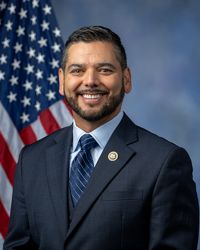
Raul Ruiz
DDemocratCA-25 · Representative
49
/ 100
Below Average
Attendance99
Avg: 96
Independence3
Avg: 4
Bipartisan Tone4
Avg: 15
Ethics Record100
Avg: 99
Transparency21
Avg: 53
Accountability Score — composite of attendance, independence, bipartisan tone, ethics record & transparency.
Methodology29
Bills Sponsored
0
Enacted into Law
0
Passed a Chamber
29
In Committee
All Sponsored Bills
HR10747In Committee
Puerto Rico Medicare Advantage Fairness Act of 2026
HRES1589In Committee
Expressing support for the designation of October 1 as "National Latino and Latina Physician Day".
HRES1583In Committee
Expressing support for the designation of October as "National Promotoras Month".
HR9877In Committee
Health Equity and Accountability Act of 2026
This bill aims to address health disparities affecting minority communities through various policy changes across multiple areas including healthcare access, nutrition programs, education, and veterans' services. The broad referral to numerous committees suggests the legislation would coordinate efforts across government agencies to improve health outcomes for minority populations through reforms in insurance coverage, food assistance, workplace safety, and other related programs. The bill is currently under review to determine which specific provisions fall under each committee's authority.
HR7994In Committee
HERO Act
Helping Educators Respond to Overdoses Act or the HERO Act This bill establishes a grant program to provide schools with opioid overdose reversal drugs and requires reporting related to the distribution of such drugs. First, the bill requires the Substance Abuse and Mental Health Services Administration to award competitive grants to eligible entities for (1) purchasing approved opioid overdose reversal drugs; and (2) developing and implementing educational programming or resources to promote student and community knowledge of cardiopulmonary resuscitation, drug-use prevention and intervention, and emergency responses to drug overdoses. Eligible entities include private elementary and secondary schools, local educational agencies (LEAs), charter schools that are LEAs, and consortia of LEAs. Second, the bill requires a covered educational institution (i.e., a private school, LEA, or charter school that is an LEA) that receives federal funds to submit a description of any distribution of an opioid overdose reversal drug by such institution to the National Emergency Medical Services Information System and the Overdose Detection Mapping Application Program of the Washington/Baltimore High Intensity Drug Trafficking Area.
HR8629In Committee
Developing the Community Health Workforce Act of 2026
The bill would provide funding and support programs to help recruit, train, and keep healthcare workers in rural and underserved areas where there are shortages of doctors, nurses, and other medical staff. By making it easier to attract and retain healthcare professionals in these communities, the legislation aims to improve access to medical care and health outcomes for people living in areas that currently struggle to find enough healthcare providers. The bill has been sent to two congressional committees for review.
HR8556In Committee
Homegrown Defense Act of 2026
The Department of Defense would face stricter oversight requirements to ensure it complies with rules about sourcing food domestically for military bases and operations. This affects military personnel, defense contractors who supply food to the military, and domestic food producers seeking to sell to the Pentagon. The bill aims to strengthen accountability and transparency in how the Defense Department manages its food supply chains.
HR8525In Committee
To amend the Specialty Crops Competitiveness Act of 2004 to provide for seasonal and perishable programs, and for other purposes.
The proposal would update federal programs that help farmers grow and sell fruits, vegetables, and other specialty crops that spoil quickly or have short growing seasons. It aims to make these programs work better for farmers dealing with seasonal crops by adjusting how support is provided. Farmers who grow perishable items like berries, lettuce, and other fresh produce would be the main beneficiaries of these changes.
HR8391In Committee
To amend titles XVIII and XIX of the Social Security Act to require coverage of certain food and nutrition services under the Medicare and Medicaid programs.
This bill would require Medicare and Medicaid to cover certain food and nutrition services for eligible patients, treating nutritional support as a covered medical benefit rather than leaving it to patients to pay for themselves. The change would affect seniors on Medicare, low-income individuals on Medicaid, and potentially healthcare providers who would deliver these services. Currently, these programs have limited coverage for nutrition-related care, so this would expand what doctors can prescribe and what insurance will pay for.
HR8389In Committee
Rural Area Population Act
Without specific subjects listed, this bill likely addresses challenges facing rural communities, possibly through agriculture, financial services, or economic development programs. The referral to both Agriculture and Financial Services committees suggests it may involve funding, lending programs, or policies to help rural areas attract or retain population. The bill's exact impact on farmers, rural businesses, or residents cannot be determined without seeing its detailed provisions.
HR8390In Committee
National Food as Medicine Program Act of 2026
This bill would establish a federal program that uses food and nutrition as a way to prevent and treat diseases, likely by covering certain healthy foods or nutrition services under health insurance or government health programs. The program would affect patients, healthcare providers, and potentially food producers by creating new ways to prescribe nutritious foods as part of medical treatment. It's being reviewed by two congressional committees because it touches on both healthcare policy and agriculture.
HR8388In Committee
Earn it First Act of 2026
The bill would prevent a sitting president or anyone acting on their behalf from naming or renaming federal buildings after themselves while still in office. This would stop presidents from using government property to create monuments to their own administration during their tenure. The restriction would apply to all public buildings controlled by the federal government.
HRES1187In Committee
Supporting the designation of the week of August 24 through August 28, 2026, as the fourth annual "National Community Health Worker Awareness Week".
This resolution would officially recognize the week of August 24-28, 2026, as National Community Health Worker Awareness Week to highlight the important role these workers play in their communities. Community health workers are frontline health professionals who help connect people to medical services, provide health education, and support patients in underserved areas. The designation aims to raise public awareness about their contributions to public health and community wellbeing.
HR8152In Committee
To amend the Agricultural Adjustment Act with respect to the treatment of dates for processing under certain marketing orders.
This bill would change how the government handles dates used in food processing under agricultural marketing rules, likely affecting when and how date products can be sold or processed. The changes would impact date farmers and food companies that work with dates, potentially making it easier or changing the requirements for getting their products to market. The bill is currently being reviewed by two congressional committees to determine how it affects agriculture policy and tax matters.
HR7965In Committee
Vote Without Fear Act
Vote Without Fear Act This bill establishes new federal criminal offenses for possessing a firearm or causing a firearm to be present in or within 100 yards of a federal election site.
HR7473In Committee
CMMSA 2.0
Without access to the full bill text, this appears to be a tax-related measure that has been sent to the House committee responsible for tax policy. Based on the title referencing "CMMSA 2.0," it likely addresses updates or revisions to an existing tax provision or program, though the specific changes would need to be reviewed in the actual legislation to explain what taxpayers or businesses would experience differently.
HR7335In Committee
Humanitarian Standards for Individuals in ICE and CBP Custody Act
This bill would establish minimum standards for how Immigration and Customs Enforcement (ICE) and Customs and Border Protection (CBP) treat people in their custody, covering things like access to medical care, hygiene, food, and safe conditions. The rules would apply to detention facilities and holding areas where immigrants are kept while their cases are processed or they await deportation. The bill aims to ensure that detained immigrants receive humane treatment regardless of their immigration status.
HR7047In Committee
Health Care for Homeless Veterans Act
This bill would improve healthcare services specifically for veterans experiencing homelessness by expanding access to medical care, mental health treatment, and support services through the Department of Veterans Affairs. The legislation aims to address the unique health challenges faced by homeless veterans, including substance abuse, PTSD, and chronic conditions, while helping connect them to housing and other support resources. Veterans and homeless service organizations would be the primary beneficiaries of these expanded programs and funding.
HR4527In Committee
Health Records Enhancement Act
HR6160In Committee
Strengthening Medicare for Patients and Providers Act
Strengthening Medicare for Patients and Providers Act This bill modifies certain adjustments to payment amounts under the Medicare physician fee schedule. Payment amounts under the Medicare physician fee schedule are based on a service's relative value, a conversion factor, and a geographic adjustment factor. Current law provides for separate conversion factors for physicians that are qualifying participants in advanced alternative payment models (also known as qualifying APM participants) and for other physicians beginning in 2026, with an annual update of 0.75% and 0.25%, respectively. The bill replaces the separate conversion factors for qualifying APM participants and other physicians with a single conversion factor and provides for an update that is equal to the annual percentage increase in the Medicare Economic Index, beginning in 2026. (The Medicare Economic Index is a specialized index that is generally used to determine allowed charges for physician services based on annual price changes.)
HR6066In Committee
CARE Act of 2025
HR6067In Committee
Tribal Internet Expansion Act of 2025
Tribal Internet Expansion Act of 2025 This bill extends to Indian country (i.e., all lands within a tribal reservation, dependent Indian communities, and tribal allotments) and areas with high populations of Indians the universal service principle that telecommunications and information services in rural, insular, and high-cost areas should be available at rates that are reasonably comparable to urban areas.
HRES745In Committee
Expressing support for the designation of October 1 as "National Latino and Latina Physician Day".
This resolution expresses support for the designation of National Latino and Latina Physician Day.
HR4722In Committee
Urban Indian Health Parity Act
Urban Indian Health Parity Act This bill applies a Federal Medical Assistance Percentage (i.e., the federal matching rate under Medicaid) of 100% with respect to amounts expended as medical assistance for services received through an Urban Indian organization under a grant or contract with the Indian Health Service.
HRES607In Committee
Supporting the designation of the week of August 25 through August 29, 2025, as the third annual "National Community Health Worker Awareness Week".
This resolution expresses support for the goals and ideals of National Community Health Worker Awareness Week.
HR4417In Committee
Mobile Cancer Screening Act
This bill would establish or expand mobile cancer screening programs that bring cancer detection services directly to communities, particularly those with limited access to medical facilities. The legislation aims to help catch cancers earlier by making mammograms, colonoscopies, and other screening tests more available to underserved populations, including rural and low-income Americans. By removing barriers to screening, the bill could improve cancer survival rates and reduce health disparities across different communities.
HR3521In Committee
Clinical Trial Modernization Act
Clinical Trial Modernization Act This bill authorizes a grant program and provides certain exemptions to support the participation of individuals in clinical trials. Specifically, the bill authorizes a grant program to support outreach, education, and recruitment efforts for clinical trials that may benefit certain underrepresented populations or communities in need, such as rural or tribal areas. The bill also exempts from anti-kickback laws for federal health care programs (1) remuneration that is offered to cover participants' expenses to participate in clinical trials, (2) the provision of free digital health technologies to support participation of underrepresented populations in clinical trials, and (3) payment for participants' cost-sharing obligations in relation to clinical trials. Finally, the bill exempts up to $2,000 in remuneration that is received for participating in a clinical trial from income tax.
HR3413In Committee
Physician and Patient Safety Act
This bill would establish new safety standards and protections for both doctors and patients in healthcare settings, likely addressing issues like medical errors, workplace safety for physicians, and patient care quality. The specific measures could include requirements for reporting adverse events, training standards, or liability protections, though the exact details would depend on the bill's full text. It affects hospitals, clinics, healthcare workers, and patients receiving medical care.
HR3200In Committee
Critical Minerals and Manufacturing Support Act
The legislation would provide tax incentives and financial support to help American companies mine, process, and manufacture critical minerals like rare earths and lithium that are essential for batteries, electronics, and defense equipment. By offering tax breaks and grants, the bill aims to reduce U.S. dependence on foreign sources for these materials and boost domestic manufacturing jobs in mining and related industries. Workers in mining and manufacturing, along with companies in these sectors, would be the primary beneficiaries of these tax and funding provisions.