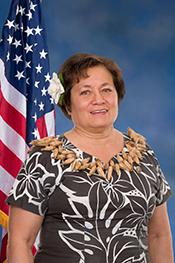
Aumua Amata Coleman Radewagen
RRepublicanAS · Representative
25
/ 100
Poor
Attendance18
Avg: 96
Independence0
Avg: 4
Bipartisan Tone0
Avg: 15
Ethics Record100
Avg: 99
Transparency1
Avg: 53
Accountability Score — composite of attendance, independence, bipartisan tone, ethics record & transparency. Limited data available — score will improve as voting and statement records accumulate.
Methodology4
Bills Sponsored
0
Enacted into Law
1
Passed a Chamber
3
In Committee
All Sponsored Bills
HR8904In Committee
To amend the Magnuson-Stevens Fishery Conservation and Management Act to provide for the regulation of fishing in marine national monuments.
The proposal would give federal authorities the power to set fishing rules and limits in marine national monuments, which are protected ocean areas. Currently, fishing regulations in these underwater protected zones are unclear or limited, so this change would let the government manage what fish can be caught there and by whom. This would affect commercial fishing companies, recreational fishers, and coastal communities that depend on ocean resources.
HR531Passed House
South Pacific Tuna Treaty Act of 2025
South Pacific Tuna Treaty Act of 2025 This bill revises federal requirements for U.S. commercial fishing vessels operating in the South Pacific. The changes reflect amendments to the South Pacific Tuna Treaty that were agreed to at Nadi, Fiji, on December 3, 2016. The treaty details mutual obligations of the United States and 16 Pacific Island countries when U.S. fishing vessels operate in the region.
HR449In Committee
To amend the Immigration and Nationality Act to waive certain naturalization requirements for United States nationals, and for other purposes.
This bill waives certain requirements for U.S. nationals applying for citizenship. Currently, individuals born in an outlying possession (i.e., American Samoa or Swains Island) are U.S. nationals but do not automatically acquire citizenship through birth in an outlying possession. Under this bill, a U.S. national who otherwise qualifies may become a citizen upon establishing residence and physical presence in a U.S. outlying possession. Currently, U.S. nationals must become a resident of a state to qualify for naturalization. The bill also waives certain naturalization requirements, including those related to English language proficiency and participation in a public ceremony, for individuals who have continuously resided in an outlying possession or state from birth to the approval of a naturalization application. Furthermore, upon meeting other requirements, this bill allows a child born abroad of a U.S. citizen parent to acquire citizenship by establishing presence and residency in an outlying possession, where currently such a child must be lawfully present in the United States to acquire citizenship through this method.
HR399In Committee
To permanently extend the American Samoa economic development tax credit.
This bill permanently extends the American Samoa economic development tax credit, effective for tax years beginning after December 31, 2021. Under current law, certain qualified domestic corporations may be entitled to a tax credit for a percentage of qualified American Samoa wages, allocable employee fringe benefits, and depreciation allowances related to qualified American Samoa tangible property. However, under current law, the tax credit is only available for such corporations for tax years beginning on or before December 31, 2021.