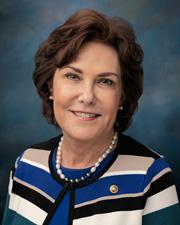
Jacky Rosen
DDemocratNV · Senator
68
/ 100
Above Average
Attendance98
Avg: 97
Independence22
Avg: 23
Bipartisan Tone20
Avg: 14
Ethics Record100
Avg: 100
Transparency100
Avg: 47
Accountability Score — composite of attendance, independence, bipartisan tone, ethics record & transparency.
Methodology63
Bills Sponsored
0
Enacted into Law
1
Passed a Chamber
52
In Committee
All Sponsored Bills
S5683In Committee
Best Practices for Military Family Child Care Homes Act
SRES929In Committee
A resolution expressing the sense of the Senate regarding equity stakes held by the Federal Government in private companies.
S5582In Committee
Veteran Education Empowerment Act
S5581In Committee
Veteran Technology Employment Success Act of 2026
SRES898In Committee
A resolution expressing the sense of the Senate that the additional tariffs imposed on Canadian goods under section 338 of the Tariff Act of 1930 and the rhetoric surrounding the bilateral relationship between Canada and the United States harm United States consumers and businesses and the tariffs should be rescinded.
S5504In Committee
A bill to require the Secretary of Defense to establish a pilot program on Department of Defense partnerships with institutions of higher education recognized in the National Centers of Academic Excellence in Cybersecurity program for Cyber Research, and for other purposes.
S5361In Committee
MMU Rural Expansion Act of 2026
S5333In Committee
Advancing American Wi-Fi Against Foreign Adversaries Act
S5251In Committee
ACPAC Modernization Act
S5233In Committee
Jobs, Not Waste Act of 2026
SRES608In Committee
A resolution expressing the sense of the Senate that Ghislaine Maxwell should not be granted a Presidential pardon or any form of clemency for her crimes with Jeffrey Epstein relating to the sexual exploitation and abuse of minors.
The Senate is expressing its official position that Ghislaine Maxwell, who was convicted of crimes related to helping Jeffrey Epstein sexually exploit and abuse minors, should not receive a presidential pardon or other forms of clemency that would reduce her sentence. This is a non-binding statement of the Senate's views rather than a law that would prevent a pardon, but it signals strong congressional opposition to any potential leniency for Maxwell's crimes against children. The resolution has been sent to the Senate Judiciary Committee for consideration.
S5145In Committee
Wildfire Air Quality Sensor Expansion Act of 2026
The federal government would be allowed to use existing money from Clean Air Act programs to buy air quality sensors that measure pollution levels in communities. These sensors would help cities and states better monitor and understand air pollution in their areas, which could improve public health by identifying problem areas that need attention. The change clarifies how environmental agencies can spend grants they already receive for air quality improvements.
S4680Reported
Expanded Consular Fellows Act of 2026
The State Department would be allowed to extend the appointments of certain consular officials (diplomats who work in U.S. embassies and consulates abroad) from their current length up to eight years, with the possibility of adding two more years if the Foreign Service needs them to stay longer. This would give the State Department more flexibility in managing its diplomatic staff and keeping experienced officials in their positions when necessary. The change primarily affects career diplomats and the operations of U.S. embassies and consulates around the world.
S3676Reported
American Decade of Sports Act
The bill aims to promote American sports and athletic programs, likely through federal support or coordination efforts that could affect athletes, sports organizations, and communities. Based on its referral to the Foreign Relations Committee, it probably includes international sports competition or diplomacy components, such as supporting U.S. athletes in global competitions or using sports as a tool for international engagement. The specific details of what funding or programs would be created depend on the bill's full text.
S332Reported
Holocaust Education and Antisemitism Lessons Act
Holocaust Education and Antisemitism Lessons Act This bill directs the U.S. Holocaust Memorial Museum to study and report on Holocaust education efforts in states, local educational agencies (LEAs), and public elementary and secondary schools. Among other elements, the study must (1) determine whether states and LEAs require Holocaust education as part of the curriculum taught in public elementary and secondary schools, (2) identify the standards and requirements relating to Holocaust education, and (3) identify the types of instructional material used to teach students about the Holocaust.
S3493Reported
Carson City Public Land Correction Act
This bill corrects property boundaries and land ownership records for public lands near Carson City, Nevada, likely fixing surveying errors or clarifying which parcels are owned by the federal government versus private parties or the state. The changes would affect how these lands can be used for recreation, conservation, or development, and could resolve disputes between the government and local landowners about who controls specific areas. The bill has been approved by the Senate Energy and Natural Resources Committee with some modifications and is moving forward in the legislative process.
S4924In Committee
Preserving Patient Access Act
The bill would protect Medicare patients and people with individual health insurance plans from losing access to their doctors and prescription medications due to insurance company decisions. It aims to prevent insurers from suddenly removing doctors from their networks or stopping coverage for certain drugs without giving patients adequate notice and time to adjust their care. This would affect millions of seniors on Medicare, people buying insurance on their own, and the healthcare providers who treat them.
SRES791In Committee
A resolution condemning the People's Republic of China's Ethnic Unity and Progress Law, concerned with its implications on the rights and freedoms, as well as survival of the identity, of Tibetans, Uyghurs, Mongolians, and other affected communities, and calling on the Government of the People's Republic of China to end its abuses and campaigns of transnational repression that undermine United States sovereignty and threaten the safety and freedoms of people in the United States.
This resolution condemns a Chinese law, known as the Ethnic Unity and Progress Law, for institutionalizing coercive assimilation of ethnic and religious minorities. The resolution also calls on the President to consider related sanctions and urges the Department of State to work with allies to monitor and report on the impacts of the law.
S4711In Committee
Strategic Unmanned Systems Partnership Act
The legislation would create a formal partnership between the United States and Ukraine to collaborate on military technology and defense innovation, allowing the two countries to share research, expertise, and resources in areas like weapons development and cybersecurity. This working group would help Ukraine strengthen its defense capabilities while potentially giving American defense companies and researchers access to Ukrainian expertise and market opportunities. The arrangement affects military officials, defense contractors, technology companies, and ultimately the security relationship between the two nations.
S4703In Committee
Redirecting Trump Slush Funds to Lower Health Care Costs Act
The legislation would prevent the federal government from using taxpayer money to pay legal settlements in cases where the government is sued, with some exceptions. This would affect federal agencies and departments that currently use budget funds to resolve lawsuits brought against them by individuals or organizations. The bill aims to change how the government handles the financial costs of legal disputes.
S4705In Committee
Redirecting Trump Slush Funds to Lower Food Costs Act of 2026
The bill would prevent the federal government from using taxpayer money to pay legal settlements in certain cases while also directing funding toward food assistance programs for low-income individuals and families. It affects how federal agencies handle lawsuit payouts and impacts people who rely on nutrition assistance benefits. The proposal is currently under review by the Senate Judiciary Committee.
S4704In Committee
Redirecting Trump Slush Funds to Support Law Enforcement Act
The legislation would prevent the federal government from using taxpayer money to pay legal settlements in certain cases, restricting how agencies can resolve lawsuits against them. This would affect federal employees, contractors, and anyone suing federal agencies, as it could limit the government's ability to settle disputes outside of court. The bill has been sent to the Judiciary Committee for review.
S4681In Committee
OASIS Act of 2026
The Department of Defense would be required to improve how it buys and develops air and missile defense systems, likely by streamlining the process and making it more efficient. This affects military personnel, defense contractors, and taxpayers who fund defense spending, as better acquisition practices could reduce costs and speed up the delivery of new defense technology to the armed forces.
S4675In Committee
Sergeant Dave Crete FORGOTTEN Veterans Act of 2026
The legislation would expand and improve health benefits and compensation for veterans who were exposed to harmful substances during their military service, such as burn pits, Agent Orange, or other toxic materials. Veterans affected by these exposures would gain better access to medical care, disability payments, and support services to address health problems caused by the exposure. The bill aims to ensure that service members who suffered injuries or illnesses from toxic substances receive the benefits and healthcare they need.
S4576In Committee
Jewish American Security Act
The bill would increase federal government resources and coordination to combat antisemitism and hate crimes targeting Jewish Americans, including funding for security improvements at Jewish institutions and community organizations. It would also establish new programs to track antisemitic incidents, educate the public about antisemitism, and work with law enforcement to prevent and prosecute hate crimes against Jewish communities.
S4536In Committee
Protecting America's Drinking Water from Extreme Temperatures Act of 2026
The bill would expand a federal grant program that helps medium and large water systems upgrade their infrastructure to better withstand extreme heat and cold. Water utilities could use these federal funds to make improvements like better insulation, backup power systems, or other upgrades that protect drinking water systems from temperature-related damage. This would help ensure communities maintain reliable access to safe drinking water during extreme weather events.
SJRES99In Committee
A joint resolution providing for congressional disapproval under chapter 8 of title 5, United States Code, of the rule submitted by U.S. Citizenship and Immigration Services relating to "Removal of the Automatic Extension of Employment Authorization Documents".
Congress is considering blocking a rule from the immigration agency that would stop automatically extending work permits for certain immigrants, which would require many people to reapply for permission to work in the United States. If approved, this resolution would overturn the agency's decision and keep the automatic extension system in place, affecting hundreds of thousands of workers who depend on these permits to legally hold their jobs.
S4318In Committee
Breast Cancer Stamp Reauthorization Act
The Postal Service would be allowed to continue selling special stamps that cost more than regular postage, with the extra money going to breast cancer research organizations. These stamps, called semipostals, have been used before for other causes and let people support medical research simply by choosing to buy them instead of regular stamps. The bill extends the program so the Postal Service can keep issuing breast cancer research stamps beyond the current expiration date.
SJRES164In Committee
A joint resolution providing for congressional disapproval under chapter 8 of title 5, United States Code, of the rule submitted by the Bureau of Consumer Financial Protection relating to the withdrawal of the rule relating to "Consumer Financial Protection Circular 2022-04: Insufficient Data Protection or Security for Sensitive Consumer Information".
Congress is considering blocking a decision by the Consumer Financial Protection Bureau to withdraw a rule that required financial companies to protect sensitive customer information like Social Security numbers and bank account details. If approved, this resolution would force the agency to keep the data protection requirements in place instead of allowing companies to drop them. The vote would affect banks, credit card companies, and other financial institutions that handle personal consumer data.
S4263In Committee
Cyber Ready Workforce Act
This bill would help prepare American workers for jobs in cybersecurity by supporting training programs, education initiatives, and workforce development in this growing field. It aims to connect job seekers with the skills and credentials employers need while addressing the shortage of qualified cybersecurity professionals across the country.
S4241In Committee
Boosting Housing Supply through Small Businesses Act of 2026
This bill would help small businesses and entrepreneurs build more housing by making it easier for them to access loans, permits, and other resources needed for residential construction projects. It aims to increase the overall supply of homes available for people to buy or rent by removing barriers that currently prevent smaller construction companies from competing with large developers. The changes would affect small construction firms, real estate developers, lenders, and ultimately renters and homebuyers looking for more affordable housing options.
S1380In Committee
SPARC Act
Specialty Physicians Advancing Rural Care Act or the SPARC Act This bill establishes student loan repayment programs to support the provision of specialty medical care in rural areas. The Health Resources and Services Administration (HRSA) must carry out such a program for specialty medicine physicians (i.e., practicing in an area other than primary care) who provide care in rural communities with shortages of such physicians. Physicians must agree to a period of obligated service and, for each year of such service, HRSA must pay one-sixth of the principal payment and interest on eligible loans up to a maximum cap of $250,000. Additionally, HRSA may carry out a similar loan repayment program for nonphysician specialty health care providers.
S2762In Committee
Supporting Our Seniors Act
This bill aims to improve benefits and support services for senior citizens, likely addressing areas such as healthcare access, Social Security, prescription drug costs, or long-term care assistance. The specific changes would affect millions of Americans over 65 who rely on federal programs, as well as their families and caregivers. The bill is currently being reviewed by the Senate committee responsible for health and social programs.
S942In Committee
REDI Act
Resident Education Deferred Interest Act or the REDI Act This bill allows borrowers in medical or dental internships or residency programs to defer student loan payments until the completion of their programs.
S547In Committee
Train More Nurses Act
Train More Nurses Act This bill requires the Department of Health and Human Services and the Department of Labor to jointly report on existing grant programs that support the nurse workforce. The report must include recommendations on how to change the grant programs to (1) increase nurse faculty in underserved areas, (2) provide more pathways for experienced nurses to become faculty at schools of nursing, and (3) support pathways for licensed practical nurses to become registered nurses.
S2220In Committee
Fighting for the Overlooked Recognition of Groups Operating in Toxic Test Environments in Nevada (FORGOTTEN) Veterans Act of 2025
Fighting for the Overlooked Recognition of Groups Operating in Toxic Test Environments in Nevada (FORGOTTEN) Veterans Act of 2025 This bill requires increased Department of Defense (DOD) documentation related to toxic exposures by military personnel and establishes eligibility for certain disability compensation and benefits for individuals who served at the Nevada Test and Training Range (NTTR). DOD must (1) expand the Individual Longitudinal Exposure Record to include specified medical information and document all toxic exposures of members of the Armed Forces, and (2) document in service records whether a member of the Armed Forces served at a location with potential toxic exposure. Members of the Armed Forces and civilian DOD employees who are or have been stationed at specified nuclear facilities must be presumed to have been exposed to toxic substances. DOD must classify the NTTR as a location where contamination occurred and the Department of the Air Force must identify those who have been stationed there since January 27, 1951. The bill establishes that onsite participation on or after January 27, 1951, at NTTR locations where there was a potential of toxic exposure is a radiation-risk activity, therefore providing a presumption of service-connection for specified conditions. The bill also establishes a presumption of toxic exposure for veterans who performed active service at NTTR locations with potential toxic exposure, including airspace above such locations. Additionally, lipomas and tumor related conditions must be considered as service-connected conditions for veterans who served at the NTTR locations.
S4127Introduced
Transportation Security Administration Pay Act of 2026
Transportation Security Administration Pay Act of 2026 This bill provides continuing appropriations to provide pay and benefits to Transportation Security Administration (TSA) employees during the partial Department of Homeland Security (DHS) shutdown that began on February 14, 2026. (A partial government shutdown is currently in effect for TSA and other DHS agencies because the FY2026 DHS appropriations bill has not been enacted and continuing appropriations for DHS are not in effect.) Specifically, the bill provides FY2026 continuing appropriations to provide standard rates of pay, allowances, pay differentials, benefits, and other payments otherwise payable on a regular basis to TSA employees during the period in which interim or full-year FY2026 appropriations are not in effect. The bill provides the continuing appropriations until the earlier of (1) the enactment into law of the applicable appropriations legislation, or (2) September 30, 2026. The bill must take effect as if it had been enacted on February 13, 2026.
S4128In Committee
No Self-Promotion with Public Dollars Act
This bill would prohibit federal agencies from using taxpayer money to create advertisements or promotional materials that feature sitting elected officials or promote their accomplishments. The measure aims to prevent government resources from being used for what amounts to campaign-style promotion of individual politicians, ensuring that public funds are spent on informing citizens about government services rather than boosting political figures.
S4073In Committee
Transportation Security Administration Pay Act of 2026
Transportation Security Administration Pay Act of 2026 This bill provides continuing appropriations to provide pay and benefits to Transportation Security Administration (TSA) employees during the partial Department of Homeland Security (DHS) shutdown that began on February 14, 2026. (A partial government shutdown is currently in effect for TSA and other DHS agencies because the FY2026 DHS appropriations bill has not been enacted and continuing appropriations for DHS are not in effect.) Specifically, the bill provides FY2026 continuing appropriations to provide standard rates of pay, allowances, pay differentials, benefits, and other payments otherwise payable on a regular basis to TSA employees during the period in which interim or full-year FY2026 appropriations are not in effect. The bill provides the continuing appropriations until the earlier of (1) the enactment into law of the applicable appropriations legislation, or (2) September 30, 2026. The bill must take effect as if it had been enacted on February 13, 2026.
S4002In Committee
Foreign Service Age Integration and Reform (FAIR) Act of 2026
This bill would change how the State Department manages its foreign service workforce, likely addressing age-related policies and hiring practices for diplomats and overseas staff. The reforms aim to modernize how the government recruits, trains, and retains people who work in embassies and diplomatic missions around the world. The changes would affect career diplomats, foreign service officers, and potentially the way the State Department operates internationally.
S3943In Committee
Housing Tariff Exclusion Act
This bill would likely exempt certain building materials and housing-related products from tariffs (taxes on imported goods), making them cheaper for construction companies and homebuilders to purchase. The goal is probably to reduce housing costs for consumers by lowering the price of imported materials like lumber, steel, or other supplies used in home construction. The bill is currently under review by the Senate Finance Committee.
S462In Committee
Truckee Meadows Public Lands Management Act
This bill would manage and designate public lands in the Truckee Meadows area of Nevada, likely establishing protections for certain natural areas while potentially opening others for development or resource use. The legislation would affect local communities, outdoor enthusiasts, ranchers, and environmental groups by determining how federal land in the region can be used for recreation, conservation, or economic purposes. The bill has advanced to the hearing stage where lawmakers are gathering information before deciding whether to move forward.
S3832In Committee
Small Business Workforce Pipeline Act of 2026
This bill would help small businesses find and train workers by creating programs that connect job seekers with training opportunities and small business employers. It likely aims to address labor shortages in small companies by making it easier for workers to develop skills that match what small businesses actually need to hire. The bill would affect small business owners looking to fill positions and workers seeking job training and employment opportunities.
S3360Reported
FREEDOM Act
The FREEDOM Act addresses international affairs matters and has advanced through the Senate committee process. Without access to the specific bill text, the legislation likely aims to promote democratic freedoms, human rights, or American interests abroad, though the exact provisions would determine whether it affects foreign aid, sanctions, diplomatic relations, or support for international organizations and allies.
SRES546Introduced
A resolution designating November 2025 as "National Hospice and Palliative Care Month".
This resolution designates November 2025 as National Hospice and Palliative Care Month. It also encourages individuals to increase their understanding and awareness of care at the end of life.
S3451In Committee
Houthi Human Rights Accountability Act
This bill would establish measures to hold the Houthi movement accountable for alleged human rights violations, likely through sanctions, investigations, or international legal mechanisms. It could affect U.S. foreign policy toward Yemen and the Middle East, as well as any individuals or organizations with ties to the group. The legislation reflects congressional concern about documented abuses and aims to pressure the Houthis to improve their treatment of civilians and prisoners.
S1195In Committee
Pershing County Economic Development and Conservation Act
This bill would likely authorize land management changes and conservation efforts in Pershing County, Nevada, potentially including designations of protected areas, management of public lands, or support for local economic development projects tied to natural resources. The measure would affect local communities, ranchers, miners, and conservation groups in the region by determining how federal lands are used and protected. Hearings have been held to gather input on how to balance economic development with environmental conservation in the county.
SRES508Introduced
A resolution designating November 8, 2025, as "National Science, Technology, Engineering, and Mathematics (STEM) Day" and celebrating the importance of science, technology, engineering, and mathematics in education and the workforce in the United States.
This resolution designates November 8, 2025, as National Science, Technology, Engineering, and Mathematics (STEM) Day and celebrates the importance of STEM.
S778Passed Senate
Lactation Spaces for Veteran Moms Act
Lactation Spaces for Veteran Moms Act This bill requires the Department of Veterans Affairs to ensure that each of its medical centers contains a hygienic lactation space that is not a bathroom and meets other specifications (e.g., must be easy to locate).
S3139In Committee
VA Zero Suicide Demonstration Project Act of 2025
VA Zero Suicide Demonstration Project Act of 2025 This bill requires the Department of Veterans Affairs (VA) to establish the Zero Suicide Initiative pilot program for the purpose of improving safety and suicide care for veterans. The program must be implemented at five VA medical centers, including one that serves veterans in rural and remote areas.
SRES470In Committee
A resolution condemning any financial compensation from the Department of Justice to President Donald Trump tied to previous Federal investigations into his unlawful actions.
S2846In Committee
HIV Medication Access Act
S2218In Committee
Combat Action Recognition and Evaluation (CARE) for Remotely Piloted Aircraft (RPA) Crews Act of 2025
The legislation would establish official recognition and evaluation standards for military personnel who operate remotely piloted aircraft (drones) in combat situations, ensuring their contributions are properly documented and assessed like other combat roles. This would affect drone operators and their military branches by creating consistent criteria for how their combat service is recorded and potentially how it factors into promotions, benefits, and military records. The measure aims to address concerns that remote pilots' combat experience has not been formally recognized in the same way as traditional combat roles.
SRES227Reported
A resolution condemning Hamas for its premeditated, coordinated, and brutal terrorist attacks on October 7, 2023, against Israel and demanding that Hamas immediately release all remaining hostages and return them to safety, and for other purposes.
This resolution condemns Hamas in the harshest terms for its attacks on Israel and demands that Hamas immediately release all remaining hostages. The resolution also (1) expresses sympathy to the hostages, those wounded, and their families; and (2) mourns those killed by Hamas on October 7, 2023, and during captivity.
S1936In Committee
Improving Access to Transfusion Care for Hospice Patients Act of 2025
Improving Access to Transfusion Care for Hospice Patients Act of 2025 This bill requires the Center for Medicare and Medicaid Innovation (CMMI) to test a model under which blood transfusions furnished to an individual receiving hospice care are paid separately from the hospice all-inclusive per diem payment under Medicare. The CMMI must evaluate the model by comparing patients participating in the model with those outside of the model in relation to specified metrics, such as hospital utilization and days of hospice care before the end of life.
S1786In Committee
One Stop Shop for Small Business Licensing Act of 2025
S1613In Committee
Tax Relief for New Businesses Act
S1565In Committee
Lowering Costs for Caregivers Act of 2025
This bill would provide tax relief to people who care for family members or dependents, likely through tax credits or deductions that reduce the financial burden of caregiving expenses. The measure aims to help workers—particularly those juggling jobs with caring for children, elderly parents, or disabled relatives—keep more of their income by lowering their taxes. The bill is currently under review by the Senate Finance Committee.
SRES132In Committee
A resolution designating March 24, 2025, as "National Women of Color in Tech Day".
S646In Committee
Born in the USA Act
S273Reported
Small Business Child Care Investment Act
Small businesses would receive tax credits and grants to help them establish or expand child care services for their employees' children. The program aims to make it easier for working parents to find affordable child care while helping small business owners attract and retain workers by offering this benefit. This would affect small business owners, working parents, and child care providers across the country.
S324In Committee
Smarter Weather Forecasting for Water Management, Farming, and Ranching Act of 2025
Smarter Weather Forecasting for Water Management, Farming, and Ranching Act of 2025 This bill directs the National Oceanic and Atmospheric Administration (NOAA) to establish pilot projects to support improved subseasonal to seasonal precipitation forecasting for water management in the western United States and for agriculture nationwide. (Under current law, subseasonal means the time range between two weeks and three months, and seasonal means the time range between three months and two years.) Specifically, NOAA must establish a pilot project to address challenges to improving forecasting and related product development for water management in the western United States. The project must address, among other items, improvements to operational modeling in mountainous regions and to the forecasting of atmospheric rivers. NOAA must also establish a second pilot project to address challenges to improving forecasting and related product development for U.S. agriculture. The project must address, among other items, improvements to operational modeling of warm-season precipitation and to the prediction of certain spring and summer weather patterns. Each pilot project must include activities that engage with and leverage the resources of academic institutions and entities within NOAA, and that achieve measurable objectives for operational forecast improvement. NOAA’s authority with respect to these pilot projects expires five years after the bill’s enactment.
S189In Committee
CONSTRUCTS Act of 2025
The legislation would establish new protections and standards for workers in the construction industry, addressing issues like workplace safety, wage requirements, and employment classification. It would affect construction companies, contractors, and construction workers by setting clearer rules about how workers should be treated and compensated on job sites. The bill is currently under review by the Senate committee responsible for labor and employment matters.